
Closing Kyiv Lavra with a certificate about a leaking roof
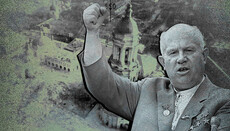
In March 1961, instead of a truck filled with armed security officers, a commission for the protection of historical monuments arrived at the gates of the Kyiv Caves Lavra.
The document from which this story begins is a resolution of the Kyiv City Executive Committee dated February 28, 1961, terminating the lease agreements with the Holy Dormition Kyiv Caves Lavra. The stated grounds sounded dull and almost routine – violation of the terms of agreements concerning the protection of historical monuments. On March 10, seals would appear on the doors of the Near Caves. And three days later, in the Kurenivka district, a dam would collapse, unleashing upon Podil a wall of mud fourteen meters high. But that came later.
It is worth pausing over this document. Its dry bureaucratic language reveals how the method of pressure upon the Church had changed. In 1930, the Lavra was shut down crudely: the monastic community was dispersed, some of the brethren arrested, and the buildings handed over to a museum complex and the State Historical Library. Thirty-one years later, an entirely different mechanism was used: “violation of the terms of agreements concerning the protection of monuments.” The Bolsheviks no longer stormed in, nor did they drag the monks away. A simple piece of paper was enough.

The dawn of the Gagarin era
The year 1961 was a year of radiant Soviet self-confidence. A month later, Gagarin would fly into space. At the 22nd Party Congress, Nikita Khrushchev would proclaim that the current generation of Soviet citizens would live under communism. Another, more venomous phrase also survived from that era – the claim that by 1980 he promised to show “the last priest on television.” Modern fact-checking, however, finds no direct promise of this kind in the official transcripts: the formula spread later, through church historiography of the 1990s. Yet the very fact that it endured, was retold, and lived on for decades speaks about the spirit of that time more clearly than any protocol record.
The Lavra, with its monks, did not fit into the age. Pressure upon it was no longer Stalinist in style.
The brethren had “evolved” from “enemies of the people” into violators of fire safety regulations. Instead of the NKVD, a sanitary inspector arrived. The style had changed, but the goal – to close the holy place at any cost – remained the same.
Shelest’s letter and the eleven remaining monks
The mechanism for forcing out the brethren worked with precision. On December 1, 1960, Petro Shelest, secretary of the Kyiv Regional Party Committee, sent an official letter to Mykola Pidhorny, First Secretary of the Communist Party of Ukraine. Referring to “planned repair works,” the letter carefully proposed closing the Near Caves. Then came a phrase containing not a single word about faith or atheism: “After the closure of these caves, the monastery will lose its significance and become a small parish church.”
By that time, only a handful remained of the former brotherhood. According to chronicles of the Khrushchev persecutions, as of January 1, 1958, ninety-six monastics lived in the Lavra; by mid-1960, thirty-seven remained; and by February 15, 1961, only eleven were left.
They were crushed under taxes on candle production, land, and buildings. Inspections descended upon each one of them. Beginning February 15, 1961, the entire Lavra territory, including the museum reserve, was closed to visitors. Signs appeared on the walls: “Passage Closed,” “Danger to Life,” “Unsafe Condition.” The shrine itself was made to appear as a threat to the health of the Soviet citizen.
Then the passport regime was set in motion. The monks were stripped of their Kyiv residence permits, and within twenty-four hours they automatically became lawbreakers. Criminal charges for parasitism loomed over the brethren. A separate propaganda campaign unfolded in the magazine Perets and the newspaper Pravda Ukrainy.
The monks were no longer portrayed as “spies of Western intelligence agencies” – that Stalinist cliché too easily turned them into martyrs. Instead, they were depicted as parasites, obscurantists, and swindlers supposedly exploiting the dark superstitions of ordinary workers.
Foreseeing the outcome, Hieromonk Anempodistus quietly removed Lavra liturgical items and entrusted them for safekeeping in the private apartments of Kyiv residents. The holy objects gradually disappeared into strangers’ kitchens and wardrobes.
The March catastrophe
On March 10, 1961, the Lavra was officially closed. The resolution of the Council of Ministers of the Ukrainian SSR referred to restoration works and the wishes of working people to transform the territory into a historical and cultural reserve.
And then, on March 13, at 6:45 in the morning, the dam holding back the hydraulic waste site at Babyn Yar began to collapse. Since 1952, liquid waste from the Petrovsky brick factories had been dumped into the ravine. By 9:20 a.m., the dam burst. A torrent of sludge swept down upon Kurenivka, destroying trams, trolleybuses, houses, and the Spartak Stadium.
The number of victims must be approached cautiously. The first Soviet report, published on March 31, 1961, listed 145 dead. A report by Ignat Kazanets, Second Secretary of the Communist Party of Ukraine, dated March 25, mentioned 137 dead and 8 missing. Petro Shelest, in memoirs published in 1995, referred to 198 victims. In the early 2000s, Ukrainian historian Oleksandr Anisimov estimated the death toll at around 1,500, based on his own calculations and materials declassified after 1991. These remain private estimates. The exact number is still unknown.
And here too one can see the operation of the same bureaucratic mechanism: victims were buried in different cemeteries, the case was classified, and long-distance telephone communication in Kyiv was shut down during the days following the disaster.
The claim that God sent the mudslide upon Kurenivka as punishment for the Lavra cannot be considered justified.
Beneath the sludge died tram depot workers, children, and ordinary Kyiv residents on their way to work. The objective cause of the catastrophe was the negligence of city authorities. In 1950, Kyiv City Executive Committee chairman Oleksiy Davydov signed the decision to dump the pulp into Babyn Yar. Residents’ complaints about the condition of the dam had been submitted since 1958, but they were buried in bureaucratic files. The dam burst not because of divine wrath, but because of years of disregard for safety regulations. Yet in the folk memory of Kyiv, these two events became inseparably linked.
The Intercession “rotation”
Nikita Khrushchev was removed from power by the Plenum of the Central Committee of the CPSU on October 14, 1964. According to the Church calendar, it was the Feast of the Intercession of the Most Holy Theotokos. Whether this was coincidence or providential convergence, let each person decide for himself.
In June 1988, the lower part of the Lavra was returned to the Church. According to the recollections of monks from the revived monastery, the first Liturgy was celebrated at the Far Caves before the Church of the Conception of Saint Anna. Archimandrite Igor (Voronkov), who lived to see that day, saw vessels containing myrrh and wept, saying: “Long ago the elder brethren told me: when they reopen the Lavra, the relics will stream myrrh. And now we have lived to see it.”
Of those who signed the February 28, 1961 resolution of the Kyiv City Executive Committee, almost none remain alive today. Their decision has been forgotten, their names survive only in archival inventories. But the relics of the Venerable Fathers of the Caves still rest in the caves, in the same places where they lay before 1961 and before all the other persecutions.