
Day before the Miracle: Beware of sleeping through Christmas in the kitchen
Unpacking the hidden meanings of Christmas Eve. Why the Royal Hours are read in silence, why hunger is needed before the feast, and where the Star of Bethlehem truly lights up.
Over these last years, all of us have become professionals in the art of waiting. We wait for news. We wait for quiet. We wait for that very moment when we can finally exhale and say, “We’re home. We’re safe.” Our life has turned into one long Christmas Eve – a time when the old world no longer warms us, and the new one has not yet arrived.
January 6 is the point of maximum tension. In the Church calendar this day is not merely “preparation,” nor is it simply an excuse to chop salads. It is a time when the familiar rush of events begins to slow.
Christmas Eve is a rehearsal of silence – and only in that silence can God be born.
If we lose this day to the kitchen stove, we risk arriving at Christmas night well-fed, yet utterly empty.
Royal Hours: Letters from the future
In the morning, churches serve the Royal Hours. The name sounds solemn and slightly archaic, but let us translate its meaning into modern language. It is an “information digest” of the whole of human history.
We are used to checking the news several times an hour: “What’s being said? What are the forecasts?”
The Royal Hours are precisely such an interception of messages coming to us across millennia. The psalms and prophecies here are not dusty texts – they are decoded letters.
Isaiah, Micah, David – these are eyewitnesses of Eternity, passing on the same news: “Help is already near. The Creator Himself is coming out to meet you. Hold on.”
When these texts are read in a half-empty church at dawn, time seems to stand still. We understand that everything we so painfully await – deliverance from fear, injustice, and death – has already been decided. God has already drawn up the plan of our salvation. Today we read out the points of that plan and realize: He is about to arrive. In this prophetic silence, Christmas ceases to be a fairy tale and becomes a fact that changes reality right now.
The Liturgy of St Basil the Great: The point of entry
By day on January 6, a liturgical paradox takes place. The feast has not yet officially begun, and yet the Nativity Liturgy is already served in the churches. It is like the first ray of light at the end of a very long, very dark tunnel.
This service is for those who do not wish to wait for the “official opening” at midnight. It is the point of entry into the event itself. At the very end of the service, in the center of the church, a single candle is brought out on a stand. This is our true “first star.” We do not need to peer into a cloudy sky, trying to catch an astronomical sign. The star is already lit. It burns here, among us.
The bringing out of that candle is the signal: the world has been turned upside down. That’s it – the waiting is over. God has entered our coordinates.
And if at that moment we are still racing through shops in search of the “missing ingredient” for the table, we miss what matters most. All that kitchen noise is only an attempt to drown out our inability to simply stand in silence beside God.
Hunger as honesty
Fasting on Christmas Eve until the candle is brought out is not a diet, and not an exercise to train the will. It is the bodily expression of our longing.
You know that state when you are awaiting a meeting so important your whole life depends on it? In such a moment, food does not go down. We do not refrain from eating because “it is forbidden,” but because the whole being is occupied with expectation.
The fast of Christmas Eve is radical honesty before God.
When we come to church on an empty stomach, our very condition says to the Creator: “Lord, look – I am empty without You.” We clear space within ourselves. We carry out the trash of bustle from the mind, grievances from the heart, heaviness from the body. We make room for the Guest who holds the universe in His hands. If we do not feel this emptiness by day, we will not be able to taste the fullness of Communion by night.
Bethlehem through the lens of reality
The cave of Bethlehem is not a cozy place from Christmas cards. It is a cold, temporary shelter. It did not smell of holiday perfume, but of manure and dampness. It was drafty, and there was no certainty about tomorrow.
Today Christmas becomes closer to us than ever. It is the feast of the “unsettled.”
Christ was born in a stable because “there was no room for them in the inn” (Luke 2:7). He became one of His own for everyone who today is not in their own home – for those warming themselves by oil heaters, for those whose homes have been ruined by warfare, or those living thousands of miles from the windows of their native place.
Christ did not recoil from concrete cold and straw. Christmas Eve is the time when God says to us: “I know how it is for you now. I was there. I was cold too, and there was no place for Me among the ‘comfortable.’” Christmas sprouts through our pain, not instead of it. It does not cancel the cold – but it gives a hope higher than any cold.
Sochivo: Life breaking through the earth
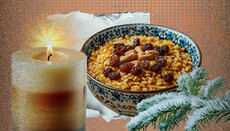
The traditional dish of this day is sochivo – boiled wheat with honey. Consider the image. A grain must be buried in the earth and “die” there, so that it can break through the soil and give life (John 12:24).
It is a metaphor for our whole existence. It feels as though we have been covered over with the heavy earth of circumstances. But on Christmas Eve we remember: the grain within us is alive. Death has no power over it if God is in it. The sweetness of honey in that wheat is a foretaste of the joy that awaits us beyond the threshold of trial.
When you sit down to the table in the evening – a table where, perhaps, many loved ones are missing – remember: Christmas Eve is not about the number of dishes. It is about the quality of silence.
When twilight thickens outside, and in the church it smells of wet snow from boots and of sharp incense, one single candle is lit. And that small point of light on the candle stand outweighs all our fear of the dark.
God has come. Never again will we be alone. The light shines in the darkness (John 1:5).