
Why did God need the Promised Land?

The Bible does not only smell of printer’s ink – it also carries the heat of sun-scorched stone. Why does “to go up to Jerusalem” mean climbing a vertical kilometer through a blazing desert?
Two hundred and fifty meters below sea level. Jericho is the lowest city on earth. From there to Jerusalem is only twenty-five kilometers. At first glance, it seems like a day’s walk. But Jerusalem stands at an elevation of eight hundred meters. The difference is more than a kilometer uphill. And the way leads through the rocky, parched, waterless Judean wilderness.
When the psalmist wrote, “I was glad when they said unto me, Let us go into the house of the Lord,” he was not rejoicing over an easy stroll. He was rejoicing over an ascent that leaves one breathless and makes the knees ache. “To go up to Jerusalem” – aliyah in Hebrew – is a verb stamped with the very contours of that land. In that language, one does not simply “go” to Jerusalem. One can only go up.

The corridor through which all the armies of the world marched
On the map, Palestine is a narrow strip between the Mediterranean Sea and the Arabian Desert – the only land bridge between Africa and Asia. Any army moving from Egypt to Mesopotamia, or the other way around, had no choice but to pass through this very place. Pharaohs, Assyrians, Babylonians, Persians, Greeks, Romans – all of them trampled this land with their boots, and every time the tiny Jewish nation living along their route found itself caught between hammer and anvil.
God did not settle His people in some secluded valley ringed by mountains, turning it into a kind of “Palestinian Switzerland.” He placed them at the busiest and bloodiest crossroads of the ancient world.
The hill of Megiddo – the very Armageddon of the Book of Revelation – was a crucial pass on the Via Maris trade route. Archaeologists have uncovered evidence there of thirty-four battles. To us, this sounds startling, but the Apocalypse is tied to a specific hill with specific coordinates, not to some mystical realm beyond the clouds.

Why would a loving God send the Jews such a severe trial? The Book of Deuteronomy answers directly: “The land, whither ye go to possess it, is not as the land of Egypt... but the land, whither ye go to possess it, is a land of hills and valleys, and drinketh water of the rain of heaven: a land which the Lord thy God careth for” (Deut. 11:10–12). Egypt had the Nile. Mesopotamia had canals. Harvests there could be calculated seasons in advance. But here, everything depended on rain, which might come – or might not.
God chose for His people a land where survival was impossible without turning to Him for help.
The deadly gorge
Between Jerusalem and Jericho lies the gorge of Wadi Qelt. This is the very road from the parable of the Good Samaritan. Guides sometimes stop the bus there and ask pilgrims to step out of the air-conditioned cabin for ten minutes. In summer, the temperature reaches forty-five degrees Celsius. The shock is immediate: the air scorches the lungs, and sweat dries before it can even appear.
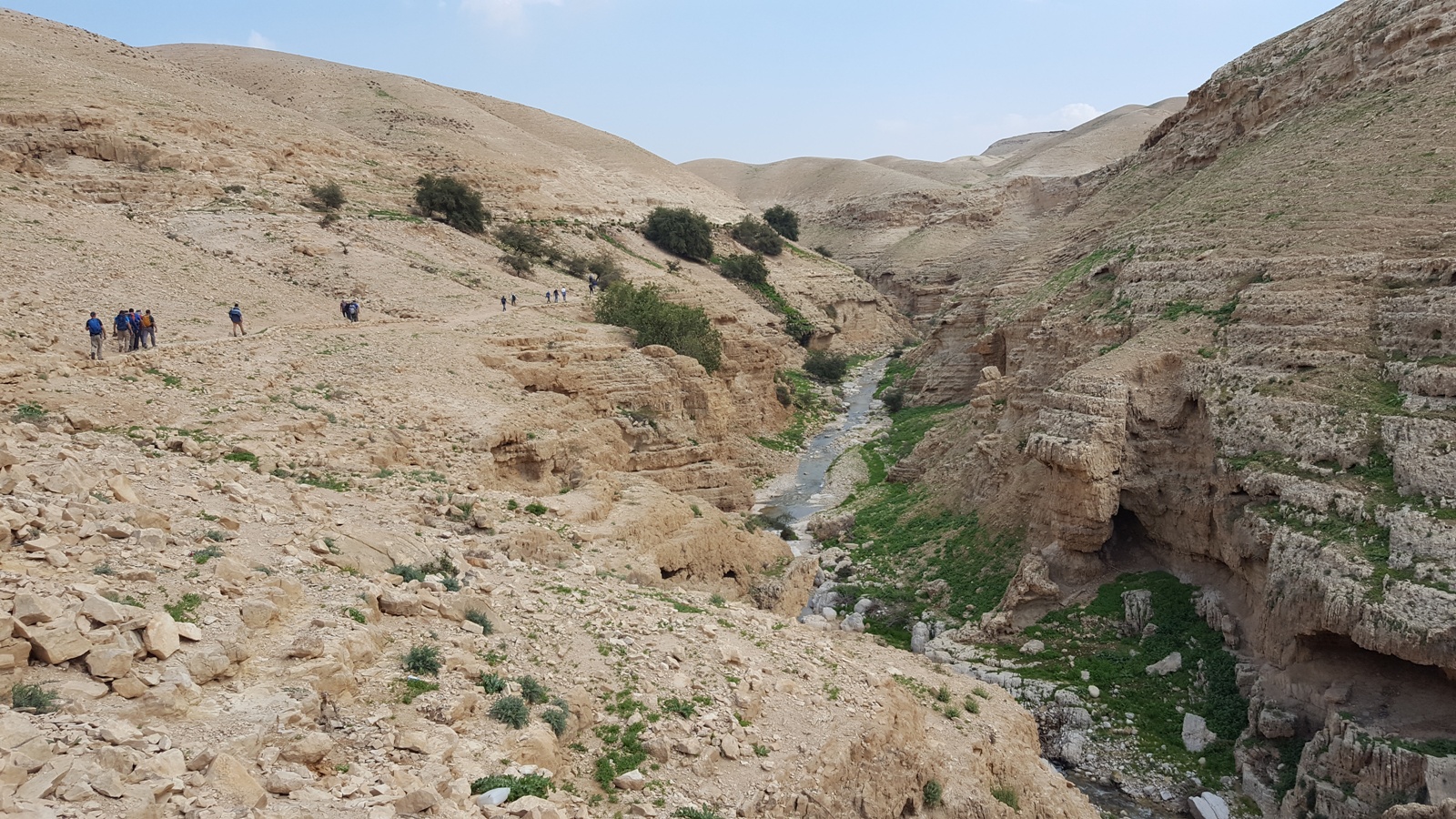
At that moment, it becomes painfully clear what the parable is really about. The man beaten by robbers and left by the roadside did not simply “need help.” He was dying of dehydration and heatstroke – within three or four hours. The priest and the Levite who passed him by did not merely show indifference – they left him to certain death. And the Samaritan did not merely “feel compassion” – he pulled a dying man out of a furnace of heat.
Blessed Jerome of Stridon, who spent the last thirty-four years of his life in Bethlehem and translated the Bible into Latin in a cave just a few miles from these places, insisted that Scripture cannot be understood without Palestine.
Just as Greek historians are better understood by one who has seen Athens, so too Holy Scripture is grasped more clearly by the one who has seen this land with his own eyes. Jerome knew what he was saying – he himself walked these roads on foot in seasons of drought.
Storms everyone knows about
Farther north, the laws of nature are different. The Sea of Galilee, Lake Kinneret, lies deep in the tectonic depression of the Jordan Rift Valley, two hundred and thirteen meters below sea level. The Golan Heights loom abruptly from the east. Cold winds from those plateaus plunge downward and collide with the overheated air above the water. Storms rise suddenly, out of nowhere, like a blow – one minute the surface is mirror-still, and five minutes later the waves are crashing over the boat. Fishermen know this well, and none of them ventures out without keeping an eye on the Golan.
.jpeg)
When we read in the Gospel that the disciples woke Christ because the boat was filling with water, this is not a parable or an allegory. It is a weather report any meteorologist would confirm. The apostles were fishermen. They had known that lake since childhood, knew its moods and tempers. And if they were afraid, then it was one of those storms after which boats are found on the bottom.
And here is what is most striking, if one pauses to think about it. The Gnostics, of whom there were many in the ancient world, taught that God acts in “aeons,” in abstract spiritual spheres far removed from dirt and stone. Christianity proclaimed the exact opposite from the very beginning: the Creator of the galaxy was born in a particular cave, walked particular roads, ate particular fish caught in a particular lake, and was crucified on a particular hill on a particular Friday of a particular month. The Gospels are crowded with places: Bethany, the Pool of Siloam, the Garden of Gethsemane, Golgotha. If the Bible were a myth, its events would unfold “somewhere far, far away.” But instead it gives the street, the turn in the road, the spring.
This land is rightly called the “Fifth Gospel.” The four Gospels were written in ink on parchment, but the fifth was written by God Himself on the stones, hills, and waters of Palestine. Without it, the first four can seem uprooted from the earth, like the roots of a tree torn from the soil.
A pilgrim who has walked the road from Jericho to Jerusalem feels it in aching knees and cracked lips. But he comes away knowing one thing that cannot be learned from a book: God does not hover somewhere in the clouds – He walked in this dust. And if He chose for Himself this very stony, scorching, dangerous, and vulnerable land, then perhaps He is calling us as well to surrender our comfort for the sake of our soul’s salvation.