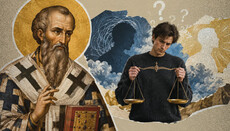

Deacon’s daily life: The unseen labor behind the closed doors of the altar
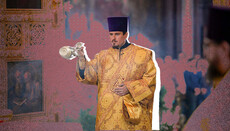
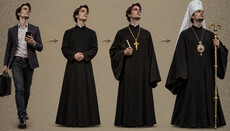
What do we really know about a deacon’s daily life? As a rule, parishioners in churches and monasteries have some idea of what belongs to the duties of a priest who performs the sacraments in church and beyond its walls. But what falls within the deacon’s responsibilities, apart from assisting the priest during services, intoning the litanies, and censing? Most believers, as a rule, have no idea. Let me share with readers my modest experience as a cathedral deacon.
What is kept in the altar
Despite my already advanced age, I have been in the diaconate for only about seven years, and at first I worried terribly lest I make some irreparable mistake. For example, when rinsing the chalice from which, with the fear of God, I had been blessed to consume the remaining Holy Gifts – the Body and Blood of the Lord – I was deeply anxious: God forbid that I should drip even a drop onto the table of oblation or let fall a particle of the Body.
And more than that, the chalice must be rinsed with the warm water in such a way that it is left perfectly clean, polished to a shine, and ready for the next service together with the spoon and the washed ladle, covered with a cloth and placed in the safe where all the liturgical vessels are kept – chalices of various sizes, discoses (footed plates), veils of different colors, stars, cloths, the spear, and other implements used in the services. For at a single service in the cathedral, Communion for the laity may be given from four or even five chalices at once. And every one of them must be absolutely spotless.
The Holy Table itself, where the Lord and His Angels repose, must likewise be kept in perfect order and purity, covered with a special covering – in our case of red velvet – as must the table of oblation and the transparent, artistically crafted tabernacle in which the Holy Gifts are kept, prepared during Great Lent for the entire year ahead for the Communion of the sick and infirm at home, when their condition does not allow them to be present in church for the service.
Passing by any functioning church, we cross ourselves – for there the reserved Holy Gifts of the Body and Blood of the Lord are kept.
All the liturgical vessels, as well as the Gospel books and altar crosses, the service books, and the differently colored vestments for the Holy Table itself depending on the service, are under the close care of the cathedral deacons. Note that on feasts of the Mother of God, the Holy Table, like the vestments of the clergy and the veils covering the Holy Gifts, must be blue; during the Paschal period and on the feasts of martyrs – red; on the days of venerable saints – green; during the Nativity and Theophany seasons, as well as on memorial days – white; while on all other feast days and weekdays – golden yellow.
I learned all this wisdom with fear and trembling, anxious not to mix anything up and determined to remember it well. I should add that in many churches, especially in rural parishes, these deacon’s duties are taken on by the priest himself. And believe me, the burden he bears is enormous and often poorly paid. So those who like to sneer about “fat priests in Mercedeses” would be very surprised – and very disappointed.
When the city is still asleep
Long before the morning service, while most of the city is still asleep, the appointed deacon hurries to the locked church with the keys taken from the duty room. The extensive grounds of our church complex, with St. Olga Cathedral and the Church of the Holy Right-Believing Prince Vsevolod – each of them hosting two Liturgies in the upper and lower chapels – along with a Sunday school for children and adults and other parish facilities, were developed over the course of more than thirty years.
It should be noted that St. Olga Parish is one of the largest in Kyiv, if not the largest. It was built through the labors of the well-known civil engineer, now honorary rector, Archpriest Vsevolod Rybchynskyi, who is 86 years old.
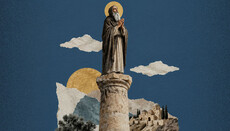
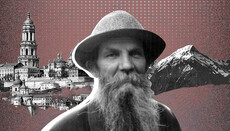
St. Olga Cathedral is encircled by seven enormous century-old oaks. According to local tradition, after the revolution of 1917 there was a dugout here beneath one of the oaks, where a clergyman from the Kyiv-Pechersk Lavra named Israel lived. The ascetic settled here after the Lavra was closed in 1923, received residents of the nearby hamlets and villages – now this is a vast residential district – and, according to old-timers, foretold that churches of God would one day rise on this very place.
.jpeg)
Tradition also says that this monk, fleeing arrest by the GPU, set off by boat along the Dnipro and, before the eyes of those seeing him off, miraculously vanished in the middle of the calm river, as though dissolved into thin air. In the early 1990s, eyewitnesses to this miracle recounted the story to Fr. Vsevolod. This episode is depicted in the frescoes in the narthex of the Church of the Holy Right-Believing Prince Vsevolod, who in holy Baptism was named Gabriel.
I should add in passing that a deacon’s labor demands not only physical effort, but prayerful effort as well.
In the evening, on the eve of the service, one should as a rule fast and read four canons, and early in the morning, along with the morning prayers, also the prayers before Communion. One must also carefully review the typikon schedule and the references.
When the deacon, having opened the cathedral, crosses the threshold, he is met in the half-dark by grace-filled silence. Having made three bows, the deacon puts on his cassock, lights the oil lamps, opens the safe, and begins preparing for the Proskomedia – arranging on the table of oblation everything needed for the Liturgy, and marking the appointed readings in the altar Gospel and the Apostle.
Soon the young altar servers arrive, then the other deacons, the serving priest, and the concelebrating clergy. Before vesting in their liturgical garments, the clergy come out onto the solea before the iconostasis and read the entrance prayers. Little by little the parishioners begin to gather. The first part of the Liturgy begins – the part called the Proskomedia. But about that, and about the Liturgy itself, I will try to speak in greater detail in the next installment.