
A quiet supper with God in the lenten twilight

The Liturgy of the Presanctified Gifts is not a feast. It is medicine for those whose strength has run out halfway through the course.
By the third week of Holy Lent, we have already lost count of the fasting days. We have worked a full day, swallowed something meager and forgettable for lunch, answered one hundred and twenty messages, of which one hundred and nineteen were not worth our attention.
At last, we are tired. It feels as though the fast is pressing on our shoulders like a soaked overcoat, and we no longer remember why we began any of this in the first place.
At that moment, the Church says to us: come to the service. Not to a festal one, not to a triumphant one. Simply come to an ordinary weekday Liturgy.

The incomplete Liturgy
Strictly speaking, what we habitually call the Liturgy of the Presanctified Gifts is not really a Liturgy in the usual sense at all. There is no Bloodless Sacrifice here, no Eucharistic canon, no moment when bread and wine become the Body and Blood of Christ. All that has already taken place – on Sunday, at the full Liturgy, when the Church celebrated her weekly Pascha. And now it is the middle of the working week, and we come to the temple not to celebrate, but to receive what has already been prepared for us in advance.
Vespers joined to Holy Communion – that is the brief essence of this service.
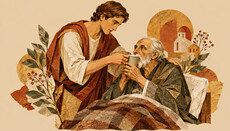
The Gifts consecrated on Sunday rest upon the Holy Table and wait for us – worn out, hungry, having lost our taste for life. The Church knew that we would break down halfway through the fast. She entertained no illusions about our endurance. And so she left us this “dry ration” – not as a punishment, but out of mercy for our weakness.
The bright sorrow of the one who fasts
We are accustomed to the Sunday Liturgy as something radiant and victorious – a little Pascha, a weekly triumph in which the choir sings the Cherubic Hymn and the soul grows warm. And it is difficult for us to understand why, on the weekdays of Great Lent, the Church has denied us that triumph.
The answer is simpler than it seems. The full Liturgy is always a feast. And a feast is incompatible with penitential weeping. One cannot at the same time mourn one’s sins and celebrate the victory over death – one of those two things will become false. Back in the seventh century, the Quinisext Council decreed that on the weekdays of Great Lent, only the Presanctified should be served.
This is not a ban on joy, but an honest acknowledgment that our joy now is of another kind – quiet, hidden, and penitential.
Protopresbyter Alexander Schmemann called this state “bright sadness.” We grieve – but ours is not a hopeless grief. We hunger – but our hunger is directed toward the One who is already waiting for us upon the Holy Table. The Presanctified Liturgy itself was born from this paradox: the Church does not summon us to a feast, but neither does she leave us without food. She feeds those who are spent – with Gifts preserved like medicine taken from an ambulance when a man can no longer walk to the pharmacy himself.
What happens in the darkness?
During the Presanctified Liturgy, the church is immersed in half-light. The priests are vested in dark garments. The Books of Genesis and Proverbs are read – Old Testament texts that carry us back to the age before Christ’s coming. We sit in the twilight with Adam and Noah, sensing ourselves to be humanity not yet saved, but already aware that the Deliverer is near.
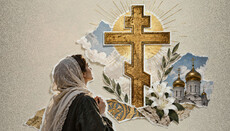
The priest comes out from the altar with a burning candle, saying, “The Light of Christ enlightens all!” – and we fall to our knees. A single candle in a darkened church. Once, this was simply a practical gesture – the bringing in of a lamp because evening had fallen outside. But the gesture became a symbol powerful enough to catch the breath: even in the thickest darkness of the fast – and of our ordinary household sadness – there is this ray. It does not flood everything with brilliance, as at Pascha. It burns quietly and stubbornly, and it is enough for us to see the road to God.
Then Psalm 140 is sung: “Let my prayer arise in Thy sight as incense, and let the lifting up of my hands be an evening sacrifice.” These words are the heart of the whole service. We stand on our knees and repeat them like a man who has no words of his own left.
When we have nothing more to say to God, the psalm speaks for us.
And at the Great Entrance, something happens that sends a chill through the soul. Instead of the Cherubic Hymn, they sing, “Now the Powers of Heaven do invisibly minister with us.” What is carried forth is not simply bread and wine – it is Christ Himself, His Body, sanctified on Sunday. The faithful fall face down to the ground. In the silence, the little bell can be heard – like a signal: do not lift your head, God is passing by.
The evening Mystery and the changes within the soul
Once, this service was celebrated in the evening – exactly as it was intended. Christians worked the whole day, eating not a crumb from midnight onward, and only at sunset on Wednesday or Friday did they come to church for Communion. The whole day became one long ожидание встречи? Need translate not leave Russian. let's continue carefully.
The whole day became one long waiting for the encounter, and weariness became not a hindrance, but part of the path toward union with Christ in the Mystery.
Today, for the sake of convenience, most churches serve the Presanctified in the morning, and because of that we lose much. But those parishes that return to the evening practice know this: when you receive Communion after a day’s work, after hunger, after legs buzzing with exhaustion – it is an entirely different experience. Communion is felt like warm food in a dark kitchen after a twelve-hour shift.
After an hour of kneeling in a dim church, after a sip from the Chalice, after the quiet words “The Light of Christ enlightens all,” suddenly it becomes easier. As though Someone has taken part of the burden onto His own shoulders and silently begun to walk beside us.
The Presanctified Liturgy does not give us the feeling of a feast, but it gives us something more important: the right to be tired. The right to come to God not with trumpets and cymbals, but with empty hands and a heavy head. The right to admit that we are not managing, and to receive help – in the half-dark, from the hands of a priest who is probably no less tired than we are.
And that gives us strength to go on living. Until next Wednesday, until next Friday. At last, until Pascha, which is still far away, yet no longer as impossibly far as it seemed this morning. For Christ is already within us – in our body and in our blood.