
Weaponizing funerals: A hero’s farewell as the fuse for a church seizure
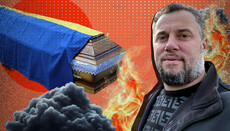
A well-rehearsed OCU playbook – a staged scene at a soldier’s funeral, and then, days later, a church “transfer” that ends in a takeover.
On January 14, 2026, the village of Komariv in Chernivtsi Region witnessed yet another episode in the ongoing campaign to discredit the Ukrainian Orthodox Church. At the funeral of Ukrainian Armed Forces serviceman Vitalii Melnyk – a father of four who died defending Ukraine – a scene unfolded that cannot be called anything but a planned provocation.
The leading role in this spectacle belonged to OCU chaplain Roman Hryshchuk – a figure whose name in recent years has become virtually synonymous with church seizures and scandals at the funerals of fallen Ukrainian soldiers. That is precisely why what happened in Komariv was not a one-off. It was a tested scheme, aimed at one goal: at any cost to bait a UOC priest into a conflict, and then accuse him of “disrespect for heroes,” “Moscow allegiance,” or “refusal to bury soldiers” – and, as the final act, take his church away.
Anatomy of a provocation: how it works
On his Facebook page, the OCU “priest” Hryshchuk posted a video of his exchange with a UOC priest during the burial service. The transcript lays bare the mechanics of this scheme.
From the very first words, Hryshchuk searches for a pretext for a scandal.
“Open the Royal Doors. This is not a dead man – this is a warrior who fell for Ukraine,” he demands.
The UOC priest answers that, according to the Church Typikon, the Royal Doors are not opened during a burial service. This is not a question of politics or patriotism – it is a centuries-old liturgical order. But the Typikon means nothing to Hryshchuk. His task is to turn a funeral into a confrontation.
“The Royal Doors must be open at the funeral of a warrior,” the OCU chaplain insists, brushing aside every explanation.
When the priest firmly refuses to violate the Church’s rule, Hryshchuk changes tactics. He begins firing off questions that have nothing to do with the burial rite itself:
“Are you for Ukraine or for Russia? Did Russia attack us or not? Who is fighting against Ukraine?”
The UOC priest understands perfectly well what is happening. These questions are not asked in search of truth; they are asked in search of a scandal. He refuses to play along. The Church stands outside politics, he says, and a burial service is not a political action but prayer for the repose of a soul. But Hryshchuk needs outrage, not dialogue.
“So are you for Ukraine or for Russia? I’m asking you!” he keeps pressing.
“We are all for Ukraine, we are all Ukrainians,” the priest replies, trying to pull the exchange back from the abyss.
It is obvious that no constructive conversation was possible – and it was never meant to be. Hryshchuk, who claims to have come to honor a hero, once again demonstrates blatant disrespect for the deceased himself, turning mourning into a political show.
After the scandal: from insults to slander
Immediately after the incident, Hryshchuk published a Facebook post dripping with hatred and contempt:
“Another Moscow animal still hasn’t decided whether it’s for Ukraine or for Russia. A Moscow priest called OCU priests and chaplains ‘actors’ and called the warrior ‘just an ordinary dead man.’ This mankurt doesn’t know whose Crimea it is, who is fighting against us, or who killed the soldier we buried today! … And this brute is a dean of the Kelmentsi district…,” Hryshchuk wrote.
Look at the vocabulary: “Moscow animal,” “mankurt,” and then “brute.” These are not the words of a priest – and certainly not of a Christian commanded to love even his enemies. These are the words of a man deliberately inciting hatred. And he incites it for a very concrete purpose: to create the conditions for seizing a UOC church.
A system of provocations: a rehearsed script
More than a year ago, UOC Deacon Andrii Hlushchenko described in detail the provocation script regularly used by OCU representatives.
Stage 1. OCU clerics reach an agreement with the relatives of a fallen soldier about a burial service – but instead of bringing the body to their own church, they bring it to a UOC church.
Stage 2. They demand that the UOC priest open the church and allow them to conduct the service there, despite knowing in advance that there can be no joint prayer between the UOC and the OCU.
Stage 3. When the priest refuses – as expected – a public scandal is staged, with accusations of “lack of patriotism,” “betrayal,” and “working for Moscow.”
Stage 4. If the UOC priest does open the church, the provocation continues by another route: demands to open the Royal Doors, admit OCU “priests” into the altar, switch to Ukrainian as a litmus test, “concelebrate,” and so on.
The aim is one and the same – by any means to provoke a conflict, film it, and then distribute it across social media and the press as “proof” that the UOC “does not respect Ukrainian heroes.”
Hryshchuk's behavior in the church: what witnesses say
Hryshchuk’s own behavior during services is especially revealing. On March 15, 2024, the Chernivtsi–Bukovyna Eparchy of the UOC published a response to the chaplain’s slander, after he accused UOC clergy of allegedly “not crossing themselves, not bowing, and demonstratively disrespecting the service.”
Video recordings show the opposite. During the burial service, it was Hryshchuk who kept turning his head, examining the frescoes, filming on a smartphone. During the singing of “Memory Eternal,” he turned his back on the fallen soldier – an unmistakable sign of disrespect to the deceased and to prayer.
During the Gospel reading, Hryshchuk walked into the center of the church and began filming again, rotating his phone in different directions. Behind him stood the UOC priest and the rector, listening attentively to the Gospel. Meanwhile, among the OCU chaplains there was already a professional cameraman broadcasting – which makes the obsession with additional filming all the more telling.
At the end of the Gospel reading, Hryshchuk “did not even cross himself,” the eparchy notes, but returned smiling to his place among the chaplains – apparently satisfied that he had found “a sensation” for Facebook and a theme for another graveside speech.
The eparchy also remarked that people had seen similar behavior in the demon-possessed at the Pochaiv Lavra.
Language provocations: Church Slavonic branded the “language of the aggressor”
Another instrument of provocation is the language of worship. Hryshchuk repeatedly claims that Church Slavonic is a “Russified Moscow language” allegedly designed to russify Ukrainians.
Commenting on the burial of soldier Mykhailo Kalancha, Hryshchuk declared: “To hear ‘Moscow-mouthed’ singing over you, when you are being buried in the language of the aggressor – that is immense pain and torment for him.”
He even offered a grotesque parallel: imagine “some Moskal in a Russian backwater” being buried in Ukrainian. That, he claims, is what the fallen soldier supposedly felt during a burial service in a UOC church.
This rhetoric is aimed at one thing – to insult the UOC and poison people against the Church as deeply as possible. Yet it is also absurd. Church Slavonic is the shared liturgical inheritance of all East Slavic peoples, including Ukrainians. It is the language in which the saints of the Kyiv–Pechersk Lavra prayed, the language of Ukrainian hierarchs and martyrs, the language in which Shevchenko and Franko read the Psalter.
And, finally,
Church Slavonic is regularly used even in the services of Patriarch Bartholomew himself. To turn it into the “language of the aggressor” is not only to erase a millennium of Ukrainian Orthodox history, but also to cast a stone into the garden of the Patriarchate of Constantinople.
Komarivtsi: from provocation to a church seizure
Another illustrative story, this time in the village of Komarivtsi, unfolded along the same now-classic OCU scenario.
On January 17, 2025, chaplains loyal to Dumenko demanded that a church be provided for the burial of serviceman Pavlo Unhurian. The UOC priest agreed and opened the church.
Yet during the service, OCU supporters inflamed hatred toward UOC clergy and believers, leading to a verbal clash. A UOC parishioner later described what happened: “It was outright provocative mockery by OCU priests, who promoted the idea of seizing the church under the cover of patriotic feelings. Shouting, pushing, obscene language right next to the soldier’s body!”
She continued: “It's beyond my understanding how people who commit such insanity and open mockery can later say they want to pray to God. Which God? My God teaches me love and mercy.”
And then, as usual, the next step followed. On January 19, 2025, OCU supporters held a “meeting” and voted for the “transfer” of the Dormition Church to their jurisdiction. A total of 146 people voted in favor. The actual parish community refused to participate.
Once again, the funeral of a fallen soldier was used as a pretext for a raider seizure of a church.
Banyliv-Pidрirnyi: how a fake is manufactured
Very often, when a conflict cannot be provoked, OCU representatives do not hesitate to use outright falsehoods. On January 6, 2026, Hryshchuk claimed on Facebook that the rector of the Ascension Church of the UOC in the village of Banyliv-Pidрirnyi refused to bury fallen serviceman Valentyn Faliboha. This lie quickly spread through Ukrainian media.
“The priests of the Moscow Patriarchate did not allow the burial of the soldier in the church of Banyliv-Pidgirnyi; the warrior had to be buried in the House of Culture,” the chaplain wrote. “OCU priests once again opened their brotherly arms to you today, offering joint prayer – and you spat on it!”
In reality, everything unfolded differently. The family had initially arranged the burial with the UOC rector. Then OCU representatives intervened. A “priest” called and demanded to be allowed to “concelebrate.” When he was refused, he began to threaten that during the service the body would be removed and the church seized. There is a recording of that call.
Pressure was then applied to the soldier’s mother, demanding her consent for an OCU cleric to conduct the rite. Consent was obtained. And what happened next? The OCU did not take the body to either of its two churches located in the same village. Instead, the “service” was performed in the local House of Culture – deliberately, to create a dramatic “victim” picture for the media.
Photos from the House of Culture were broadcast everywhere, inflaming outrage and hatred. And then the mother insisted on her original decision: her son was brought to the Ascension Church of the UOC, where twenty priests conducted the burial service for the fallen soldier. But, of course, no one reported that.
The reward for provocations
We cannot pretend that Dumenko “doesn’t know” what figures like Hryshchuk are doing. Most likely, he knows perfectly well – and it is precisely for this kind of “work” that Roman Hryshchuk receives awards from the OCU leadership. A man who calls priests “beasts” and “brutes,” who stages scandals at funerals, who exploits the deaths of Ukrainian soldiers for church-political manipulation, is treated as a man of honor.
That alone tells us a great deal about those who decorate him, because it reveals the true price of all the talk about “patriotism” and “love for Ukrainian heroes” behind which the provocateurs hide.
At the same time, the Chernivtsi Eparchy discloses certain details from the biography of Bukovyna’s most notorious church raider. One episode is especially telling – the story of an adopted child. Hryshchuk took a fifth child from an orphanage, and then returned the child, claiming the child was “possessed.” There is little to add – the act speaks for itself. We will keep silent about other pages of this “priest’s” biography as well – including how he raised his own son. The question here is no longer chiefly about Hryshchuk. It is about Dumenko, who rewards him.
For what are these orders and medals being awarded? For missionary work, for evangelization, for bringing people to faith? Hardly. They are being awarded for something else entirely – for stoking hatred against UOC clergy and parishioners and, in the end, for church seizures.
What lies behind the provocations
It is vital to understand that
provocations at funerals are not random, isolated incidents. They are part of a carefully planned, systematic campaign.
Its aims are obvious.
First – to discredit the UOC in the eyes of society, to create the image of a “church that does not respect Ukrainian heroes,” of “Moscow agents,” of “traitors.”
Second – to prepare public opinion for church seizures. After a scandal at a funeral, it becomes far easier to mobilize local residents for “transfer” meetings.
Third – to pressure UOC clergy and believers, to create an atmosphere of fear and constant tension.
Fourth – to divert attention from the OCU’s own problems – problems that today only the lazy or the blind pretend not to see.
And there is also money. With their political activism, OCU “priests” are not only trying to compensate for a lack of spiritual authority – they are earning very real profits from seizures.
That is why provocations at the funerals of Ukraine’s defenders are a cynical exploitation of a national tragedy for mercenary ends. Soldiers who died for the country’s freedom are turned into instruments in church-political games, and their deaths are used to inflame hatred between Ukrainians. What could be more cynical?
Voices from the ground: what people are saying
People in the villages where such provocations occur see everything from the inside. Their testimony looks nothing like what OCU activists write on Facebook.
A parishioner from Komarivtsi says: “It hurts that people who have nothing to do with our Church, who do not partake of her Holy Mysteries, were shouting that they have the right to decide her fate. I know that just as the Lord, before the Crucifixion, understood that what was written had to be fulfilled, so we too say: let His holy will be done. But we pray that He will change the thoughts of those who go against us, turning us into enemies.”
Parishioners in Bukovyna describe Hryshchuk as a “malicious raider” who “rages” because in his own village two UOC churches are always full, while few people come to him.
These voices are barely audible in Ukraine’s information space today – a space saturated with accusations and lies aimed at the UOC. Yet these voices show the reality in which ordinary believers are forced to live.
And the stance of UOC clergy is perfectly clear: the Church stands outside politics. A burial service is not a political performance and not a demonstration of loyalty. It is prayer for the repose of a soul, a sacred rite performed according to the Church’s rule.
UOC priests never refuse to pray for fallen soldiers. They do not show disrespect for their sacrifice. They simply follow the centuries-old tradition of the Church, which exists regardless of the political weather.
But it is precisely this position – “the Church is outside politics” – that is intolerable to those who have turned religion into an instrument of political struggle. For them, being apolitical equals betrayal; fidelity to the Church’s rule is labeled “working for Moscow.” And if priests refuse to speak in political slogans – they are declared enemies.
Conclusions
Ukraine is at war. Every day, the defenders of the country are killed. Their families endure unbearable grief. In such moments, the Church is called to be a source of consolation, prayerful support, and spiritual strength.
Instead, the OCU has long been using soldiers’ funerals as a battleground for political influence. The cost is immense: it deepens the split in Ukrainian society, sows hostility among people who should be united in the face of an external threat, and devalues the very idea of church ministry, turning the Church into a political instrument.
Most tragic of all, soldiers who gave their lives for Ukraine are turned into bargaining chips in the hands of political activists wearing cassocks. This is not service to Ukraine. It is service to themselves, wrapped in patriotic rhetoric.
Ukraine deserves more. Its defenders deserve more. And Ukrainian believers – regardless of jurisdiction – deserve more than a “church-activist” for whom politics matters more than prayer, and Christianity is merely a cover for political goals.