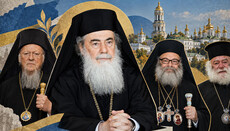

Religious “advocacy” of the authorities is inherited from Soviet times
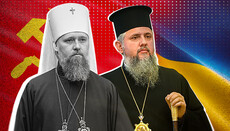
The Ukrainian authorities delegate religious leaders to the West to give the impression that there is no persecution of the Church in the country. The USSR government did exactly the same. We illustrate this with examples.
In recent years, a strange term “advocacy” has appeared in the authorities’ rhetoric on church matters. High-ranking representatives of Ukrainian denominations are sent abroad by the state with a peculiar purpose: to assure that there is freedom of religion in Ukraine. For example, Bishop Vitalii Kryvytskyi of the RCC in Ukraine spoke about the most recent advocacy visit of the Ukrainian Council of Churches and Religious Organizations (UCCRO) to the U.S.: “We repeatedly encounter this reproach, the claim that there is religious persecution in Ukraine. As the Ukrainian Council of Churches and Religious Organizations, we say: today in Ukraine there are no signs of persecution specifically for faith.”
Similar statements from the OCU, UGCC, RCC, Jews, Muslims, and Protestants now number several dozen.
In fact, “advocacy” means “defense”. Pastors, rabbis, and bishops abroad are engaged in defending the Ukrainian authorities. But defending them from what?
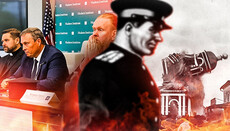
In September 2025, seven UN special rapporteurs on human rights sent an official letter to the Ukrainian government accusing it of systematic violations of religious freedom against the Ukrainian Orthodox Church.
In another report in June 2025, the UN stated that radicals in Ukraine were attacking UOC believers and seizing their churches. Even earlier, in a 2024 report, the Office of the UN High Commissioner for Human Rights said that Ukraine failed to justify the law on UOC ban.
In the spring of 2024, current Vice President J. D. Vance spoke in Congress about the persecution of the UOC by the Ukrainian authorities.
And in 2023, Tucker Carlson’s broadcast with UOC lawyer Robert Amsterdam was watched by over 100 million people in total, including on Elon Musk’s X channel, which reposted the video.
Reports of persecution of the UOC are heard around the world regularly, though not on the scale they should be. And the statements of international speakers boil down to one clear and logical demand: stop persecuting the Church.
One would think the authorities should listen and comply. But it is not the case. Zelensky chooses a different tactic. Its main message is: “You’re all lying.” As “evidence,” the authorities send a “task force” of religious leaders who are part of the Ukrainian Council of Churches and Religious Organizations. The subtext is obvious: these are all “men of God,” who by definition cannot lie. And if they say there is no persecution, then that is exactly the case. For example, OCU head Dumenko explicitly states that if the UCCRO says there is no persecution, then that is the reality. Any other statements are dismissed as Moscow propaganda.
Back in March 2023, UCCRO members held a meeting with a delegation from the World Council of Churches and stated that “freedom of religion is respected in Ukraine, and there is no religious persecution during the war.”
Immediately after the sensational Carlson–Amsterdam broadcast, the authorities hurriedly sent a delegation to the U.S., where OCU spokesperson Zoria assured Americans that “they are not telling the truth; they are only spreading propaganda.” In turn, Kyiv’s chief rabbi, Yaakov Bleich, told the U.S. that he supported the law banning the UOC because “defending the freedoms of individuals and organizations while at the same time protecting the country from the aggressor is difficult.”
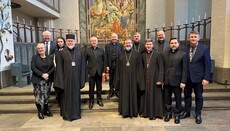
Since 2023, the number of “advocacy visits” by UCCRO members has already reached dozens. Both the authorities and Zelensky himself have repeatedly thanked religious leaders for carrying out the tasks assigned to them in 2024 and 2025. Zelensky personally thanked Epifaniy as well.
And “advocacy” (or, to be frank, lies) by UCCRO is indeed necessary for Zelensky. It gives him the ability to claim that there is no persecution of faith in Ukraine.
Here’s a simple scheme: instead of stopping the persecution of the Church, the authorities promote “hand-picked” religious leaders, only to later cite them as unquestionable authorities.
It may seem like an original move by the government to disguise its actions against the Church. But if we look at history, it turns out that the same “advocacy” scheme was already used by one state, and quite recently.
At a time when thousands of churches in the USSR had already been blown up, tens of thousands of priests and bishops were executed or tortured in labor camps, the Soviet authorities were “working” with religious leaders, extracting statements from them that nothing of the sort actually happened.
“Advocacy” under Soviet rule
The most striking case of “advocacy” is probably the interview of the de facto head of the Russian Orthodox Church, Metropolitan Sergius (Stragorodsky), given in 1930 to Soviet and foreign journalists. In it, he literally stated: “There has been no persecution of religion in the USSR. By virtue of the Decree on the Separation of Church from State, the practice of any faith is entirely free and is not persecuted by any state body <…> some churches are closed. But this closure is not carried out at the initiative of the authorities but at the will of the population, and in some cases even by the decision of the believers themselves <…> Repressions enforced by the Soviet government against believing clergy are applied to them not for their religious beliefs, but in a general manner, as to other citizens for various anti-government actions.”
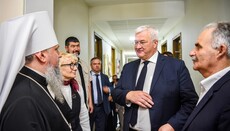
Notice: exactly the same narratives as today.
But it was not only representatives of the Russian Orthodox Church who engaged in “advocacy.” A well-known figure, and later the head of the Ukrainian Greek Catholic Church, Josyf Slipyj, wrote in 1944: “Personally, the clergy and I are grateful to the Soviet authorities. The entire funeral procession [of Andriy Sheptytsky] demonstrated in practice that there is freedom of religion in the Soviet state. <…> We will pray for the victory of the Soviet Union.”
Some historians question the authenticity of this quote, but it could very well be genuine, since the head of the Ukrainian Uniates at the time, A. Sheptytsky, wrote to J. Stalin in the same year, 1944: “You have once again reunited the western Ukrainian lands with the great Ukraine. For fulfilling the cherished wishes and aspirations of Ukrainians, who for centuries considered themselves one people and wanted to be united in one state, the Ukrainian people offer you their sincere gratitude. These bright events and the tolerance with which you treat our Church have also inspired hope in our Church that, like the entire nation, it will find complete freedom of work and development under your leadership in the USSR, in prosperity and happiness. For all this, Supreme Leader, you have our deep gratitude.”
Another “advocate” of the Soviet authorities, who continues similar “advocacy” even today, is the “Honorary Patriarch” of the OCU and head of the UOC-KP, Filaret Denysenko. His service to the Soviet authorities, as well as his work for the KGB of the USSR, is confirmed by many documents. For example, in an interview with the APN agency on February 20, 1976 (published in the “Journal of the Moscow Patriarchate”), he said: “I am surprised that our Church and believers are called persecuted. In the Soviet Union, there are no persecuted for religious beliefs. <…> The Soviet state understands the Church’s needs. <…> On the contrary, some Western news agencies, using slanderous and biased information, try to mislead world public opinion.”
“Advocate” under any authority
However, the most consistent “advocate” – under any authority and in any era – is the head of DESS, V. Yelensky, who denied persecution of the Church then and continues to deny it now. In 1988, as part of the series “Atheist Student’s Library”, he published a booklet “Jewish Clericalism and Zionism”, in which he writes, among other things: “The lie about the ‘persecution’ of believers under socialism, about the ‘forcible eradication’ of religious institutions, is spreading ever more persistently <…> No ingenuity was spared by the defenders of the fake ‘persecution of faith in the USSR,’ no lie was too extreme for the anti-Soviets, and no perspective was left unexplored in presenting their own falsehood!”
Just as today V. Yelensky claims that churches join the OCU by the will of the people, in Soviet times, he said that the actions of the Soviet authorities toward the Church were entirely approved by the working people: “Party organizations, Soviets, in their practical implementation of Lenin’s decree ‘On the Separation of Church from State,’ relied on the anti-clerical movement of the workers, who for the most part received it favorably.”
Today he promotes the thesis that clergy and believers are persecuted not for their religious beliefs but for “working for Moscow,” for maintaining “ties with the aggressor,” and so on. Under the Communists, he said the same thing: “After the Revolution, the reactionary clergy and monks became agents of foreign interventionists, and monasteries located behind Soviet lines turned into strongholds of bandits.”
Today he argues that the law banning the UOC is not persecution of the Church but a normal regulation of church-state relations. Under the USSR, he wrote similarly. He stated: “Elementary legal norms, by which the relationships between the state and religious organizations are regulated, are immediately declared ‘interference,’ ‘encroachment,’ ‘infringement,’ etc. Moreover, these norms are often distorted beyond recognition or suddenly acquire such ‘details’ that could only have arisen in the fevered imagination of a certified anti-Sovietist.”
Conclusions
The result of this comparison is clear: the state’s current position toward the Church is borrowed from the Soviet times. In the case of Viktor Yelensky, even the personalities remain the same. And if not for the years and infirmities of Filaret Denysenko, there is no doubt that he would participate in today’s “advocacy” for the Ukrainian authorities just as he served the Soviet regime.
When hierarchs are prosecuted for preaching, churches are physically destroyed or turned into warehouses, and the law banning the country’s largest denomination is called “normal regulation” – and all of this is presented to the world as “freedom of religion” – we are no longer talking about a mistake or mere propaganda. We are talking about a deliberate substitution of reality.
The Soviet authorities acted in the same way: they lied themselves and forced church leaders to participate in that lie. History has already answered the question of whether such schemes work. They do not. Lies do not erase facts, and persecutions are not diminished simply because they are denied. Sooner or later, the truth comes out anyway.