
Exarchate of Constantinople for the UOC: a solution or a trap?
What lies behind the talk of a “third way” for the Ukrainian Orthodox Church, and how might consent to a new structure under the omophorion of the Phanar ultimately end?
In recent months, the word “exarchate” has been heard more and more frequently in Ukraine’s church sphere. It refers to the possible creation by the Constantinople Patriarchate of a special structure on Ukraine’s territory. It is meant to become something of an intermediate station for those hierarchs, clergy, and faithful of the UOC who are not ready to join the OCU, but at the same time want to rid themselves of government persecution and distance themselves as much as possible from the ROC.
At first glance, the idea appears reasonable and even humane: to give people a choice, to ensure freedom of conscience, to offer a “safe haven” in the midst of a storm. However, behind the fine words about a “third way” lie serious canonical, legal, and political questions. The answers to them may prove far less reassuring than the proponents of this idea promise.
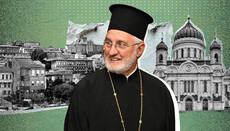
Talk of an exarchate is fueled by statements from influential hierarchs of the Constantinople Patriarchate. At the end of January 2026, Archbishop Elpidophoros of America, one of the most prominent spokesmen of the Phanar, gave a major interview. In it, he repeatedly hinted quite transparently at the need for the UOC to recognize the authority of Patriarch Bartholomew and to begin commemorating him liturgically.
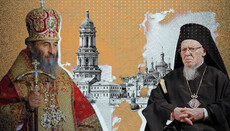
Shortly before that, Kirill Govorun, a theologian and former cleric of the Russian Orthodox Church, well aware of the inner workings of church politics, openly described the exarchate as a “transit zone” and a temporary solution for those in the UOC who are dissatisfied with the current situation.
But what really lies behind these proposals? Can an exarchate truly become a way out for the UOC, or is it a carefully designed mechanism for its absorption? To answer this question, one must examine the details – from canonical structure to geopolitical interests.
What an exarchate is and how it functions
First, it is necessary to clarify what an exarchate represents in the Orthodox tradition.
An exarchate is a church structure in direct subordination to a particular patriarchate (in this case, Constantinople), which is headed by an appointed exarch. Essentially, it is something midway between a fully autonomous church and an ordinary eparchy.
An exarchate possesses a certain degree of self-governance, but key decisions are made by the patriarchate to which it is subordinate.
It is important to understand that an exarchate is neither autocephaly nor even autonomy. It is a form of direct governance by the “Mother” Church. The exarch is appointed by the Patriarch, reports to him, and may be replaced at any moment. All bishops, clergy, and laity of the exarchate commemorate the Patriarch of Constantinople during the divine services, thereby accepting his supreme jurisdiction.
Existing examples show how this works in practice. In Lithuania, there is an exarchate of the Constantinople Patriarchate, formed by former parishioners of parishes of the Moscow Patriarchate. Observers note that this experiment is functioning, though not without difficulties. The community lives according to the new calendar and commemorates Patriarch Bartholomew, while continuing to use the familiar Church Slavonic language in its services.
The number of parishioners is small – around 40–50 people at a Sunday service in one church. Yet the very existence of such a community demonstrates that this model is technically feasible.
The Phanar’s Exarchate already exists in Ukraine
Here we come to one of the key, yet often overlooked, questions: there is already the Exarchate of the Constantinople Patriarchate in Ukraine, headed by Bishop Michael (Anishchenko) of Komana.
A logical question arises: if an exarchate already exists, why create a new one? From the standpoint of canon law, how would two parallel structures of Constantinople on the same territory relate to one another? Would the existing exarchate be abolished and merged into the new one? Or would the new exarchate function alongside it? The latter would create a situation unprecedented from a canonical perspective: two exarchates of the same Patriarchate on the same territory.
Supporters of the idea of a new exarchate usually pass over this question in silence, which in itself speaks volumes. The canon law of the Orthodox Church has always upheld the principle of territoriality: as a rule, one canonical jurisdiction operates within a given territory. The creation of a second exarchate, parallel to the first and parallel to the OCU, would generate confusion difficult to imagine even for sophisticated experts in canon law. It should be recalled that the OCU also exists under the aegis of the Phanar (although it is formally declared to be an independent structure) and, from its perspective, is canonical.
At the same time, according to the logic of the Tomos granted to the Ukrainian schismatics by Patriarch Bartholomew, the entire canonical territory of Ukraine belongs to the OCU. The creation of yet another parallel structure of Constantinople would effectively mean that the Phanar calls into question the fullness of the OCU’s jurisdiction – that very structure which it created and for which it bears responsibility before the entire Orthodox world.
What does Archbishop Elpidophoros say?
Archbishop Elpidophoros’ interview with the “Viche” channel in January 2026 deserves close attention. Behind the diplomatic wording lies a fairly concrete program of action. The archbishop’s key thesis can be formulated as follows: if the hierarchs of the UOC want help from the Ecumenical Patriarch, they must first recognize his authority, specifically begin the liturgical commemoration of Patriarch Bartholomew.
“How can you ask someone for help if you do not recognize his authority to help you, if you question his jurisdiction to help you?” Archbishop Elpidophoros asks. “If someone needs the help and authority of the Ecumenical Patriarch, the first step must be to accept his authority and commemorate him.”
It is important to understand that in the Orthodox tradition, commemorating a Patriarch during the Divine services is not merely a polite gesture. It is a recognition of jurisdiction, submission, and canonical communion.
Notably, at the same time, Archbishop Elpidophoros challenges the very canonicity of the UOC: “Since these hierarchs refuse to commemorate the Patriarch of the ROC, how can they claim that they are a canonical Church? How can you be a canonical Church if you commemorate no one?”
This argument is a double strike. On one hand, it delegitimizes the current status of the UOC. On the other, it offers a “solution” in the form of commemorating Patriarch Bartholomew. According to Archbishop Elpidophoros, there is no other option: either you are “non-canonical,” or you submit to us.
Moreover, Archbishop Elpidophoros speaks quite harshly about those who recognize the canonicity of the UOC. The local Orthodox Churches that support the UOC he directly calls “Russian satellites”: “What ecclesiastical status do the metropolises under the omophorion of Metropolitan Onuphry and all his hierarchs have? Their only status is that they are recognized by the Russian Orthodox Church and by all other Orthodox Churches that are political and ecclesiastical satellites of Russia.”
It is clear that such rhetoric leaves no room for diplomacy or dialogue: you are either with us, or you are a “satellite of Russia.”
Govorun and the idea of a “transit zone”
In turn, Kirill Govorun, who was stripped of his clerical rank in the ROC, suggests viewing the exarchate as a “third way” between the OCU and the UOC. It is a transitional option for those dissatisfied with the situation within the UOC but not ready to join the OCU. In his interpretation, the exarchate is a “quiet harbor,” a temporary solution, and a “transit zone.”
Govorun describes the situation within the UOC as follows: the faithful try to reach the hierarchs and the Primate but encounter “ignorance and deafness.” At the same time, harsh rhetoric comes from the OCU side: “you are schismatics,” “you are collaborators,” “you are all FSB agents in robes”, etc. In these conditions, many believers seek a way out, and the exarchate is presented as exactly that solution.
However, Govorun reveals more when he discusses the canonical logic of the situation. In his view, after the Phanar revoked the 1686 Letter, all parishes and bishops of the UOC effectively “became parishes and bishops of the Ecumenical Patriarchate.” Recall that, according to this Letter, the Metropolis of Kyiv was placed under the administration of the Moscow Patriarchate.
In other words, this is not about any voluntary transfer. It is about the fact that the Phanar claims for UOC, which only needs to be “formalized”.
Thus, the exarchate is less a proposal of assistance and more a demand for the “legalization” of the existing situation, at least according to Constantinople.
The question of the exarchate, Govorun says, “is a question of whether to recognize de jure what exists de facto.” But the “de facto” in this case is only one interpretation of canonical history, and far from undisputed.
Govorun names two priorities of the exarchate. The first is freedom of conscience: every Ukrainian should have the opportunity to choose where to go. The second is national security: it is necessary to neutralize the influence of Moscow’s propaganda through the Church. It should be noted that the second point immediately moves the discussion from a spiritual plane into the political one.
Why the exarchate is a one-way road
Now let’s move to the most important question: what would happen if the UOC (or a more or less significant part of it) agrees to the exarchate?
First: loss of subjectivity. Joining the Phanar’s exarchate automatically means recognizing the supreme authority of the Patriarch of Constantinople over Ukrainian territory.
If the UOC recognizes the Phanar’s right to determine the fate of Ukrainian Orthodoxy, it automatically legitimizes all of its previous actions, including the legalization of schismatic structures and the creation of the OCU.
Second: loss of autonomy. An exarchate is not autocephaly. Being under the direct authority of Constantinople, the Ukrainian episcopate loses the ability to independently make decisions on key issues. The exarch is appointed by the Phanar, and the most important personnel and canonical decisions are made in Istanbul. For a Church with thousands of parishes and millions of faithful, this practically means giving up many of its independent decisions.
Third: inevitable merger with the OCU. This is perhaps the most serious problem. Sooner or later, the Patriarchate of Constantinople will inevitably decide to unite the OCU and the UOC exarchate. This is evident from the rhetoric and the logic of the Phanar’s decisions regarding Ukraine in recent years.
Fourth: a split within the UOC. The proposal of an exarchate will, by itself, create internal problems. A confrontation will emerge between those willing to join the exarchate for the sake of “legalization” and protection from state persecution, and those who see it as a betrayal of the canonical position.
This is a classic strategy: to create within a church structure a group that believes “we have no choice,” and set it against the leadership. Hierarchs who wish to engage with Constantinople will be portrayed as “realists” and “saviors” of the Church, while dissenters will be cast as “stubborn fundamentalists” obstructing progress.
Patriarch Bartholomew and the “unifying potential of the Tomos”
Kirill Govorun, commenting on Epiphaniy’s recent visit to the Phanar, reports that Patriarch Bartholomew’s message contained “important signals.” In his interpretation, Bartholomew admitted that the Tomos granted to the OCU has not achieved its original goal – unity of Ukrainian Orthodoxy. Moreover, the Tomos has become “a tool in the hands of opposing sides.” Some use it as a means of protection, while others see it as a weapon directed against them.
Govorun claims that the Tomos still holds “an unrealized unifying potential,” and this is precisely the potential Patriarch Bartholomew has in mind. The solution, according to Govorun, is dialogue: “just start talking to each other,” “enter into communication. Not necessarily immediately Eucharistic, but at least on a human level.”
It sounds appealing, but a question arises: what kind of dialogue can this be if one side has already predetermined its outcome? Archbishop Elpidophoros is explicit: “If they really mean what they say about dialogue with Constantinople, they must start by commemorating the Patriarch of Constantinople.”
In other words, “dialogue” begins with submission. This is not dialogue in the usual sense of the word – it is an ultimatum wrapped in polished diplomatic language.
Notably, Govorun admits that a mass accession of the UOC to the OCU “will no longer happen.” According to him, the Ukrainian Orthodox Church sees the Tomos as a threat. “Partly, this is the result of Moscow’s propaganda; partly, it is the result of internal propaganda.”
But instead of recognizing that the problem may lie in the Tomos itself and in the way it was “promoted” (through violence and church seizures), a new form of pressure is proposed – the exarchate.
At the same time, the whole issue of the exarchate cannot be considered outside the context of the war, which is being used as an additional lever of pressure. The logic is simple: the situation is critical, there is no time to think, and action must be taken now. And the only “right” choice is the exarchate (read: submission to the Phanar). Any doubts or objections are dismissed as a “pro-Moscow position.”
It should also be emphasized that the situation in Ukraine is not an isolated case. It fits into a broader strategy of the Constantinople Patriarchate to expand its influence. This strategy is being implemented simultaneously in several other countries: Montenegro, Lithuania, Latvia, and Estonia. This approach shows that the exarchate for the UOC is just one element of this global strategy. The ultimate goal is the maximal expansion of the Constantinople Patriarchate’s jurisdiction at the expense of other Orthodox structures.
What remains off-screen: church seizures and clergy mobilization
One of the most painful aspects of the situation is hushed up by the exarchate supporters. Thousands of UOC faithful have experienced the seizure of their churches, violence, and humiliation. The clergy face pressure from the state, and many have been forcibly mobilized. There are already numerous documented cases where parishioners and priests have been physically attacked, resulting in injuries and mutilations.
Notably, Archbishop Elpidophoros has refused to discuss these issues. His silence speaks louder than any words. A person who calls for “unity” and “dialogue” is not even willing to admit the problem of violence. This raises another question: how can one trust promises of protection from a structure that turns a blind eye to persecution?
For the UOC faithful who have endured church seizures and physical violence, the proposal of an exarchate sounds like bitter irony. Churches were taken by those acting with the silent connivance of the Phanar. The seizures were carried out by the very structures that Constantinople recognized as legitimate. And now the Phanar extends a helping hand – of course, under its own jurisdiction.
It is like offering a person whose apartment was seized to move into a communal flat run by the raider.
Canonical ambiguity
One of the most complex points in the argumentation of exarchate supporters is the question of the UOC’s canonical status. The Phanar promotes the following logic: after the revocation of the 1686 Letter, the Metropolis of Kyiv “returned” under the jurisdiction of Constantinople. Therefore, all parishes, bishops, and priests of the UOC are already part of the Ecumenical Patriarchate, just not formally legalized yet.
However, this position is extremely vulnerable. First, the interpretation of the events of 1686 is a matter of sharp disagreement among historians and canonists. Moscow maintains that the Metropolis of Kyiv was fully transferred. The Phanar claims that the transfer was temporary and conditional. The truth, as usual, lies somewhere in between, and any unequivocal interpretation is an oversimplification.
Second, even if one accepts the Phanar’s argument, the question remains: why then did it decide to “restore” its jurisdiction only in 2018, that is, 332 years after the transfer? The answer is obvious: because at that time, the political situation enabled this action.
President Poroshenko actively lobbied for the creation of the OCU, and the Phanar took advantage of this. The canonical arguments were tailored to fit an already-made political decision, rather than the other way around.
For UOC believers, this means that their fate is being decided not on the basis of spiritual or canonical principles, but according to political expediency. Today, it is expedient to offer an exarchate, so an exarchate is proposed. Tomorrow, it may be expedient to demand a merger with the OCU, so a merger will be demanded.
What to do?
It should be understood that the majority of the UOC episcopate will almost certainly not join the exarchate. Out of fear of a merger with the OCU, distrust of the Phanar’s promises, and the impossibility of explaining such a decision to ordinary believers. The situation is indeed complex, and there are no simple solutions. But there are several principles worth keeping in mind when evaluating any proposals.
First: any decision must be made freely, without pressure – neither from the state, the church, nor society. Govorun rightly emphasizes freedom of conscience as a priority. But freedom of conscience also means the possibility to choose something that pleases neither the Phanar nor state officials.
Second: pay close attention to those presenting a “solution”. The Phanar, which legalized schismatic structures, remains silent about church seizures, and calls dissenters “satellites”, is not a mediator to be trusted unconditionally. Its motives are at least as political as they are spiritual.
Third: dialogue is possible and necessary, but only on equal terms. True dialogue does not begin with a demand for submission. If you are told, “first recognize our authority, and then we will talk”, that is an ultimatum rather than dialogue.
Conclusion
The exarchate may appear to be a lifeline for the UOC. But on closer inspection, it becomes clear that this “lifeline” is tied to a ship sailing in a direction very different from where the passengers would like to go. The logic of the process, as experience and the direct statements of its participants show, leads to a single outcome: the complete absorption of the UOC into structures under Constantinople’s control and its eventual merger with the OCU.
For the millions of believers who go to UOC churches, pray, baptize their children, and hold funerals for their near and dear, the Church is neither a “geopolitical tool,” nor a “satellite,” nor a “transit zone.” It is their spiritual home. And they have the right to know exactly what is being offered to them when the exarchate is discussed, with all its hidden pitfalls and potential consequences.
The choice, of course, belongs to each individual. But that choice must be made consciously. And to make a conscious choice, one needs full information, not only promises of a “safe haven,” but also an understanding of exactly where the ship is headed and who is at the helm.