
The Aedicule of the Holy Sepulchre: architecture of the empty center
To enter the Aedicule, one has to bend down. The doorway is low and narrow, just slightly wider than an adult’s shoulders. The body instinctively folds before one even has time to think about it. You take one step, then another, and find yourself in the Chapel of the Angel. In the center of the tiny chamber stands a low pedestal, which preserves a fragment of the very stone rolled away from the Savior’s tomb.
.jpeg)
The air here is different. It is slightly cooler and seems motionless. There is a thick, heavy scent of melting wax and rose oil. There is a thick, heavy scent of melting wax and rose oil. This is often the case in deep niches of ancient churches, where thick stone holds its temperature steadily, completely indifferent to what is happening outside at that moment: whether a colourful crowd of pilgrims is bustling, the scorching Jerusalem sun is blazing, or a winter downpour is falling.
The second opening is even lower than the first. When you straighten your back in the burial chamber itself, the space around you does not become wider. The entire room is approximately two meters long and slightly more than a meter wide. If two people stand side by side in this chamber, it becomes unbearably cramped. On all sides there is a solid marble lining. Beneath the low ceiling, dozens of oil lamps are crowded together, casting more trembling shadows than steady light.
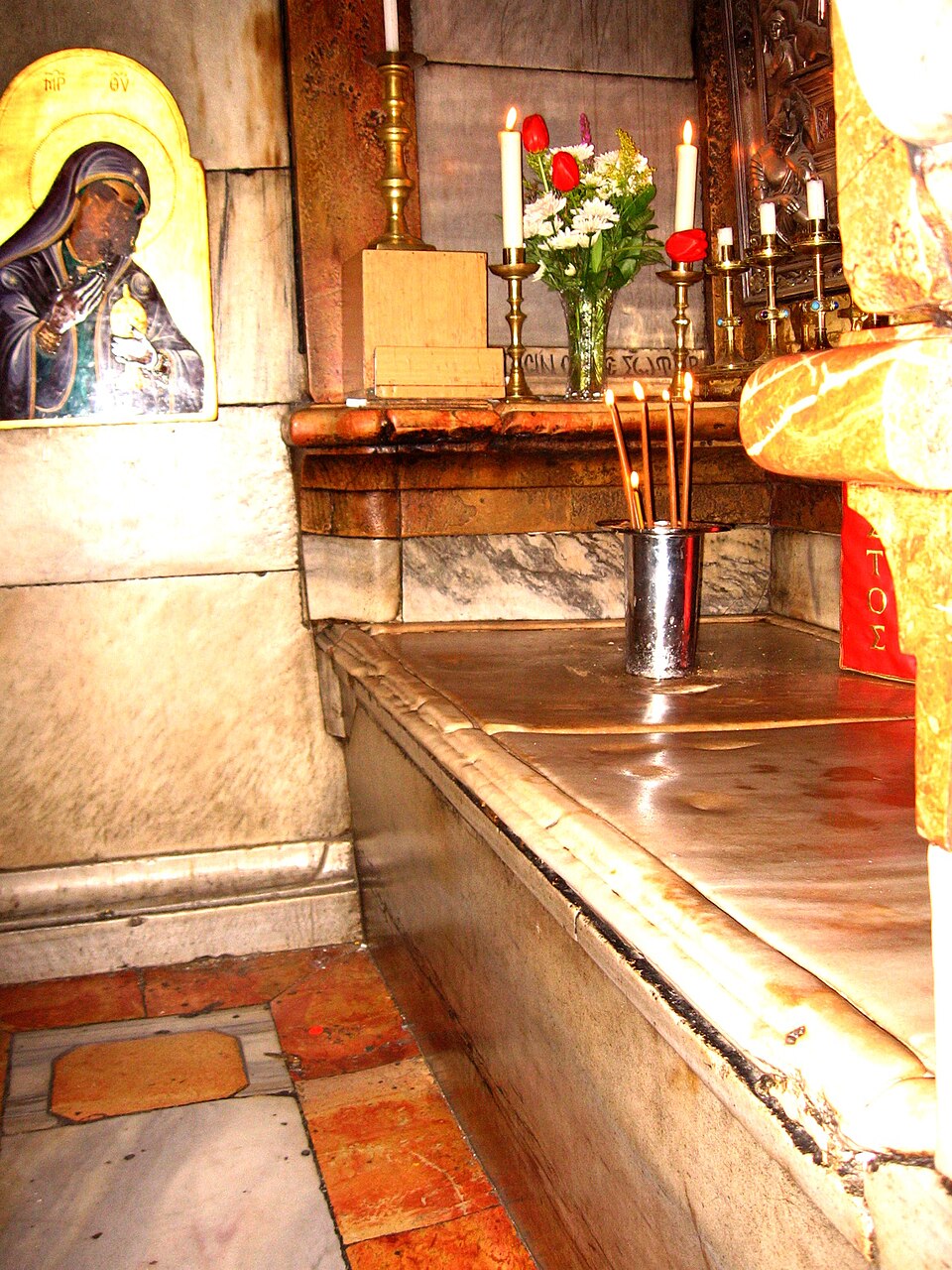
On the right is the burial bed – a smooth marble slab. This is the center of the enormous temple. The place that people searched for, for which they went to their deaths for centuries, around which basilicas were built. It was destroyed, burned, and stubbornly rebuilt again. And yet the very heart of the Christian world is smaller than most parish chapels.
Shell and rock
From the outside, the Aedicule looks entirely different. Its façade is made of warm yellow-pink limestone. Neat columns, cornices, niches with oil lamps, and darkened silver coverings – all of it is crafted with the generous care typically used in the decoration of monumental palaces.
Directly above the chapel rises a rotunda. Its gigantic dome speaks to us in the understandable, universal language of imperial architecture: this is what the center of the earth looks like.
But the dome merely covers the Aedicule. The Aedicule preserves the confined burial chamber. The chamber hides the marble slab. And beneath this slab lies a hidden piece of uneven rock.
.jpeg)
For centuries, grand architecture has built a strict, weighty shell around this point: vaults, colonnades, gold, and marble. But at its very heart there is no portable ark, no precious artifact, and no statue. At its very center there is emptiness.
The decision to hide this stone under heavy marble was made in the sixteenth century. The motive was very simple and practical: it was necessary to protect the ancient rock from the pilgrims themselves, who for centuries had tried to chip off at least a tiny fragment as a memento. The stone became inaccessible, but was preserved thanks to this solid shell.
This gesture – the attempt to preserve what is most precious through concealment – is repeated here from century to century.
As early as the 4th century, Emperor Constantine the Great ordered the cave to be cut away from the rest of the rocky mass and placed in the center of the temple under construction. In the 11th century, when the basilica suffered severe destruction, the Byzantines spent years gathering enormous funds to rebuild piece by piece what remained of the shrine. Later came the Crusaders, who carefully added their own decoration.
When the Ottoman Empire legally established the status quo regime in the church among the Christian denominations, the space was divided down to the millimetre. A crack in the marble would become the subject of long, exhausting negotiations: who exactly it belonged to, and who had the right to restore it.
Waiting for Fire
In the autumn of 2016, a restoration team lifted the main slab for the first time in several centuries. This took place behind tightly closed doors of the church.
Under the upper slab was another one, with a carved cross – probably from the time of the Crusaders. And beneath it, an uneven limestone surface of the rock was revealed. Samples of the mortar between the layers dated back to the mid-4th century. The ancient foundation was exactly where it was expected to be. At the very base of this structure, refined over centuries with meticulous precision, lay simple, rough stone. No hidden artefacts. Only cold rock.
But the emptiness did not become a museum of absence. Once a year, on Holy Saturday, the cramped chamber becomes the focus of colossal spiritual tension.
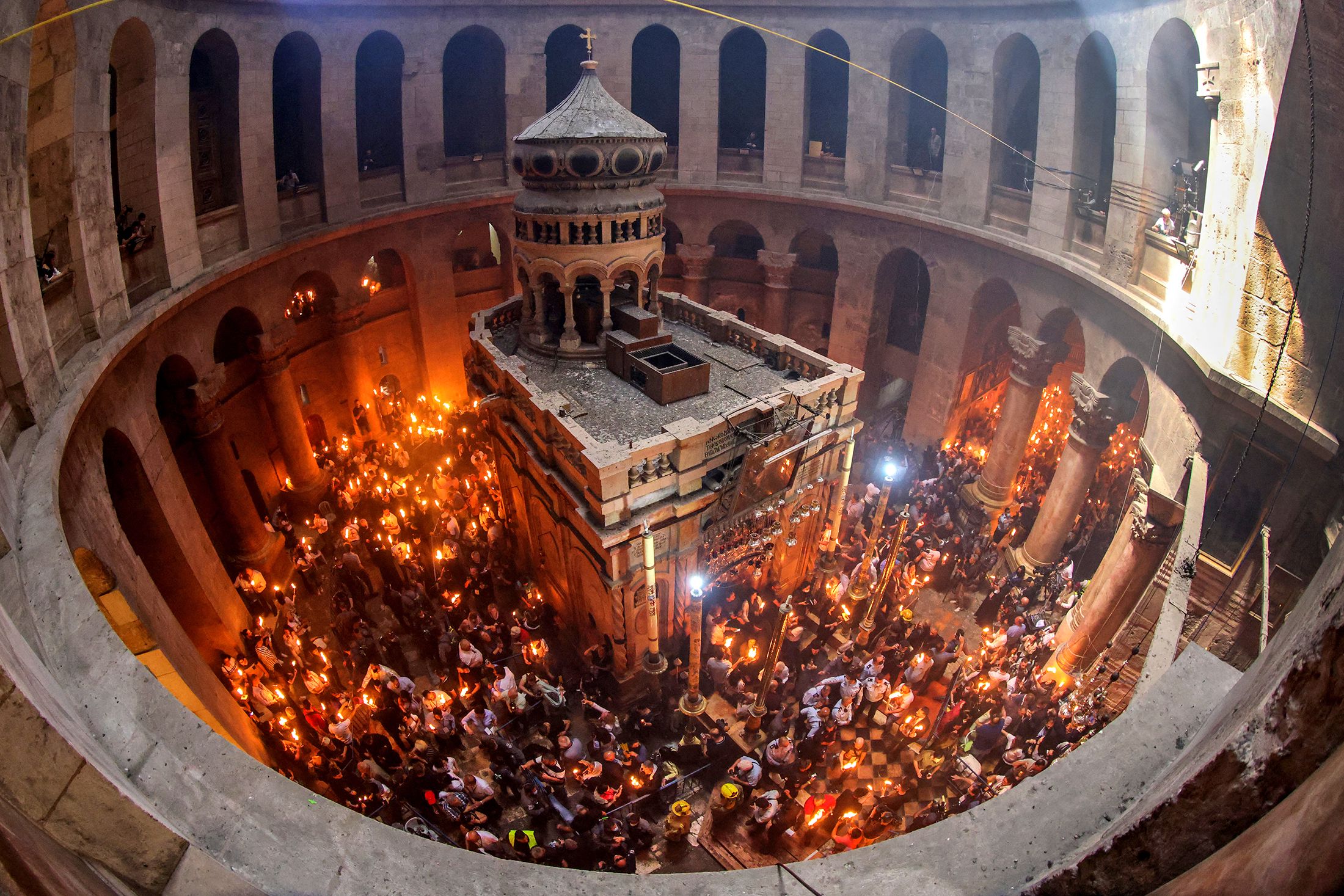
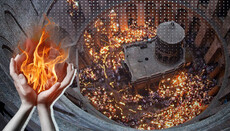
All the lights in the church are extinguished. The thousands-strong crowd falls silent. The Patriarch of Jerusalem enters the Aedicule, and the doors close behind him. In the darkness, by the empty marble slab, a man stands alone before God. The minutes of waiting stretch unbearably long. People weep, pray, and peer into the chapel’s dark openings. And then, in the round windows of the Aedicule, light flares up. The Holy Fire is passed outside, and in an instant the vast church erupts in jubilation and a sea of flame. Thus, emptiness gives birth to light.
"He is risen; He is not here. Behold the place where He was laid," says the angel in white clothing to the bewildered women. He speaks these words as if this were the most important answer to all human fears.
The immense dome, the historical rights of the denominations, scientific restoration work, hours-long queues of weary people, and the held breath on Holy Saturday – all of this exists solely in order to come as close as possible to this answer. The Church of the Resurrection was built not to contain a relic within itself but to bear witness to the miracle of the empty tomb.
When a person reaches this place, they find a space that has remained forever free, because death could not hold it. And the first thing they do, stepping across this threshold, is to bow their head in silence.