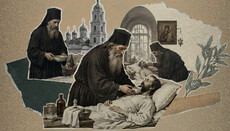

The Bridegroom at midnight: the quiet sound of night alarm
For those of us living in wartime, we know the frightening feeling of waking up in the middle of the night to a sudden sound. This is not the familiar alarm clock ring that you've long been internally prepared for. This is a sharp, frightening jolt through deep sleep. For the first few seconds, you don't understand at all where you are, what day it is, or what's happening. Your heart beats too fast, your body feels heavy, foreign, and completely disobedient.
The first sensation in such moments is always anxiety. The second is timid relief if everything around seems quiet, nothing is flying, no one is screaming, and nothing irreparable has happened. And the third is again a dull tension. Because in this sudden night silence, something has imperceptibly changed, and you understand that it's impossible to sleep any longer.
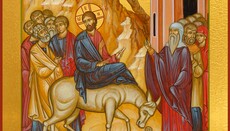
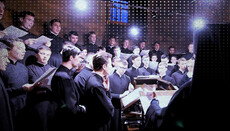
It is precisely to this very understandable experience that the Church turns in the very first days of Holy Week. Behind us is the noisy Palm Sunday, ahead lies the Cross and Golgotha. People come to evening services tired after long working days. At Matins of Great Monday, Tuesday, and Wednesday, the light in the church is almost completely extinguished. Only sparse oil lamps remain burning. In the thick twilight, the choir begins to sing quietly and restrainedly: "Behold, the Bridegroom comes at midnight..."
This is not a solemn festive hymn to which you want to joyfully cross yourself and sing along. This is a stern voice from the darkness that conveys an utterly clear thought: the main encounter of your life can happen right now, at this very minute.
The weight of drooping eyelids
The words in this chant are remarkably precise and hit right the target. "Be not weighed down by sleep" – in Greek this sounds even harsher: "Be not knocked down by sleep." This is not simply a beautiful poetic metaphor about some abstract spiritual laziness. This is a very precise description of how the irresistible weight of sleep literally knocks a person down. You simply don't have the strength to stand straight, hold your back, and look forward. Your eyes close by themselves.
And nearby sounds the word "slumbering." In Church Slavonic, it means a person who is careless and relaxed. One who has allowed himself to become so soft that he has stopped distinguishing what is truly important from daily trifles.
We commonly perceive such words as a routine reproach from the pulpit. But the text speaks of what we are afraid to admit even to ourselves. It describes the state of a person who has grown so strongly together with the comfort, vanity, and habits of this world that they perceive Christ's coming not as long-awaited joy. They feel in this a frightening intrusion into their cozy, long-inhabited darkness.
Sleep here is not simply natural fatigue after a long and difficult day. This is a terrible state when the soul grows deaf, becomes covered with a crust, and the call from outside reaches it as if through thick cotton.
And the only movement you prove capable of is an attempt to hide from this voice, burying yourself deeper in the warm blanket of your everyday life.
Oil that cannot be borrowed
This text is inseparably connected with the Gospel parable of the ten virgins. The Bridegroom was delayed on his journey, and all ten girls fell asleep waiting – both the wise and the foolish. All fell asleep because human nature is weak.
But the difference turned out to be not in who among them slept more soundly or who woke up earlier. The difference was in who had enough oil for their lamps when in the dead of night a loud cry suddenly rang out: "Behold, the Bridegroom comes at midnight, and blessed is the servant whom He shall find watching...." The foolish virgins rushed to ask for oil from their friends, but they refused. Not out of greed, but because there are things that cannot be borrowed from a neighbor: someone else's love, someone else's faith, someone else's hard-won attention to God. While they ran to buy this oil, the door closed.
Saint John Chrysostom many centuries ago said that such spiritual sleep is voluntary darkening. A person himself, step by step, day by day chooses not to notice what is approaching.
Knowledge always requires some kind of response from us. A response always requires effort, action, life change. And any effort prevents us from sleeping peacefully. And we choose sleep again and again.
How footsteps sound in the darkness
Today choirs sing this troparion in different ways, and the Church has preserved many beautiful local chants. But the most recognizable and profound has become the Kyiv chant. Its melody is sung in a low register, without sharp leaps or complex vocal ornamentation. It flows evenly, in a slow, measured tempo.
If you try to imagine this music visually, it is not the light trembling of a candle flame in the wind. This is the slow, inexorable approach of something very large, strong, and real.
According to the liturgical typikon, this troparion should be sung three times in a row. Experienced choirs often sing it this way, although the typikon does not directly require this: the first time they begin singing almost in a whisper, with lips only, as if the sound comes from very far away, from the other end of the street. The second time they sing more fully, louder, and more confidently. And the third time – in full voice, filling the entire altar and the narthex with sound.
The result is not simply a memorized threefold repetition of the same words. The result is a tangible sensation of approaching footsteps. Each time the sound becomes closer, until it is right next to you, demanding an immediate reaction.
The time when we remain alone
The light in the church during this singing is almost completely extinguished. Darkness covers people like a heavy blanket. This is not at all a theatrical production to create the right emotional mood. Thus the church together with us lives through that very night in which the Bridegroom comes. The darkness forces us to feel with our own skin that very confusion and blindness in which the sleeping virgins are caught when there is no time left for preparations.
Why did precisely midnight become the main image of this encounter? Because this is the time of our greatest vulnerability.
During the day, we are protected by our work, conversations, and plans. At night, these defenses are gone. At the same time, night is the only hour that demands the clearest and most uncompromising sobriety from us. The ancient ascetics understood the expectation of the end of the world not only as a global historical event. For them, midnight was the moment when a person remains alone with God.
We do not know for certain who exactly wrote this powerful text. Researchers suggest different names and debate over ancient manuscripts, but have never reached a consensus. Perhaps, that is for the best.
The voice that awakens us in the night and warns of the Bridegroom's coming should not come from a specific person. It sounds like a voice that seems to come from everywhere.
We hear it only once a year, in these three special spring days of Holy Week. The Bridegroom comes not to cruelly punish us, caught off guard in wrinkled clothes. He comes to meet those whom He loves. But this encounter cannot happen if we continue to sleep.
The choir sings the troparion three times, giving us three chances to wake up. And then falls silent.
Silence in a dark church after these words always becomes different. It becomes tense. Something in it has been changed forever. Now we must decide for ourselves: will we close our eyes again, or will we rise to meet the Bridegroom's footsteps?