
A priest with no past stops bloodshed
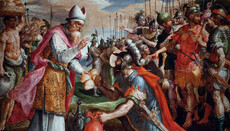
Abraham was returning from a heavy battle when an unknown king came out to meet him – and his bread and wine overturned the logic of human history.
When you walk for a long time through the dried riverbeds of the Judean Desert, you quickly understand why biblical texts speak so much about thirst and shade. The text of Chapter 14 of the Book of Genesis describes a very recognizable, harsh reality of the Middle East.
Abraham and his three hundred and eighteen household members are returning home after a long pursuit. Behind them lies a bloody battle in the valley of Siddim, the defeat of a local coalition of kings, and the rescue of his captured nephew Lot. War always remains dirty and exhausting work, even if you are simply defending your loved ones. Abraham's men are deadly tired. Leather marching straps have rubbed their shoulders raw, heavy bronze blades are covered with a crust of dried sand. The victorious detachment treads heavily on the scorched earth, eager to reach their tents as soon as possible.
And then a local ruler comes out to meet the weary victor. He does not carry chests of silver to buy off the foreign army, nor does he bring out weapons as a sign of submission. In his hands rest warm bread and a cup of wine.
Bread instead of sacrificial blood
The priests of those times sought heaven's favor exclusively through blood. On the stone altars of Canaan they slaughtered calves and rams, because sacrificial killing seemed to people the most understandable way to speak with the deity. Against this background, the appearance of Melchizedek looks completely different. The King of Salem - the city we know today as Jerusalem - brings out a bloodless sacrifice to meet the exhausted detachment.
Scripture records this moment thus: "Then Melchizedek king of Salem brought out bread and wine. He was priest of God Most High" (Gen. 14:18). Centuries later, the holy martyr Cyprian of Carthage would write that in this episode we see a direct prefiguration of the Eucharist. The unknown ruler does on a dusty road what Christ would later perform in the Upper Room of Zion. In the very center of war, among armed men, he creates a place of peace where no one needs to be killed anymore.
A priest with no past
For the Semitic peoples of antiquity, ancestors meant absolutely everything. Your father's name and belonging to a specific tribe replaced passport, recommendations, and social status. A person without lineage was simply an outcast whom anyone could offend with impunity. But Melchizedek emerges from nowhere. The Apostle Paul would later draw attention to this mystery: the king of Salem appears on the pages of Scripture "without father, without mother, without genealogy."
His biography is simply left off-screen. The ruler's personal history completely gives way to his prophetic role. The very name Malki-Tzedek translates literally from Hebrew as "King of Righteousness," and the title of the ruler of Salem is formed from the ancient root "shalom," which means peace. In an era of endless slaughter between neighboring tribes, the Creator preserved His priest. This proves that God never leaves the world without witnesses to truth, even in the darkest times when it seems that there are no believers left around.
The victor lowers his sword
Abraham was a patriarch. He had just defeated a coalition of quite powerful rulers. On his side was real military force, spoils, and unquestionable authority. By the rules of that time, he could dictate terms to any prince he encountered. The victor takes everything, and the defeated pays tribute.
But something happens that no one expected. The patriarch silently gives the unknown priest a tithe from the best spoils. Saint John Chrysostom in his homilies drew attention to this paradox: the lesser is blessed by the greater. Abraham voluntarily bows his head before the cup that is brought out. Military force acknowledges the higher authority of Divine peace. The victor's sword submits to the dignity of sacred bread.
A place of peace amid enmity
Today we too live within an endless battle. The weary soul wanders through the cold valley of modern history. Sometimes it begins to seem that we are gradually getting used to breathing this smoke of mutual hostility.
But the ancient meeting of Abraham with Melchizedek gives comfort to the weary heart. Right in the middle of the nightmare of wartime, there is a place for peace. It is precisely the liturgy that remains that moment when God tells us: stop, leave your aggression at the entrance to the temple. Take bread and wine – the Body and Blood of Christ, and receive communion.
The empires of ancient kings have long since been ground into dry dust. Today, their ambitions interest no one but archaeologists. But the King of Righteousness, who brought a cup to weary men, gave rise to the priesthood that still sustains our world. Psalm 109 sealed this victory over time: "You are a priest forever according to the order of Melchizedek" (Ps. 109:4).
The realization that above all political catastrophes stands the priest of the Most High with bread in his hands dispels panic. True power is not exhausted by weapons and administrative might. Every sword will sooner or later rust in its sheath. But the Chalice of Communion will remain.