
The axe at the root: What the Palm Sunday icon conceals
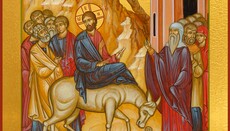
Let us begin not with the central figure of the icon of the Entry of the Lord into Jerusalem. Let us begin with what unfolds at the very bottom.
In the lower corner of the old panel – where the viewer’s eye barely lingers – a boy has raised an axe. He is not cutting branches. He lifts the blade to the very root.
We are accustomed to reading this icon as we have been taught: we look first for Christ, note His seat upon the colt, read the gesture of His blessing hand. But fifteenth-century iconographers sometimes structured the drama differently.
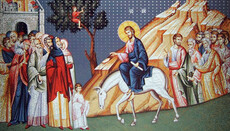
They concealed the key point of meaning precisely where triumph does not look – at the very bottom, beneath the animal’s hooves.
The Orthodox icon speaks not in literal scenes, but in symbols.
Where the garments are cast
The lower tier is a world of its own. Above, the composition unfolds in strict rhythm: the apostles follow Christ at a measured distance, the inhabitants of Jerusalem come out in orderly formation. But below, something altogether different is taking place.
One boy has become entangled in the sleeves of the garment he is trying to pull over his head, unable to free himself from the cloth. In some icons of the Pskov school, this moment is rendered with striking immediacy.
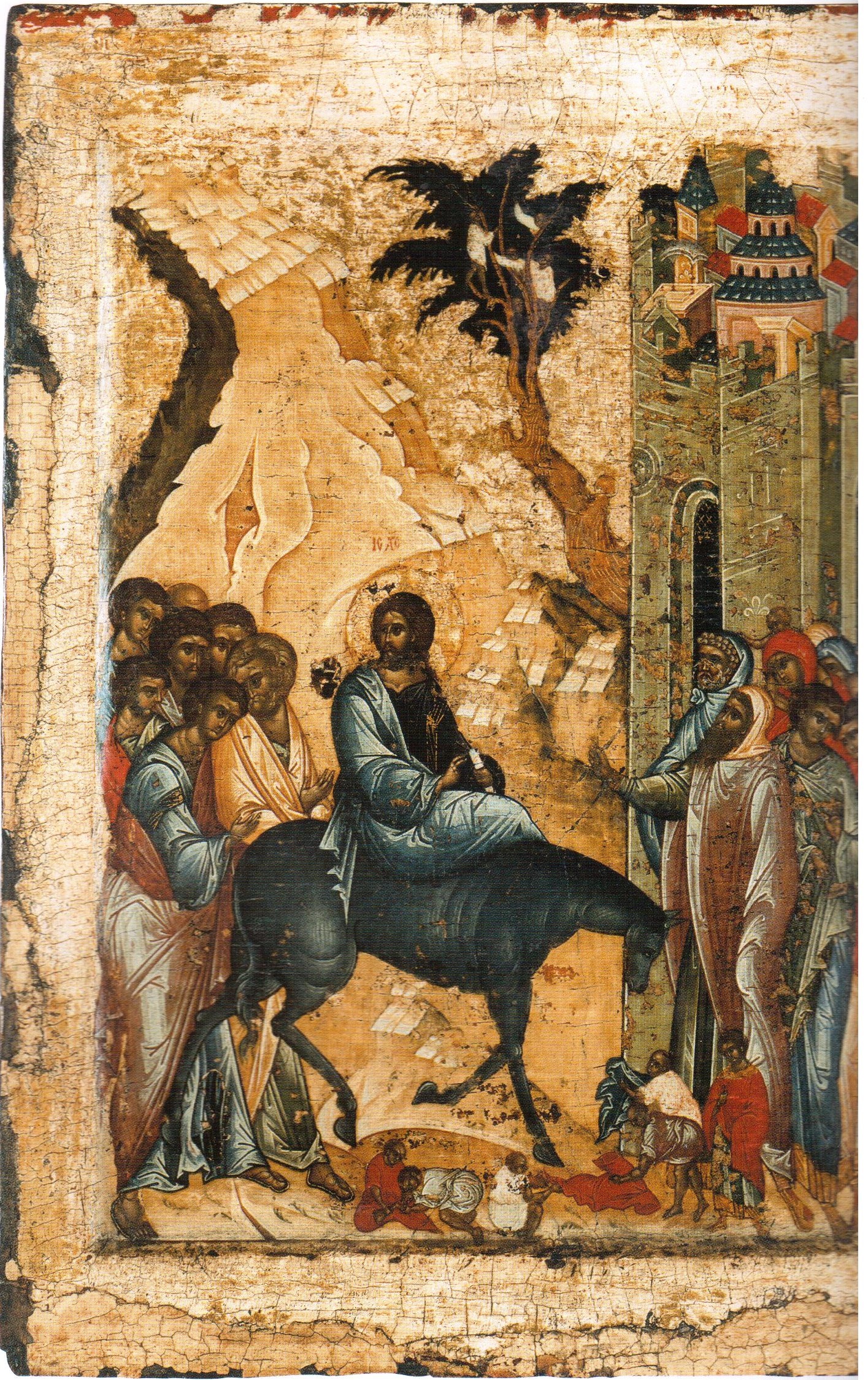
Nearby, another child sits, absorbed in pulling a thorn from his heel. Iconographers of the Novgorod tradition – as seen, for example, in the celebrated double-sided tablet icon of the early fifteenth century from St. Sophia Cathedral in Novgorod – introduced this motif deliberately.
The palm is a rough, thorned tree. One cannot climb it without cost. Contact with holiness leaves marks upon the body. The Gospel does not explicitly place children along the road at this moment – Matthew speaks of them crying out later in the Temple. Yet iconography brings them into the procession as a living commentary.
Children on the icon are the only ones incapable of stillness.
The adults stand frozen in ceremonial poses. The folds of their cloaks fall neatly, their gazes are directed where they ought to be. The children act with their whole bodies, outrunning their own intentions. Before God, they appear in complete, disarming helplessness.
Blessed Theophylact of Ohrid saw in the garments cast before Christ a profound symbol: “They lay down their garments – that is, they subject the flesh to the spirit.” On the icon, the children do this not with understanding, but with their bodies.
“The axe is already at the root of the trees”
But the most unsettling child in this tier is the one with the axe. This motif is not universal; it does not appear on every icon of the feast. Yet in a number of fifteenth-century Novgorod and Pskov variants – and in Athonite frescoes such as those in the katholikon of the Dionysiou Monastery – it is rendered with striking clarity.
If one looks closely at what the boy is doing, unease sets in. He is not cutting a festive branch. He has set the iron at the base of the trunk.
The axe and the thorn are not charming details meant to enliven the scene. They are severe theological signs, read in direct connection with Scripture.
Long before these events, John the Baptist spoke the terrible words: “The ax is already at the root of the trees, and every tree that does not produce good fruit will be cut down and thrown into the fire.” (Matt. 3:10). The iconographer takes this warning and places it – quite literally – into the hands of a child.
Why a child? Because he is free of ceremony. He wears no social mask. He does not conceal his hands. He acts directly, becoming an unwitting bearer of prophecy.
Jerusalem greets the Messiah with cries of “Hosanna!” – yet, as the Fathers note, it expects only a political triumph. The axe at the root exposes the tragedy hidden within the celebration.
The tightness of a closed city
Now lift your gaze to the right edge of the panel. Jerusalem is not depicted as an open, festive city welcoming its guest. It is a heavy, multi-layered mass of stone, pierced by narrow slits like arrow loops. The gates are dark and constricted. The clustering of improbable structures creates a palpable sense of confinement.
This is a fortress on edge.
In some later variants, above the rooftops, a red cloth – a velum – is stretched between the towers. In iconography, the velum typically indicates that an action takes place indoors, beneath a covering. Yet the Entry into Jerusalem unfolds in the open air. Why then suspend a canopy over the sky?
One compelling reading sees in the velum a symbol of the veil of the Temple – the very veil that will be torn in two at the moment of Christ’s death.
The iconographer suspends it above the city in advance, because in the space of the icon, the future is already present within the present.
The Pharisees emerge from the gates without branches in their hands. Their hands are often concealed within heavy folds of cloth. In the visual language of iconography, hidden hands signify a closed heart. Behind Christ, the apostles exchange glances and speak among themselves. As the Evangelist John the Evangelist writes plainly: “At first his disciples did not understand all this. Only after Jesus was glorified did they realize that these things had been written about him and that these things had been done to him.” (John 12:16).
A gaze turned back
And finally, the central figure.
Christ sits sideways upon the colt – both legs hanging to one side. This is not the posture of a Roman conqueror, but of a weary traveler.
In the Palaiologan type, widely adopted in Russian iconography of the fifteenth century – in the circle of Andrei Rublev and Dionisy – He turns back. The Savior looks not toward the city that greets Him ahead, but toward His disciples.
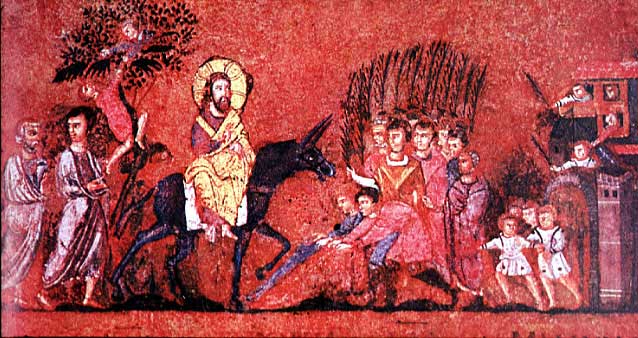
An earlier tradition presents another image. In the miniature of the Homilies of St. Gregory the Theologian (late ninth century, Bibliothèque nationale de France), Christ faces the city – and His face is marked by profound sorrow.
This is the moment described by the Evangelist Luke the Evangelist: “As he approached Jerusalem and saw the city, he wept over it” (Luke 19:41). Iconographers gave different forms to this grief, but its presence never disappears.
Beneath the colt lie crumpled garments. The children with the thorn and the axe remain close to the earth. Above the dark gates hangs the red veil.
The city rejoices, not yet knowing what will unfold in a matter of days.
But the Savior knows.
He looks upon those heavy walls and quietly mourns their fate, seeing already the destruction to come. The icon does not pronounce a final judgment. Instead, it creates a tension – between the mercy of God and the judgment into which man himself steps.