
The Lord’s Entry into Jerusalem: A triumph the empire never noticed
A true imperial triumph means the clash of arms, the gleam of gold, and the scent of power. What took place in Jerusalem on the Sunday before Passover had nothing in common with any of that.
The iron-bound wheels pounding heavily against the basalt paving stones – that was the sound of Rome’s authority. The classic triumph of a conqueror meant a quadriga drawn by snow-white stallions, and a commander in a purple toga, his face thickly smeared with red pigment in imitation of the ancient bronze gods. At the head of the procession, defeated rulers of foreign peoples walked in heavy chains. Behind them marched the legions in perfect step, bearing captured gold. Thick sacrificial smoke and costly incense filled the air. It was the unmistakable, blunt language of empire – the language by which it spoke to the rest of the world, asserting its unquestioned dominion.
Now let us look instead at the dusty road descending from the Mount of Olives. There is no gold here, no formation, no martial splendor. Only white limestone dust, the smell of sweat, sheep’s wool, and an overheated crowd. And cries utterly unlike the measured acclamations offered to a Roman victor. All four Evangelists – Matthew, Mark, Luke, and John – would write of that spring day. The people around Him cried out, “Hosanna!” Interpreters traditionally render this ancient Hebrew word as “save now,” drawing on Psalm 117. But in that moment it sounded less like a festive political slogan than like the desperate plea of ordinary people worn to the breaking point by the burden of life and the yoke of foreign occupation. They were waiting for a deliverer.
A view from the tower
Roman sentries could likely watch that road from the walls of the grim Fortress of Antonia, looming heavily over the Temple courts. The sources preserve no direct account of the garrison’s reaction, but it is not hard to imagine that what they saw put them on alert.
In the hands of the pilgrims, freshly cut palm branches swayed.
In the historical memory of the Jews, this was far from an innocent decorative flourish. It was a potent national symbol of freedom.
According to the chronicles, long before this day, the people had greeted Simon Maccabeus in just the same way – with palm branches in their hands and songs of praise on their lips – after he had driven the Syrian invaders out of Jerusalem.
A vast crowd, an obvious religious fervor, cries announcing the coming of a King – legionaries were trained to recognize such things. To Rome, any gathering of people carrying national symbols smelled of rebellion. Yet the alarm, it seems, never turned into military action. At the center of this spontaneous popular procession there was nothing that resembled the armed uprising empire understood so well.
Another kind of kingship
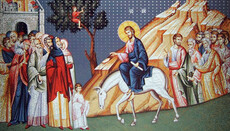
At the very heart of the jubilant procession rode a Man on a young donkey.
In the ancient and Near Eastern world, a warhorse always meant one thing – war. A conqueror entering a subdued city on a battle horse proclaimed his unbreakable strength and his right to violence. But a ruler entering among his people on a peaceful animal proclaimed peace. This was precisely what the prophet Zechariah had foretold five centuries earlier: “Behold, thy King cometh unto thee: He is just, and having salvation; lowly, and riding upon an ass, and upon a colt the foal of an ass” (Zech. 9:9).
This was an utterly different kind of kingship. The Savior was showing that His Kingdom is built not on fear, but on the authority of meekness – an authority that speaks directly to the human heart.
The Evangelist Matthew draws attention to a detail of great importance: the disciples brought not only the colt, but also the mother donkey walking beside it (Matt. 21:2). For the holy fathers of the Church, this was never merely a touch of local color. In this pair of animals they saw a vast prophecy about the destiny of humanity.
St. John Chrysostom and Blessed Theophylact of Bulgaria wrote that the old tethered donkey represented Old Testament Israel, long accustomed to bearing the heavy yoke of the Law. The young colt, untamed and never broken in, represented the Gentile nations. Christ sits precisely upon the young colt. The wild, ungoverned pagan world suddenly and joyfully receives the Savior, and is the first to enter en masse into the early Church He founded. The old donkey simply follows behind in obedience. So too, in the thought of Christian interpreters, the Jewish people will turn to Christ at the sunset of earthly history, following in the steps of the Gentiles who believed before them.
The Evangelists add one more important detail: the colt was young and, as Luke makes clear, “no man ever yet sat” upon it.
In Near Eastern tradition, an animal that had never borne a yoke was reserved either for sacred use or for a king alone.
Here the Gospel leaves us space for a careful act of imagination. Let us picture the visible side of the scene. A young, entirely unbroken animal feels the weight of a man on its back for the first time. Around it roars a massive crowd. Branches and garments are flung beneath its feet. The natural reaction of any animal unaccustomed to the saddle in such a situation would be panic – sudden jolts, wild movements, an attempt to throw off the unfamiliar rider. And yet one can almost see the colt passing through that whole noisy, frightening route with astonishing steadiness and calm, as though submitting to the invisible power of the One seated upon it.
A path made from other people’s poverty
As they moved along, people pulled off their cloaks and threw them beneath His feet. Not luxurious Persian carpets, not expensive fabrics from wealthy markets.
The himation was the heavy outer garment of an ordinary peasant or fisherman, coarsely woven and utterly practical. By day on the road it shielded a man from choking white dust and the burning sun. By night it became the pilgrim’s only warm blanket on the hard ground. For a poor Galilean who had come from afar for the feast, it was the most necessary and irreplaceable thing he owned. Without it, he was left defenseless against the chill of the night.
And yet people, without hesitation, threw their only protection into the dirt of the road.
The purple cloth and incense of a Roman triumph were always paid for out of the bottomless treasury of the state. The “carpet” prepared for Christ was woven from the garments of the poor. It was poverty itself, ready to give God its last possession without calculation, without bargaining, without asking anything in return.
A quiet overthrow of meaning
When this procession reached the city gates, something happened of which the Evangelist Matthew speaks plainly: “And when He was come into Jerusalem, all the city was moved, saying, Who is this?” (Matt. 21:10–11).
The atmosphere was charged to the breaking point. During the feast of Passover, Jerusalem swelled beyond measure. Vast numbers of pilgrims slept under the open sky, and the streets became one immense, humming human encampment. The city trembled with excitement, passing from mouth to mouth the news of Lazarus’s resurrection.
So what did those stationed in the watchtowers – those appointed to guard imperial order – actually see from above? Dirty peasant cloaks in the dust. Common people weeping and shouting for joy. No military insignia, no formation, not a single drawn sword. Just a weary crowd and a meek Man riding on a donkey.
Those soldiers did not even suspect that the King entering Jerusalem was one whose true power was measured not by the number of His legions, but by His willing resolve to go to the Cross.
And this quiet revolution of meaning, which forever changed the fate of the world, remained utterly unread by those who had grown used to looking at reality through the narrow metal slits of a helmet.