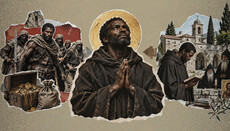

Loneliness on the Threshold of Eternity

We fear old age, hiding wrinkles and pushing away thoughts of infirmity. What did the great saints feel when their bodies began to fade?
We are so afraid of old age that we have learned to cleverly hide it from ourselves. We buy creams, anxiously examine new gray strands in the mirror, wave away the tingling in our hearts, and pretend that eternal youth lies ahead. Illness frightens us more than external catastrophes, because it lays bare our helplessness. It seems that a frail person inevitably loses dignity, falling into bitterness or oblivion.
And when you open the works of ancient authors, you subconsciously expect banal instructions along the lines of: "be patient, brothers, do not grumble, the soul matters more than the perishable shell." We imagine that the great saints were made of a special stone that felt no pain.

But history has preserved quite different testimonies. In the solitude of the Cappadocian estate of Arianzus, at the end of his earthly days, one of the greatest theologians of Christianity wrote far from optimistic verses. Saint Gregory the Theologian left us a document of human decline. Gazing at the yellowed lines of his late poetry, we are mentally transported to his empty cell in the mountains.
An Evening of Sorrow in the Arianzus Exile
Having left the noisy capitals, the pulpits, and the weighty disputes, the saint returned to his native estate of Arianzus. There his health finally abandoned him. Fevers plagued him, his joints ached from the damp, and his strength faded day by day.
In the poetic cycle "Mystical Hymns" he leaves a stunning self-portrait. The saint describes himself without embellishment, looking truth in the eye: "My gray head and wrinkle-covered body have already bowed toward the evening of a sorrowful life." And a little earlier comes a precise formulation: "youth is a fleeting surge; gray hair is the sorrowful sunset of life."
– Your Grace, can it really be that even faith in God's Providence does not save one from the burning sense of loneliness in the twilight of life? – I ask across the centuries.
The saint sighs bitterly, leaning on his wooden staff:
– I have no caring wife to free me from incurable cares... I am not gladdened by dear children, in whose presence old age is heartened and begins to walk again with youthful steps. I am not consoled by kinsmen or friends: some have been taken by cruel death, others... are seized with trembling at the slightest disturbance.
The saint, without pretending to be an unfeeling stoic, says that the absence of family and the loss of loved ones in old age is a heavy, bleeding wound. He mourns his deceased brother Caesarius, suffers from the betrayal of his companions, and bitterly feels the abandonment in an empty house where there is no one to bring him a cup of water.
The Personal Enemy of the Aging Theologian
The most remarkable of his poems from this period is called "On Illness." In it the saint addresses his own ailment as a living being, as a cunning enemy who has burst into his cell.
– Why do you speak so harshly to your pain, Your Grace? Would it not be better to bear it humbly? – I wonder.
The saint frowns sternly, recalling sleepless nights, and once again addresses his ailment:
– You fell upon strong flesh and weakened me from head to foot, loosening the bonds of those humors with which God moistened the dry matter within me... You came with murderous designs and poured upon me, poor wretch, all the venom of your bitter malice.
Illness here seems to acquire the face of an aggressor, with whom one must wage a daily exhausting war. The elder stands alone against the destruction of his own body.
At the same time he frankly calls the flesh a flattering adversary that constantly torments the soul. The body becomes for him a burden that hinders prayer, a source of pain. But it is precisely through this crucible of decay that the saint learns to look at himself without illusions.
Alone with his fading flesh, he poses the existential question that every person has asked themselves at least once: "Who was I? Who am I now? And what shall I become?" And he himself answers it honestly, reflecting during his solitary walks: "I am nothing fixed, but the current of a muddy river, which flows ceaselessly and does not stop for a moment."
Remedies Against Bodily Infirmity
Understanding his own transience and fragility does not lead the saint to despondency. Having grasped the full extent of his helplessness before old age, he develops a strategy of resistance to it. In the poem "Lament over the Sufferings of His Soul," the saint lists six methods of healing that he employed in the wilderness of Arianzus.
– What is one to do when strength fails? – I ask the weary elder.
The saint looks sternly, offering a rigorous ascesis:
– Six methods of healing I employed against the hostile flesh. Even gray hair serves as an aid against my passions. Among them: strict fasting and moderation in food, sleep on bare ground or hard branches, limiting idle words, reducing the flow of impressions through sight and hearing, and above all – unceasing penitential weeping.
Gray hair and bodily infirmity become for him not a reason for self-pity, but an instrument of purification. If the flesh is irreversibly decaying, that destructive energy can be turned to good through voluntary humility.
The experience of Saint Gregory restores hope to us. It turns out that the fear of old age and infirmity is a normal, natural feeling, experienced even by the great pillars of the Church. Saints were not born as unfeeling robots. They too feared loneliness, they too suffered from pain, and they too mourned their departing youth.
But the difference between them and us is that they did not shut themselves off from their fears. They brought them into conversation with God, turning the fading body into an instrument for the salvation of the soul. On the threshold of eternity, the saint leaves a simple parting word: "do not fear the fading of the flesh, for through the decay of the temporal man within you, the eternal man is born."