
The technological trap of the end times
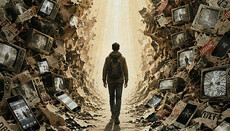
Digital globalization and artificial intelligence algorithms are creating an environment that threatens to alienate humanity completely from God. A reflection on the spiritual challenges of our age.
Throughout Christian history, the world has, in one way or another, gravitated toward an anti-Christian way of life. The pride of rulers and the passions of humanity at large have prevailed over piety and purity. True Christians have always been a little flock, persecuted from both without and within.
What distinguishes our world, however, is globalization. Information now travels almost instantaneously. Something that happens on one side of the earth reaches the other in a matter of seconds. The internet and universal digitalization are gradually bringing all humanity together into a single supranational system. Never before could such a thing even have been imagined.
A global network of human passions
Yes, these technologies are, in themselves, neutral. A microphone transmits a sermon about love just as readily as a call for genocide. Artificial intelligence algorithms can organize theological texts or build flawless systems of total surveillance.
Yet modern digital infrastructure and the media environment possess particular characteristics that make them ideal amplifiers of human passions.
Social media platforms are designed to hold users’ attention at any cost. The most effective triggers are negative emotions – anger, righteous indignation, and fear. Algorithms recommend content that reinforces people’s existing prejudices, creating self-contained information bubbles. As a result, society rapidly fractures into irreconcilable camps whose members are ready to dehumanize their opponents. The younger generation is increasingly being conditioned to think in fragmented, bite-sized pieces, losing the ability to perceive life deeply and meaningfully.
The loss of personal spiritual responsibility
The constant stream of short videos, notifications, and news headlines erodes our capacity for sustained concentration, deep reflection, and quiet prayer. Spiritual life requires silence and inward attention, while the modern media landscape offers an endless race across the surface of things.
Moreover, despite all the benefits AI offers, its emergence inevitably contributes, in one way or another, to the abdication of personal responsibility for our choices and the erosion of critical thinking. As AI systems and algorithmic governance develop, moral decisions are increasingly delegated to software. People grow accustomed to entrusting their choices to an external authority – a recommendation system, a rating, or a smart assistant – gradually losing the habit of personal spiritual discernment.
Whereas many passions were once restrained by physical proximity, the opinions of neighbors, and the institution of the family, the internet now offers the illusion of complete anonymity and impunity – from accessing morally corrupting content to participating in the harassment of someone on the other side of the planet.
Technological progress has not created new sins, but it has removed the old natural barriers and equipped human passions with the means to operate instantly on a global scale.
All these factors, and others like them, will transform the very mentality of human beings, their inner world, which has remained essentially unchanged for centuries. For thousands of years, people passed down their way of life from generation to generation, drawing on the experience of their ancestors.
In the near future, a new type of humanity will emerge, shaped by the synaptic connections that the virtual world creates in our brains. And this process will begin practically from the cradle.
The all-knowing, all-seeing window into the virtual world will become father and mother, teacher and mentor, friend and adviser on every question of life. The continuity of generations will no longer run from father to son, but from screen to screen.
A comfortable world without Christ
The final deception will offer the world not chaos or overt Satanism, but a highly efficient, outwardly humane, comfortable, and seemingly just world without Christ. It will promise to solve all humanity’s external problems: the conquest of disease, the elimination of economic crises and social instability, and absolute digital order and security.
No miracles or supernatural revelations will be able to help such a humanity anymore. As the Revelation of St. John the Theologian tells us, at the end of time, two witnesses of God will appear. They will preach with great power and perform signs, yet their ministry will provoke only hatred, and their murder will become an occasion for universal rejoicing (Rev. 11:3–10).
In essence, this is a repetition of what happened during the Savior’s earthly life when He raised Lazarus, who had been dead for four days. The response to this unmistakable and extraordinary miracle was a decision to kill not only Christ but Lazarus as well.
Once the human heart has chosen comfort, its own righteousness, or an ideology, any evidence of the Truth will be met with irritation and aggression.
The Gospel tells us: “And unless those days were shortened, no flesh would be saved; but for the elect’s sake those days will be shortened” (Matt. 24:22).
The end of humanity’s earthly history
This shortening will come about because the historical environment itself will have exhausted its potential. When society becomes a completely regulated system in which every step is governed by algorithms and every manifestation of sincere, free spiritual life meets fierce resistance from the system, the continuation of history will lose its meaning.
History is the space granted to humanity for freely determining its relationship with God.
When the conditions for this freedom are destroyed, whether through an absolute choice of evil or absolute systemic determinism, the historical process approaches its end.
History is moving toward its ultimate limit, but the central question of eschatology is not one of dates or external circumstances. It is a question of what our hearts will be like when eternity touches time.