
The Theologian's Exhaustion from Capital Intrigues
We often think that burnout is a disease of our hectic age, born of deadlines and constant stress. It seems to us that people of past eras possessed some kind of iron shield against despondency. Especially when it came to church work, to defending the faith, to the lofty ministry of a bishop...
We look at icons, at magnificent temples, at the books of the Fathers — and we imagine monolithic heroes who never doubted, never wept at night from hurt, and never wanted to abandon everything halfway through.
But open the pages of church history — and you see Saint Gregory the Theologian — a man who desperately fled from human malice.
Heated Disputes about God
In the spring of the late 370s, the capital of the Byzantine Empire was heated to the extreme. Saint Gregory of Nyssa caustically noted that on the streets, markets, and crossroads, every former day laborer had suddenly fancied himself a professor of theology, while servants who had fled from slavery were instructing passersby on the incomprehensibility of the Divine Being. Everyone argues. Everyone denounces one another. And into this boiling cauldron of ideological warfare arrives a frail man from the provinces, to lead a small community.
All the major churches of the city were under the control of the opposition. Bishop Gregory had no cathedral with gilded domes. He began his ministry in an ordinary living room at a relative's villa, converted into a house church. This tiny chamber he named "Anastasia," hoping that here the crushed Orthodox faith would begin to rise.
But his hopes crumbled in the very first year. On Holy Saturday, a crowd of opponents burst into the church in the middle of the Sacrament of Baptism. Monks and enraged townspeople hurled stones at the bishop. He was led through the streets to the local authorities like a criminal. Physical danger hung in the air every day.
A Triumph Resembling the Taking of a City
Time passed. The situation changed, Emperor Theodosius took the side of the Orthodox, and the day came when Saint Gregory was led with honor into the magnificent Hagia Sophia. The streets filled with an immense crowd. Soldiers stood in rows, holding back the press of people.
How did the bishop himself describe this moment of triumph in his autobiographical poem? He compared the solemn procession to the taking of a city by an enemy. The crowd roared, the streets resembled a besieged bastion. Even at the moment of supreme recognition, when the emperor personally handed him the keys to the enormous cathedral, the pastor's soul knew no peace. Everywhere there was commotion, tears, and cries. The air was so charged with tension that it seemed peace would never come here.
This inner anguish reached its peak at the Second Ecumenical Council. Intrigues behind his back, the ambitions of delegates, constant behind-the-scenes reproaches, and attempts to remove him from his see finally broke the universal teacher.
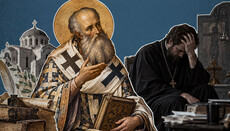
We transport ourselves in our minds to him — weary, gaunt, stooped under the weight of the episcopal omophorion.
— Your Eminence, — we address him, quietly approaching during a recess in the Council sessions, — was it really impossible to endure for the sake of the common cause? The emperor is on your side, the people rejoice, victory stands behind you. Why abandon everything at the peak of glory?
The saint raises a weary gaze, in which there is nothing but endless pain.
— What glory... — he replies. — Do you think the episcopal throne is a consolation? I was brought here not for prayer, but to be torn apart. Those around me speak of the Trinity, but in people's eyes I see only a thirst for power. Every bishop pulls the blanket toward himself, divides sees, weaves webs. I came to save the faith from heresy, and I fell into a web of human malice. Did Christ go to the cross for this?
— But you were the president of the Council... You could have restored order.
— Order? — the saint smiles bitterly. — At the Council I was accused of violating ancient canons, as though I had arbitrarily transferred from one see to another. The very same people who yesterday cried "hosanna" today demand my expulsion. I am tired of proving the obvious. I did not rejoice when I ascended the throne, and now I descend from it of my own free will.
"I Bow to Councils from Afar"
In June 381, Bishop Gregory delivers his farewell address before the fathers of the Council. It is the text of a man who voluntarily lays down the heavy burden of power. He tells the assembled bishops that the question of his person is secondary. He asks only one thing: to remember his humble labors for the sake of the Holy Trinity.
He departed. He returned to his native Nazianzus, and then withdrew to the quiet estate of Arianzus. He never again attended noisy church gatherings.
In letters to friends he drops a remarkable phrase: "I bow to councils and conferences from afar, ever since I experienced much that was evil." This was his conscious drawing of boundaries for the sake of self-preservation.
There, far from the capital's noise, in silence and infirmity, he writes theological works and a detailed autobiography. It turns out that flight from ecclesiastical bustle was not a defeat, but the only way to remain faithful to Christ without losing love along the way. We are often afraid to admit to ourselves that we are tired of endless struggle. It seems to us that leaving a post or withdrawing from a dispute means showing weakness. But sometimes the highest expression of wisdom lies in departing in time to a place where one can finally hear the voice of God, no longer drowned out by the cries of the crowd.