
Nativity in hell: Why God was born not in a palace but in a manger
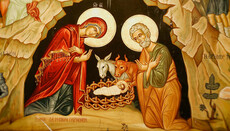
We are accustomed to a comforting fairy tale, yet God was born in dirt and cold. How to find light when surrounded by darkness and death? This is a feast not for the well-fed but for those who are struggling to survive.
We have become so accustomed to the kind, bright tale of a "sweet" Christmas that we have completely forgotten about the dirt of the manger, the mortal fatigue of the Virgin Mary, the poverty, cold, and hunger of the Holy Family. I do not aim to shatter the candy-coated cliché of the Christmas Nativity scene. Life holds so much darkness and evil, and we long so deeply for light and goodness, that we are willing, for their sake, to forget the Gospel truth of the Nativity story. But today I feel the need to break a different cliché.
As soon as Christianity became the state religion, it immediately began to create the image of the One God in the likeness of pagan gods. Today, in every church, you can find an icon of Christ Pantocrator. The Savior is seated on a throne in bright red garments, with a crown on His head and a scepter in His hands.
Such an icon is not copied from Christ but from a Byzantine emperor. This was done so that people would believe: the emperor is a reflection of God on earth. To please the basileus, the clergy erased from our memory the first images of Christ, painted in the pre-Nicene catacombs.
The image of the humble Good Shepherd and the meek Lamb was replaced by the splendid golden and purple garments of the Pantocrator, taken from the imperial wardrobe.
The imperial church adapted the image of Christ from Savior to punisher to please secular power. God must be fearsome – it is easier to manipulate the human flock that way.
The meeting of two abysses
The Christmas feast is the best occasion to dispel this misconception and remember the true Gospel image of Christ. The Infinite, Almighty, All-Powerful God limits Himself to the size of an infant, completely dependent on the warmth of a mother's arms and the reliability of a manger.
God enters history through the back door, like the last beggar: without personal guards, without gold, and without influential servants. Salvation begins not with the suppression of evil by force but with extreme openness and defenselessness. On Christmas night, the great God becomes an infant so that we stop fearing His greatness and learn to love His simplicity.
And if He became small, then not a single "small" detail of our life is devoid of meaning. Our quiet sighs, unnoticed good deeds, and small victories over ourselves become the space where the meeting with Eternity occurs.
Christmas is not just the birthday of Jesus. It is the moment when Infinity fell in love with our finiteness. It is the day when God became "one of us" so that we could become "like Him". It is not a religion of rules; it is a religion of the meeting of two abysses – the abyss of Divine love and the abyss of human need.
The philosophy of small magnitudes
From the moment of Christmas, time ceased to be a cemetery of hopes and became a field for eternity. Matter ceases to be a "prison of the soul". It becomes sacred. Now every atom of the Universe potentially carries God within it because God Himself became an atom, a cell, and a body. The world "became pregnant" with God.
Now He can be seen in everything: in a piece of bread on the table, in the glow of the sunset, in the cat that falls on its back for you to pet it, in the smell of an apple, in a mug of cold water on a hot afternoon. His love lives in everything and everywhere.
The Logos, who created all this, lies silently in the manger. In His silence is a deep mystery. We want to find God in high words, complex philosophy, or deep theology, but He awaits us in the simplicity and silence of the reality of this world.
Christmas teaches us the philosophy of small magnitudes. Humanity seeks salvation in great reforms, powerful technologies, or global ideas. But God comes as something extremely small, defenseless, and quiet.
The light of Tabor through the bars
After Christmas, there is nothing "meaningless". Any trifle – the smell of fir branches, the light of a lantern on wet snow, the sound of rain on a windowpane – can become a place of meeting with God. God can now be found even where He supposedly cannot be.
Father Pavel Florensky, in his letters from the Solovetsky camp, awaiting execution, wrote to his children about the beauty of seaweed, the structure of ice crystals, about how beautiful God's world is even through the prison bars. His Christmas took place in the camp hell, but he saw the "light of Tabor" in matter. He did not curse the flesh that suffered from the cold; he praised it as a miracle of God's creation. This is the view of a person for whom Christmas is the sanctification of all reality, entirely.
The stubbornness of the spirit
In German concentration camps, the time of Christmas was the peak of suicides. People killed themselves out of longing for home and light. But Viktor Frankl noticed that those who found "inner Christmas" survived. They understood: The light shines in the darkness, and the darkness (in the form of barbed wire and camp dogs) cannot overcome it. If God was born in a manger, then He is present in the barrack.
In the concentration camp, Viktor Frankl discovered what he later called "the stubbornness of the spirit".
He noticed: those who survived found within themselves a certain "holy place", a point of peace and meaning that the overseers could not destroy.
The infant in the manger was found by those in whom the light kindled – a light that “darkness could not overcome”. When all that is external is stripped away, only one thing remains: your own true self, united with God. This is the place of eternal life amid the darkness of hell.
Atoms of goodness
Today we live in a large concentration camp, where we are also systematically killed. And we celebrate this Christmas amidst the hell of war. It is important for us to survive not only (and perhaps not even so much) physically, but spiritually. And survival is possible only by believing that the Infant Christ is stronger than Herod, even if He now seems infinitely small and vulnerable. That Truth and Love are stronger than death, lies, and violence.
Strength is found where we stop waiting for a "great miracle" from outside and begin to become a small miracle for a neighbor.
Purchased food for a poor person, a call to a lonely old man, a kind word to someone in despair – these "atoms" of goodness form armor that no shells can penetrate. We cannot stop the rockets, but we can comfort those nearby. And at this moment, "the stubbornness of the spirit" turns into real strength, which proves to be stronger than concrete.
The most difficult "small magnitude" is to maintain the ability to compassion and love when the world demands only hatred from you. To hold within that very "holy place" that Frankl wrote about is the daily birth of Christ in your soul. When a person shares their last blanket in a shelter, they repeat the gesture of the shepherds and wise men. This "small deed" saves not only the body but also humanity.
The art of small steps
Tolkien wrote "The Lord of the Rings" after going through the trenches of the First World War. There is a poignant moment when Sam in Mordor sees a small star among the clouds. He understands: The Shadow is only a temporary phenomenon, and the Light is eternal and unreachable for it. This "small magnitude" (a point of light in the sky) gives him the strength to move on.
Antoine de Saint-Exupéry, a pilot who fought in the Second World War, wrote a prayer that today sounds like a manifesto: "Lord, I do not ask for miracles, but for the strength of each day. Teach me the art of small steps." This is the path of the wise men to Christ.
Finding Christmas in hell means believing that the Infant (Life) is more important than Herod (Death).
This is not passive waiting but active "stubbornness": "You can destroy my home, you can kill me and my entire family, but you cannot make me hate. You can turn off the light by destroying power plants, but you cannot extinguish the candle that burns in my heart."
Yes, it is extremely hard. It requires immense courage. But Christ’s Nativity teaches us precisely that there are no easy paths to God. We can reach Him only by the very same way that He came to us. There is no other way. But it is on this path, in our "smallness" and fragile determination to remain human despite everything and against all odds, that God is born within us.