
Betrothed to God: Two Catherines, two fates, one faith
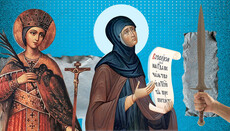
On December 7 the Church commemorates the Great-Martyr Catherine. But for Ukraine this date carries a double meaning: on this very day was born another ascetic – Venerable Eutropia of Kherson.
In the Church calendar there are no accidental coincidences. Dates are spiritual coordinates, points where earthly time intersects with Eternity. On this Sunday we customarily lift our prayers to the “wise bride of Christ” – Catherine of Alexandria. Yet by God’s Providence this very day also became the beginning of the earthly journey of another striver, almost our contemporary, whose relics now rest in long-suffering Kherson – Venerable Eutropia.
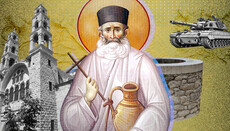
Between them lie fifteen centuries and an abyss of historical circumstances. One shone with beauty and brilliance in the capital of the ancient world; the other bore her cross meekly in the dusty steppe of Tavria during the years of godless persecution. But if we look more attentively into their lives, we will see not the divergence of biographies, but the unity of spiritual disposition. This is a story of two women who understood the essential truth: fidelity to God is worth more than life itself.
The sacrifice of the mind: When human wisdom bows before Truth
To understand the feat of Mother Eutropia, we must first look to the one whose name she received at Baptism.
Saint Catherine the Great-Martyr revealed how human intellect bows before divine Truth.
A young aristocrat who mastered Homer and Plato, who excelled in rhetoric and healing, undertook an act incomprehensible to the pragmatic world.
With every opportunity to shine at the imperial court, she chose the scaffold. Why? Because her enlightened mind awakened: pagan idols are dead, but Christ is living. Her famous disputation with fifty of the empire’s most learned men was not merely a contest of eloquence – it was a testimony that true learning does not contradict faith but inevitably leads to it when a person is possessed by the search for truth.
The Apostle Paul wrote: “The wisdom of this world is foolishness with God” (1 Cor. 3:19).
Catherine revealed the reverse movement: wisdom cleansed of pride becomes a path to the knowledge of God.
On icons we often see a ring upon her finger – the symbol of her mystical betrothal to Christ, the Bridegroom of the soul. She refused earthly suitors not out of disdain for marriage, but because her heart had already tasted another, higher love. And this “gene of fidelity” would, across centuries, blossom in a simple peasant girl born on Kherson soil.
From Catherine to Eutropia: The metamorphosis of confession
On November 24 (December 7, new style) 1863, in the village of Bila Krynytsia, in the pious family of Leonty and Agafia Isaenkov, a daughter was born. They named her Catherine – in honor of the saint commemorated that day. She grew up more serious than her years: while other children played, she prayed. At twelve – the age when children barely begin to understand themselves – she made a choice worthy of a mature ascetic: she left for the Aleshky women’s community, the future Dormition Monastery, as a novice.
There, in the quiet of prayer, her soul was forged. At monastic tonsure she received the name Eutropia, meaning “well-disposed,” “well-turned to God.” But her peaceful monastic life did not last long. In 1917 the storm broke: revolution, civil war, and the beginning of dreadful persecution of the Church. The monastery was closed and destroyed; the sisters dispersed.
And in that moment her true “bloodless martyrdom” began.
Whereas Catherine of Alexandria suffered beneath the sword of pagans, the nun Eutropia took upon herself a long feat of holy foolishness and wandering in a state that had declared war on God.
She settled in Kindiyka, a suburb of Kherson. Her dwelling scarcely resembled a home – more a poor, temporary hut. Yet there, like pilgrims to a living spring, people began to stream. In years when faith meant execution, when the very name of God was being purged from national memory, Mother Eutropia feared nothing. She wore heavy iron chains beneath her tattered clothing. This voluntary ascetic burden, borne for Christ, was her hidden answer to the outward bondage of the Soviet regime.
A log for a pillow: Asceticism as testimony
The life of Venerable Eutropia is filled with details that astonish the modern person accustomed to comfort. Witnesses recalled: the mother had no bed. She slept sitting on a little stool, resting her head on a wooden block – a simple log. In this position she passed her short hours of rest – for decades.
“Mother, it must be unbearably hard!” visitors would lament. “One must endure,” the elder would reply with a quiet smile.
In that “endure” there was no dark hopelessness. On the contrary, Eutropia radiated Paschal joy. She possessed the gift of clairvoyance, which she used to comfort and guide souls.
During the war, women whose husbands were at the front came to her. To one she silently handed a piece of bread – and the husband returned alive. To another she gave a handful of earth or a splinter of wood – and soon a death notice arrived. She knew the will of God, but revealed it with tenderness, preparing the human heart for the unavoidable.
A special miracle is tied to her repose. Mother foretold that when she would be buried, “everything will be blooming.” She passed to the Lord in 1968 at the age of 105. Her spiritual children remembered: despite the sorrow of farewell, the air was filled with fragrance, and their hearts with a strange, unexplainable peace. It was as if they were not burying a person but escorting an angel home.
The relevance of holiness
Why is it so important to recall this today?
We live in difficult times. The land once walked by Venerable Eutropia’s bare feet is now torn by shells. Kherson endures terrible trials. And today the witness of these two saints becomes for us not merely edifying history but a spiritual lifeline.
Saint Catherine of Alexandria teaches us not to betray Truth for the sake of momentary safety or illusionary advantage. She reveals that faith always leads to God, while unbelief – no matter how scientific its costume – is always poverty of mind.
Venerable Eutropia gives us an image of inner strength amid sorrow. She lived in an age of ruin, famine, and terror, yet preserved holiness within. Her chains and wooden log testify that outward circumstances hold no power over a Christian’s freedom.
One may dwell in a palace and be enslaved to passions, or live in a hut and converse with the Mother of God.
Today the relics of Venerable Eutropia rest in the Nativity-of-the-Mother-of-God Church in Kindiyka. And, as Kherson’s faithful testify, prayer before her shrine brings wondrous consolation. She is our own, our near saint – one who knows what pain is, what it means to lose one’s home, what war is. She passed through all this and did not break.
Binding together the memory of the Alexandrian Great-Martyr and the Kherson ascetic, we behold the continuity of holiness. The flame of faith ignited in ancient Egypt burned anew in the Tavria steppe centuries later. And our task is to keep that flame alive, no matter what storms rage outside our windows.