
Triumph of Orthodoxy – why this feast belongs to artists
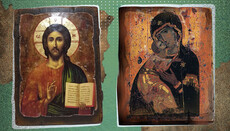
There is a small icon in the British Museum – just thirty-seven centimeters high. It is from this modest board that one should begin speaking about what happened in March 843.
There is an icon from the late fourteenth century, painted in a Constantinopolitan workshop and now kept in London, in the British Museum. Its dimensions are modest – thirty-seven centimeters in height, thirty-one in width. Yet one must look at it for a long time, because it is an icon about an icon – and in this strange recursion lies the entire meaning of the feast.
At the center of the upper register the Mother of God stands enthroned – the Hodegetria, the Guide. Two angels in crimson court garments steady her on either side. To her left stand Empress Theodora and her young son, Michael III. To her right – Patriarch Methodius, Bishop Theodore, and two monks. And below, in the lower register, there are eleven saints. At the far left is the martyr Theodosia, holding a small image of Christ Emmanuel. Tradition says it was she who once stopped soldiers from tearing down the bronze icon of the Savior from the gates of Constantinople – and she was killed for it. Beneath the great icon of the Mother of God stand Saint Theophanes the Confessor and Saint Theodore the Studite, holding together an image of Christ.
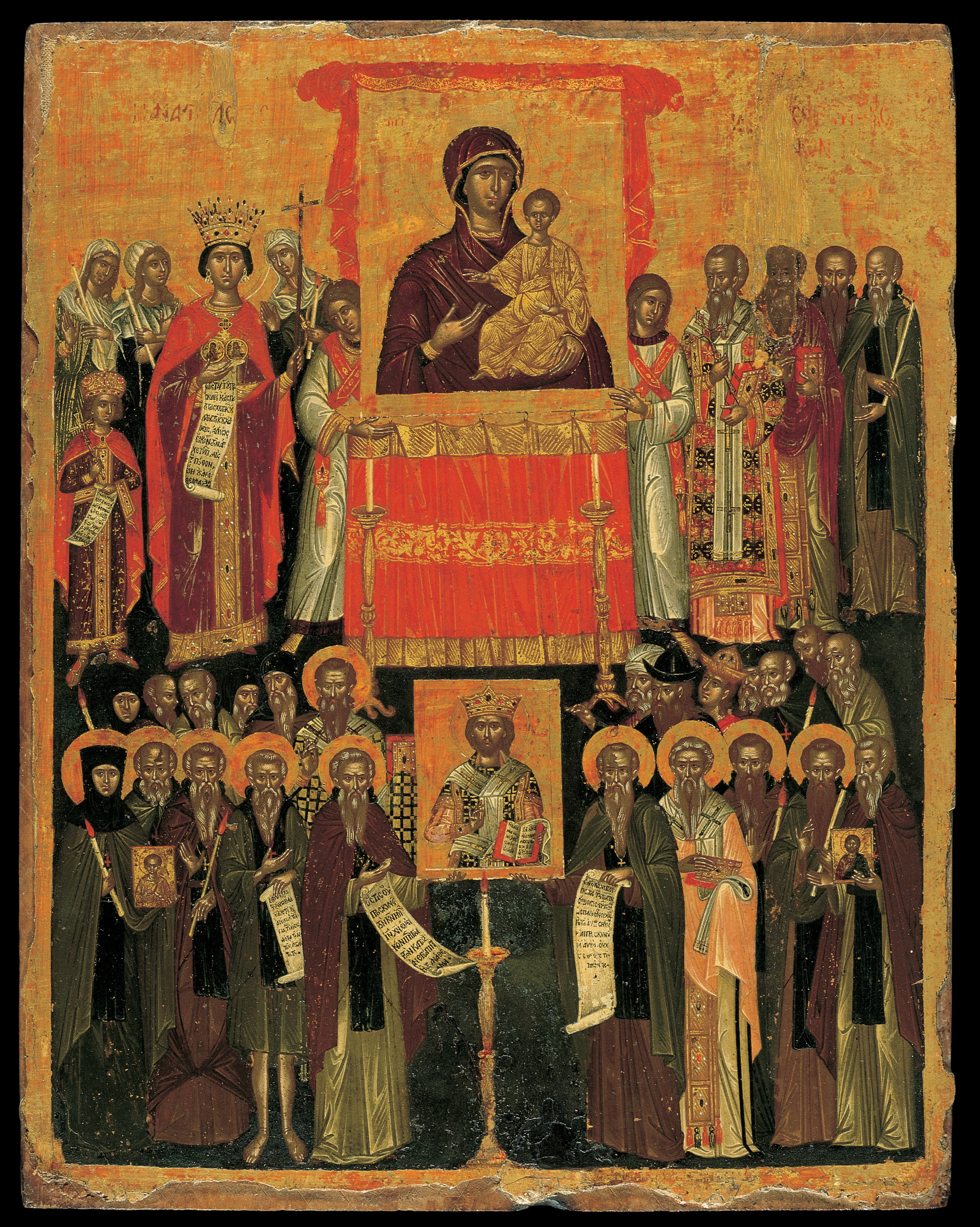
In truth, the whole story is here, on one small piece of wood. The living and the dead, the victors and the martyrs – all gathered into a single space, around a single image. The gold background has dimmed with time and old restoration, but the message is still legible: this is what the long war ended with – the war for the right to paint the Face of God.
What happened in 843
On the first Sunday of Great Lent in 843, Empress Theodora and Patriarch Methodius led a procession to Hagia Sophia, and Constantinople filled again with singing it had not heard for more than a century. Icons returned to the churches. Those imprisoned for keeping holy images were released from their cells, restored to their ranks and duties. Iconoclasts were made to vacate their posts.
We call this the Triumph of Orthodoxy, and we celebrate it every year on the first Sunday of Great Lent – not on a fixed calendar date, but at the very threshold of the Lenten road.
This matters: the feast of freedom stands at the doorway of repentance.
Behind that triumph lie a century and a half of struggle that was not merely theological debate. To keep an icon could cost you your life. Theodosia, whom we see on the London icon, died precisely in this way. The brothers Theophanes and Theodore, also pictured below, were arrested under Emperor Theophilus. Condemning inscriptions were burned into their faces with red-hot iron – and so they were called “the Branded.”
What the fight was about: fear of matter
The iconoclasts appealed to an instinct that had lived in the Christian world for a long time and sounded persuasive to many: God is infinite and immaterial, and to trap Him in paint on wood is to demean Him. This was not merely imperial whim. It was a serious theological position, fed by a very old source – an ancient fear of matter inherited from the Gnostics: spirit is light, matter is a prison.
The Church’s answer was exact and irreversible: God became Man. If the Creator truly took on human flesh, then flesh is vindicated. Then wood and pigment can carry within themselves something greater than wood and pigment. Saint John of Damascus, writing from the monastery of Mar Saba during the height of persecution, formulated this with such clarity that his words entered history: “I do not worship matter, but I worship the Creator of matter, who became matter for my sake, who willed to dwell in matter and through matter worked my salvation.”
And this was not merely a theological victory.
From 843 onward every iconographer is not a craftsman producing wall ornament, but a witness to the Incarnation.
Every stroke of his brush testifies: Christ was a real Man, with a real face – a face that can and must be painted.
How an icon works: a view from outside
Let us return to the London icon and look again, differently. Notice how space is built. In Western Renaissance painting, lines converge toward a vanishing point somewhere inside the picture, beyond an imagined horizon. The viewer’s gaze is drawn inward, into depth.
In the icon everything is arranged the other way around. Here the lines do not converge within the board – they open outward as they recede. The vanishing point is outside the icon, in the eyes of the one who looks. Priest Pavel Florensky, in his work Reverse Perspective, explained it this way: the icon itself looks at the human being, making him the center of the space. The world of the icon does not retreat from us – it comes toward us, inviting us not to watch from the side, but to enter.
There are no shadows in the icon. The light does not fall from above or from the side – it rises from within faces and objects, because it is the uncreated light of Tabor, which has no external source. The gold background is not display, not decoration.
In Byzantine aesthetics, gold is the symbol of divine energy permeating all that exists – and that is why it was not replaced with blue sky or green earth.
Now look at the board itself – at what any icon is made from. The wooden base is the plant world. The gesso ground of chalk and fish glue is the animal world. Egg tempera and mineral pigments are the mineral world. The icon gathers every level of creation into itself and brings it to God, transfigured. This is not accidental technique. It is theology embodied in matter.
The face as proof
In the iconographic canon, the eyes are always slightly larger than in nature, the forehead higher, the features thinner and more severe. This is not ignorance of anatomy, and not mere stylization for beauty. The iconographer shows a person already freed from passions – a person in his “heavenly rank,” as he was intended before the Fall and as he is called to become.
The iconoclasts feared “limiting” God by depicting Him. But the Church replied: a Person has a face.
If we cannot paint Christ, then He did not truly become Man. The Seventh Ecumenical Council, which affirmed the veneration of icons, proclaimed that the human eye is worthy to see, already here on earth, through matter, a glimmer of the light of Tabor.
Fasting as work with matter
The Triumph of Orthodoxy stands at the beginning of Great Lent – and this is no accidental neighborhood. The meaning of ascetic labor is not to kill the flesh for the sake of killing it. Fasting is work with matter. The same work an iconographer performs.
The ground beneath a painting must be even and clean – otherwise paint will blister and peel. Fasting prepares such a ground inside us. In ascetic struggle, the body becomes like gesso before painting: we scrape away excess, level what is uneven, remove whatever catches the light on itself and refuses to let it pass beyond. We do not destroy the flesh – we make it transparent to the grace of God.