
Lenten spring or arid hell: what Zosima’s duel with Ferapont teaches us
Why Father Ferapont’s rusks smell of pride, while Elder Zosima’s cherry preserves smell of love. Reading Dostoevsky in the middle of Lent.
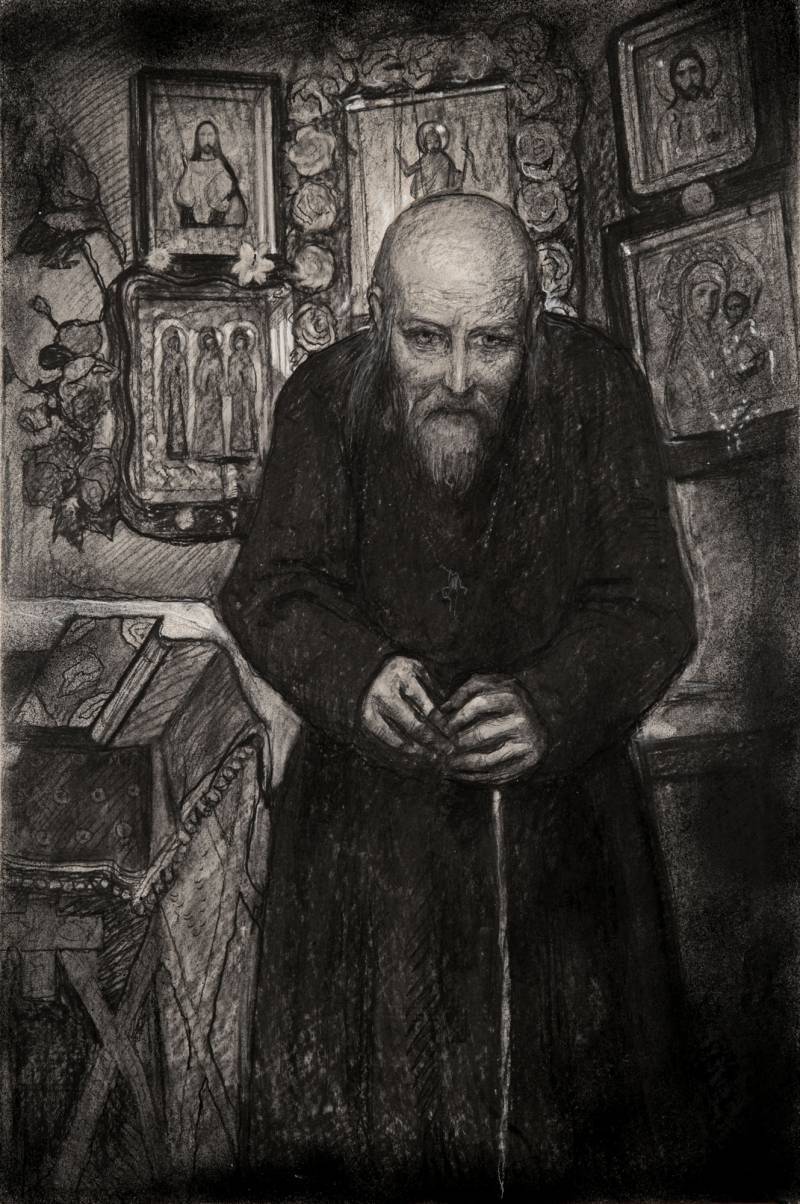
In Ilya Glazunov’s illustration for The Brothers Karamazov, Elder Zosima is shown in his cell – amid the flicker of oil lamps before the icons, in a soft light that seems to pour down from somewhere above and wrap itself around him. We look at this drawing, done in black chalk and pastel, and think: this is what spiritual joy in God looks like when it no longer needs words.
But there is another image that Dostoevsky deliberately does not allow us to examine too closely. Father Ferapont bursts into the novel abruptly, like the sound of a door slamming shut. We scarcely see his face – only the bones overgrown with hair, a wild stare, the clank of chains, and his triumphant cry at the coffin of the deceased Elder Zosima. These two never speak to one another. They live in the same monastery, yet are as far apart as two poles, and between them runs one of the novel’s deepest nerves. By the end of the second week of Great Lent, when fatigue has already done its work, that nerve begins to ache in us as well.
Two cells: from light into shadow
We step first into Zosima’s world. His cell is a small wooden one-story cottage, filled with flowers brought by grateful visitors. On the table stands a glass of tea and a little dish of cherry preserves. This detail, familiar to every reader of The Brothers Karamazov, scandalized zealots without understanding even in the earliest editions: how could it be? An elder – and indulging in sweets? But Dostoevsky introduces the detail deliberately. After Zosima’s death, it is precisely this that resurfaces in the talk of his accusers: “He was not strict in fasting, allowed himself sweets, ate cherry jam with tea – loved it very much – ladies used to send it to him.”
For them, this is proof of gluttony. For us, looking at the scene differently, Zosima’s preserves are a sign of hospitality and of a holiness that does not terrify.
Yes, he sinned in his youth. He remembers his duel, the insult he dealt his orderly, and how long a road it was from that insult to repentance. That is why his holiness is compassionate: it knows where sin comes from – and does not frighten others with excessive severity.
Now let us go the other way, toward Father Ferapont – through the woods, to the gloomy hut at the edge of the monastery. There are no flowers here. Only wooden boards instead of a bed and a stone instead of a pillow. Bread, water, a handful of dried forest mushrooms – and nothing else but chains that rattle with every movement. Ferapont sleeps on the floor like a warrior before battle, yet strangely enough, his battle never ends in victory. It demands ever more enemies. And he finds them everywhere – in the monks, in the abbot, in the very air of the monastery, which Ferapont imagines teeming with demons.
For him, spiritual life is not labor over his own heart. It is war against external monsters, in which the enemy never runs out.
Looking at these two cells, you realize that before us stand not merely two monks with different habits. Before us are two ways of meeting God.
Dried mushrooms and a dried-out heart
In ascetic theology there is the concept of prelest – spiritual delusion, the self-deception in which a person mistakes his own malice for zeal for God. It is precisely this condition that Dostoevsky depicts in the figure of Father Ferapont. His fasting has turned into an end in itself, into a system of proofs of his own exceptional status. When the body is exhausted to the limit but the spirit has not been purified by love, pride enters the void that opens up – and it is more terrible than any demon Ferapont thinks he is trapping in doorways.
Ferapont loves no one. Zosima’s joy irritates him. It infuriates him that people are drawn to the “weak” elder, while from the “strong” Ferapont there blows the chill of the grave.
The stricter his fast becomes, the less love there is in him, and the more counters of sin he keeps – who ate how much, who broke the rule, who is worthy and who is not.
Saint John Chrysostom warned of this with complete directness: “Do you fast? Then flee greed, robbery, strife, and soul-destroying envy.” Not “flee sins in general,” but precisely these ones – because beneath the mask of abstinence they hide with particular cunning. One can refrain from meat and still “devour” one’s neighbor with a glance. One can make prostrations to the ground and still look down on everyone else.
Somewhere around the middle of the second week of Lent, this begins to happen to us as well. Our eyes involuntarily fix on the sausage on someone else’s plate. Irritation rises against those who are “fasting incorrectly” – too lightly, too cheerfully. We do not recognize Ferapont in ourselves because he is too grotesque. But the little Ferapont – there he is, alive and quietly sucking the air out of the heart.
An icon on gesso
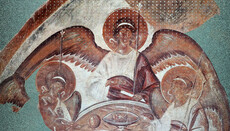
Fasting is often compared to a diet, a training regimen, or even a medical procedure. But there is a more accurate image in Dostoevsky, though not a direct one. An icon is painted on a wooden panel coated with levkas – a special chalk ground that must be perfectly white, without stains or cracks. Only then do the colors lie properly, and through the layers of ochre and azure the Face begins to appear.
Our body in fasting is that gesso ground. We cleanse it not so that it may become rigid and dead, like a dried-out chalk board, but so that it may no longer hinder the image of God from appearing within us.
For all his ascetic rigor, Father Ferapont is like a badly primed panel: its surface is dry and hard, the paints do not hold, and the Face cannot be seen. Elder Zosima is the panel on which the icon has already been painted. In his face, as Dostoevsky says, there is something that makes people want to live and to change.
The difference between them lies not in how much they have eaten, but in the direction of the will’s effort. One emaciates the body in order to exalt himself above others. The other limits himself in order to make room within himself for love toward others.
That is the true meaning of fasting – not to subdue appetite, but to enlarge the heart.
Have we begun to pity people in their weakness? Do we feel the desire to embrace the world, as Elder Zosima called us to do? Has it become easier for those at home to breathe beside us while we are fasting? If instead there is irritation, condemnation, a desire to bark at our neighbors, then the fast is not working. It is merely bodily exhaustion draped in quotations.
The scandal at the coffin
The climax comes after Zosima’s death. Everyone was expecting a miracle – incorruption, an immediate sign. But the elder’s body began to give off the odor of decay, a “corrupting smell.” For medicine, this is normal. For fanatics, it is catastrophe. It is as though God Himself allowed it in order to separate those who love magic and “wonders” from those who love God.
The scene in which Father Ferapont bursts into the cell of the reposed elder with the triumphant cry, “It stinks!” is one of the most horrifying in Dostoevsky. In Ferapont’s exultation is everything we have already seen in his mushrooms, his chains, his tally of other people’s sins. He is happy, because he has received proof that he was right. The “radiant elder” has turned out to be a “sinner.”
A little earlier, through the lips of Elder Zosima, Dostoevsky utters perhaps the most important thing he ever said about the nature of hell: “What is hell? The suffering of being unable to love any longer.”
Ferapont voluntarily chose that hell while still alive, replacing God with the rulebook, and love with chains.
The earth beneath Alyosha’s cheek
After the scandal at the coffin, Alyosha Karamazov leaves the monastery. He is shaken not by the elder’s death, but by Ferapont’s triumph, by the cold breath that swept over those who had come to bid farewell to their beloved teacher. And then Alyosha falls to the ground and kisses it, weeping with love.
We look at this scene as at a final examination. Zosima had said, “Love to throw yourself upon the earth and kiss it.” Alyosha did not merely hear those words – now, for the first time, he lives them, truly, through tears and the smell of soil. He forgave Zosima the “odor of corruption,” because beyond that smell he saw eternity. He conquered the Ferapont within himself by that collapse to his knees.
This is what we are moving toward in these weeks of Lent. Not toward eating less and praying more by schedule. But toward the moment when one day – perhaps unexpectedly, even to ourselves – we fall face down upon the earth out of love.
Zosima taught that this is precisely what paradise is: “Do not weep, life is paradise, and we are all in paradise, but we do not want to know it.” Ferapont spent his whole life building himself a hell – with chains and with the guilt of others. Which of these two ways of thinking will we choose in the end?