
DESS draws parallels between liquidation of UGCC and present day
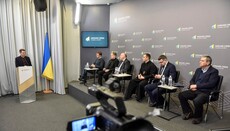
An event in Kyiv marked the 80th anniversary of the Lviv Council, at which a decision was taken to dissolve the Ukrainian Greek Catholic Church.
The Ukrainian Greek Catholic Church (UGCC) was the focus of a public discussion titled “The UGCC in the Crosshairs of Russian Imperial Policy: From the Lviv Pseudo-Council to Modern-Day Bans.” The event took place at the Ukrainian Crisis Media Center in Kyiv, according to the website of the State Service of Ukraine for Ethnopolitics and Freedom of Conscience (DESS).
Participants included officials from DESS, representatives of the Security Service of Ukraine (SBU), the head of the Ukrainian Institute of National Memory, and clergy of the UGCC.
Viktor Voinalovych, First Deputy Head of DESS, said that Russia’s current rhetoric repeats arguments used by the Stalinist regime in its plan to liquidate the UGCC after World War II.
“At that time, they also spoke about ‘agents of the Vatican,’ a ‘threat to the state,’ and ‘support for the Ukrainian national movement.’ Today we hear the same accusations. In effect, directed at each other – almost like a carbon copy,” he said.
The DESS official did not comment on whether similar accusations are currently being made by Ukrainian authorities against the Ukrainian Orthodox Church (UOC).
According to Voinalovych, “we are witnessing bans on Church activity, the confiscation of religious buildings and property, and the deprivation of the right to conduct religious services.”
“In the 1940s, the Church effectively faced a stark choice without compromise: either to become an instrument of the Soviet regime or to remain unconquered while fully aware of the consequences. The UGCC chose the second path. After its ban in 1946, it developed a unique experience of preservation – underground, in the catacombs, through the transmission of tradition, formation, episcopal ordinations, and continuity of ministry despite pressure,” Voinalovych said.