
A broken vessel: How Judas became the mirror of our spiritual bookkeeping
The traitor’s argument always sounds persuasive. When someone calls to “give it to the poor,” most of us instinctively agree. So where is the trap hidden in that flawless logic?
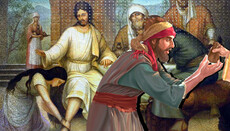
The alabaster vessel is broken with a sudden, violent snap. In the stillness of a room where travel-worn people are sitting together, that sharp crack must have sounded almost frightening. In Mark’s Gospel, the Greek verb συντρίβω means precisely “to shatter” – to break off the fragile neck, not simply to remove a stopper with care.
And after that abrupt gesture, everything becomes irrevocable. The entire perfume is poured out at once. Nothing can be saved for later, and the empty, shattered vessel can no longer be sold to anyone.
The thick, sweet, spicy fragrance of precious nard instantly fills the cramped house of Simon in Bethany. The disciples exchange bewildered glances, unsure how to respond to such apparent extravagance.

The voice of reason from the corner of the room
The first to speak is the man accustomed to counting other people’s money. Judas Iscariot – the official keeper of the apostles’ common purse. The one responsible for the material needs of their small community.
His exact words are these: “Why was not this ointment sold for three hundred denarii, and given to the poor?” (John 12:5). And the force of that sentence lands squarely on target, sobering everyone present.
The Evangelist John would later add a bitter remark: Judas said this not because he truly cared for the poor, but because he was a thief and kept the money box. But in that moment, in that room, his real motives were hidden from the others.
Three hundred denarii was an astronomical sum for poor Galilean fishermen. It was a full year’s wages for an ordinary day laborer – a man bending his back from dawn to dusk beneath the burning sun.
The trap into which we all fall
Judas was not exaggerating the scale of the financial loss. Before his eyes, a fortune had just been poured over the Teacher’s hair and dusty feet – enough for a family to live on in modest security for years.
The strangest – and most terrifying – thing about this scene is that the treasurer merely gave voice to the thought already stirring in many minds.
The same episode appears in Matthew, who says bluntly: “When His disciples saw it, they had indignation” (Matt. 26:8).
Judas’s logic seemed entirely reasonable to the other apostles. Entirely correct. And here lies the deeply familiar inner snare into which we tumble almost every day. We, too, so often assume that a useful action must always matter more than a beautiful but seemingly useless gesture.
It is as though we are standing in that same crowded room, inwardly nodding our approval to the treasurer. Would it not be more sensible to feed a crowd of hungry people than to pour out a treasure beyond price?
The bookkeeping of betrayal
The apostles had seen great miracles with their own eyes. They had absorbed every word of the Sermon on the Mount. And yet their frame of reference was still calibrated by earthly arithmetic. The woman’s exalted act struck them as wasteful, even foolish.
Judas was sincerely outraged by the loss of three hundred denarii. Yet only a few days later, this same man would slip into the night and coldly sell his Teacher to the chief priests. The price of that bargain is known throughout the world – thirty pieces of silver.
Historically, these were Tyrian staters, or shekels. In approximate Roman terms, that amounts to about one hundred and twenty denarii – the wages of roughly four months of hard labor. In other words, two and a half times less than the cost of the perfume Judas had found so painfully extravagant.
The price of damaged property
In the Book of Exodus, thirty shekels of silver is the fixed compensation prescribed by law for a slave accidentally gored to death by another man’s ox.
It is a humiliating sum – the kind paid not for a living person, but as reimbursement for damaged property. In the end, Judas valued the life of his Teacher at less than the perfume poured out upon Him.
This was not the impulsive frenzy of a madman. It was the cold, consistent logic of a man whose mind had been fitted with scales forever. A man accustomed to measuring, controlling, calculating everything.
That is why the Church reads this Gospel passage during Holy Week, on Great Wednesday. On that day, the faithful remember how the sincere repentance of a woman who gave everything collided with the calculating spirit of a disciple preparing betrayal – and that stark contrast sets the tone for the final days before the Crucifixion. The liturgical text pits two poles of the human soul against each other. The harlot spends all she has on Christ and receives eternal forgiveness. The chosen disciple haggles over a handful of coins and loses his own life forever.
The verdict of Great Lent
Metropolitan Anthony of Sourozh saw in this episode a perfect spiritual diagnosis. “Judas was a practical man; he knew how to count, he knew what things cost. And when he saw that the woman had broken the alabaster vessel... a storm of indignation rose within him,” the bishop said in his sermon for Great Wednesday. Not crude envy – but what seemed to be righteous, practical outrage from a man who knew the value of money.
Metropolitan Anthony names the problem with uncomfortable directness: “Do we not reason this way constantly? Do we not say, ‘Why this waste of time? Why these services that go on for hours?’”
Righteous anger in place of love
“Why spend so much strength on God,” the preacher asks, “when it could be given to people instead?”
And we forget a simple but terrible truth: if we do not give God our very best, without reserve, then what we offer to people will be something pitifully thin.
Ourselves – and nothing more. But our own little “self” is too small to save anyone.
King David once uttered those great words: “Neither will I offer... burnt offerings unto the Lord my God of that which doth cost me nothing” (2 Samuel 24:24). A sacrifice that costs you nothing, one that has been carefully budgeted and prudently minimized, ceases to be a sacrifice at all.
A person incapable of giving something to God recklessly, without counting the cost, will in the end prove incapable of truly loving his neighbor. Strict social charity without any movement toward Heaven always turns us into Judas, distributing imaginary thousands to the poor.
The extravagance of a true gift
Outwardly, it can all look like noble concern for the needy. But at the first convenient moment, such a calculating mind will just as easily hand over the Teacher for a third of the real price.
“Love does not calculate. Love does not seek its own. Love weighs nothing. It only gives – and therein is its joy, and therein its fullness,” Metropolitan Anthony continues.
The woman in Bethany may not even have known the exact market value of her nard. And if she did know, that is perhaps why she broke the fragile alabaster neck with such force – so that no road of retreat would remain.
The Evangelists show no interest whatsoever in where this immense treasure came from. Did she save it over long decades? Receive it from her parents as an inheritance? Keep it as a dowry for a wedding that never came to pass?
What remains after us
When Christ says, “Wheresoever this gospel shall be preached in the whole world, there shall also this, that this woman hath done, be told for a memorial of her,” He settles forever the argument about human usefulness and efficiency.
This is His direct answer to every rhetoric of cold calculation.
What endures in the memory of ages is not a flawlessly balanced ledger, not coins carefully saved, not prudent investments in social projects.
What remains is the broken alabaster vessel and the heavy fragrance of perfume. What remains is true love – love unafraid to look foolish, untimely, irrational in the eyes of respectable society.
A personal challenge to the conscience
Judas never lived to spend his honestly earned thirty pieces of silver – neither on the poor nor on himself. In mute despair, he hurled them onto the cold stone floor of the Temple and vanished forever into the darkness of the night.
And we, reading these lines today, seem still to be standing in that same cramped room in Bethany. The sweet scent of precious nard still hangs in the stale air.
The woman who gave all she had has already slipped quietly out the door. The treasurer has already calculated the imagined losses in his mind and made his fatal choice. Now the turn has come to us.
Are we ready to break our own vessel and give up what is most precious – or will we go on carefully weighing love on the scales, slowly preparing an excuse for our compromise?