
Why only one out of ten survives: the grim statistics of gratitude

An analysis of the Gospel drama about leprosy. On why faith is a leap beyond common sense and why the "sons of the kingdom" risk ending up in darkness.
The reading about the healing of the ten lepers is heard every time a thanksgiving service is held. We hear this reading this Sunday as well. On the surface, it seems to be about etiquette: "Children, be polite, don't forget to say 'thank you' to God." In reality, there are much deeper meanings present here.
This passage is a map of our soul.
It depicts the tragic drama of the relationship between the Gift and the Source, between "being" and "having."

The biology of decay: when the soul loses sensitivity
The ten lepers stand afar, not daring to approach Christ. They are afflicted with leprosy. Leprosy is a striking disease. A person dies alive, yet feels no pain. The cause is a unique microorganism – Mycobacterium leprae. It is the only bacterium in the world that can penetrate nerve tissue. The bacteria physically destroy the "insulation" of the nerves, so the pain signal simply does not reach the brain.
We, too, are afflicted with the leprosy of the soul. And this is not a symbolic image. We are being dehumanized, becoming demon-like, yet we feel no pain.
The lepers stood at a considerable distance from Christ. This is not about physical distance, but about the ontological gulf between us and God, between the creature and the Creator. The first thing a person begins to feel when turning their face to God is their otherness, their darkness against His bottomless Light. The lepers address Christ with the Jesus Prayer. The first practitioners of this prayer were the lepers and the blind. It is not a request to be immersed in the stillness and passionlessness of hesychia. It is the cry of a soul living in the final stage of despair.
When one's strength is already at its end and there is no other hope. Christ responds to this request very strangely. He does not heal the lepers immediately, as He usually did. Christ says, "Go, show yourselves to the priest." This was done by lepers when the last signs of the disease had already disappeared. But they are still sick!
The leap of faith: against common sense
Here is a very important lesson: God requires us to move against the obvious. The Danish philosopher Kierkegaard called this the "leap of faith".
From the point of view of formal logic, Christianity is absurd. No matter how much one tries to dress it in some scientific guise, it has nothing in common with worldly logic or common sense: from the doctrine of the Trinity to the expectation of the resurrection of the dead. A Christian believes not because someone proved the truth of these propositions to him, but because he was able to leap over common sense, following the inner intuition of the spiritual heart.
The life of the father of believers, Abraham, consists of such leaps. Was it not absurd to leave his homeland, to believe an old man with an old wife that he would have descendants as numerous as the sand of the sea, to raise a knife to sacrifice his only son?
In such a leap, there is always the fear of uncertainty. No one will understand or approve of your choice. From the point of view of public opinion, you are a madman.
Abraham looked exactly like that. Faith is an intimate, inexpressible state. In this leap, there is no evidence: if you had evidence, you would not need faith. You would simply know. A leap is only possible where there is doubt.
We are in this leap every time during the liturgy. We see ourselves as mortal, sinful, inept, and graceless. We see that we are covered from head to toe with spiritual leprosy, yet we thank God with the words of the Eucharistic canon.
We thank Him for "not abandoning all things, until You raised us to heaven and granted us Your future Kingdom." We thank Him for the purity, innocence, and joy of eternal life that we have already received. Like the lepers, a miracle must happen to us on the way. Grace is not static; it is dynamic. God enters into synergy with the effort of a person who makes his way along the path of faith, not knowledge.
The tragedy of consumption: God as a function
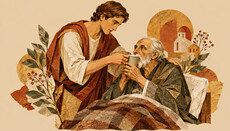
Ten people received healing. The skin is cleansed. Joy, euphoria - it happened! They act according to protocol: they run to the priests to get permission for normal social life. What is their tragedy? They accepted the Gift but rejected the Giver. For them, God was just a tool. A function. "Heavenly emergency service." As soon as the problem is solved, God becomes unnecessary. This is how nine out of ten act!
We pray in danger, in illness, and in fear. But when we receive what we asked for, we dissolve into the horizontal of being.
Sometimes we even steal from God, appropriating what actually belongs to Him. We say, "This is my success, I did this, this is my achievement." Nine out of ten celebrate the triumph of being in the world over being in God. Nine out of ten choose biology (health) over ontology (salvation). This is the statistic.
The paradox of salvation: why the stranger became one of us
Another important point: one returned, and he was a heretic, a Samaritan. Here we can note that Christ repeatedly places heretics and outsiders above His co-religionists, although He affirms the truth of the Jewish faith. "Salvation is from the Jews," He says at the well. But to whom does He say this? To a Samaritan woman.
In the parable of the Good Samaritan, Christ for some reason decided to set an example of a non-believer, not a pious Jew. To the Roman centurion, He says that He has not found such faith among His compatriots. And then comes a terrifying prophecy: "Many will come from the east and west and will sit with Abraham, Isaac, and Jacob in the Kingdom of Heaven; but the sons of the kingdom will be cast out into outer darkness: there will be weeping and gnashing of teeth."
We think that we, the Orthodox, are the ones who will come from the east and west. And therefore we are sure that everyone else, except us, is destined for the fiery Gehenna because they "believe incorrectly". I have heard this more than once from people who call themselves Orthodox theologians. But the Jews thought the same way.
I also have no doubt that salvation is from Orthodoxy. I have no doubt that the Truth is in the Orthodox Church.
But let it not happen that the "sons of the kingdom," who are destined for the fiery Gehenna, turn out to be those who "know for sure" who and where will spend eternity. Who despise everyone else just because they have a monopoly on the truth.
I urge you not to forget one obvious thing that runs like a red thread through the entire Bible: the "logic" of God is paradoxical. It cannot be calculated or predicted. Therefore, it is better to be cautious in your judgments so as not to make a mistake, God forbid. The price of a mistake can be too high.
Leave healthy or stay saved?
The Samaritan returned to Christ because he understood: healing is not just a medical fact. It is a flow of uncreated energy emanating from that Stranger who told them "go".
Instead of fulfilling the letter of the law, the Samaritan fulfills the law of love. He returns to Christ to perform the Eucharist (translated from Greek - "thanksgiving").
And God accepts this Eucharist. Because he is the only one of the ten who understood: the meaning is not in the Gift itself, but in touching the hand of the Giver through the gift. And God, in the person of Christ, accepting this gift from the Samaritan, weeps for the truly believing who turned away from Him: "Were not ten cleansed? But where are the nine?" This is God's lament over loneliness. God gives Himself away, and in return receives the backs of departing people. And only to one does He say: "Your faith has saved you."
Nine are healthy. But only one is saved. This is a terrifying statistic. What is the gift of healing? It is merely a postponement of death. The body will die anyway.
Salvation is union with Eternity, something that will never pass.
Out of ten, one received salvation, and he was a heretic. Terrifying statistics and a frightening prophecy for all of us. The Samaritan carried with him not just clean skin, but Christ Himself in his heart. He became a temple. The other nine remained merely "biological units", content with their comfort.
Practice: How to stop the moment
How can we apply this theology to our lives? The nine lepers acted on autopilot (‘received – ran’). The Samaritan stopped. When something good happens in your life – the pain disappears, joy comes, a problem is resolved; or simply when you suddenly realize that the world you live in is so beautiful – pause. Physically stop. Don’t rush to "use" it. Don’t hurry to claim it for yourself. Take a deep breath of gratitude. Realize: "This is not a coincidence. This is a touch." Turn your inner gaze from the Gift (from the event) to the Source. Say: "Lord, I see You behind this event. Thank You."
Even pain can become a prayer.
It is easy to give thanks when you are healed. It is hard to give thanks when the "leprosy" is still upon you. But if we can take our greatest problem, the one pressing on us right now, and try to see in it not punishment, but the "scalpel of the Surgeon", everything changes. Say: "I stand at a distance, like these lepers. But I believe that You see me. I thank You even for this darkness, for in it I seek Your light with a force I would never have sought it in comfort." This turns pain into prayer.
The Samaritan saw God in the Man Jesus. We must learn to see God in the essence of being. Look at your hand, at a glass of water, at the face of a loved one. Think: this might not have existed. I might not have existed. The darkness of non-being is my normal state. That this exists, and that I exist, is a moment-by-moment miracle, sustained by God’s energy.
Hold this thought in your mind for at least five minutes. Watch – your world will begin to glow from within. Understand: God is not seeking our politeness. He does not need our "thank-you" as checkmarks in a report. He longs for a Meeting with us. But for that, at the very least, we need to stop turning our back on Him.