
From Nativity scenes to pole dancing: Is Europe abandoning Christ?
The official policy of many European countries aims to oust Christ from the public space. But millions of ordinary Europeans perceive this as a betrayal.
Christmas in Europe has long become an indicator of a spiritual divide. On the one hand, there are attempts by authorities and opinion leaders to "reconsider" Christianity in such a way that almost nothing of Christ remains in it. On the other hand, there is resistance from ordinary believers defending their right to faith. So what is happening to Europe? Let's turn to the facts.
When a Nativity scene becomes a scandal
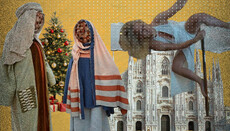
At the end of November, an unusual Christmas Nativity scene was installed in the central square of Brussels. The Virgin Mary and Joseph were depicted as faceless figures made from recycled fabrics, with mosaics instead of faces. The authors explained that they wanted to to provide "an inclusive mix of all skin tones" and create a maximally universal image. It should be noted that a huge number of believers disagreed with such an "interpretation" of the Gospel events, comparing the figures to "zombies" and calling the installation primitive and provocative.
An even stranger case occurred in Stuttgart. During a Christmas mass in the Catholic Church of Saint Mary, the Christ Child was portrayed by an adult man. He was wrapped in rice paper and some slimy membrane, placed on straw, and illuminated with red light. The man barely moved and breathed heavily. The entire event was broadcast on German television.
At the same time, in December, an event called "Decolonization of Christmas" was planned in Berlin. The goal was a critical rethinking of Christmas traditions.
Pole dancing and Dracula
All of the above is only a small part of the deliberate and systematic de-Christianization that has been taking place in recent times. Thus, in many European cities the name of Christ has been removed from holiday inscriptions. This applies not only to countries with a Catholic majority, but also to states where Orthodoxy prevails (for example, Greece). People are no longer greeted with “Merry Christmas,” but instead with “Happy New Year and Christmas holidays.” The impression is created that someone is deliberately trying to ensure that we no longer remember either Christ or faith in God. And if this is indeed the case, then this tactic is producing certain results.
For example, many Catholic and Protestant churches in Europe are losing parishioners en masse. And it would seem that the only way to bring them back to the churches is to preach the Gospel again, to tell people about Christ, to show the world the beauty of the Christian faith. But some Christian churches have decided to take a different path...
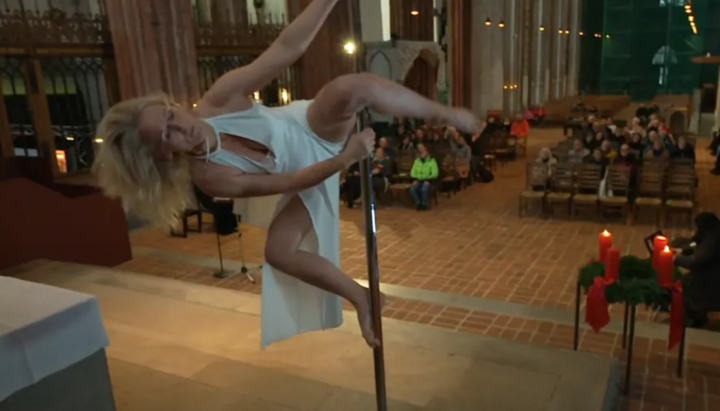
For example, they conduct truly radical experiments. Thus, in a Lutheran church in Lübeck, parishioners were shown a pole dance. At the same time, Pastor Inga Meissner called the dancer a "deeply spiritual person" and stated that her performance was a form of self-expression.
Even further went Catholic priest Michael Correll in Freising. On the eve of All Saints' Day, he appeared before parishioners in a Dracula costume, with artificial fog and a half-open coffin.
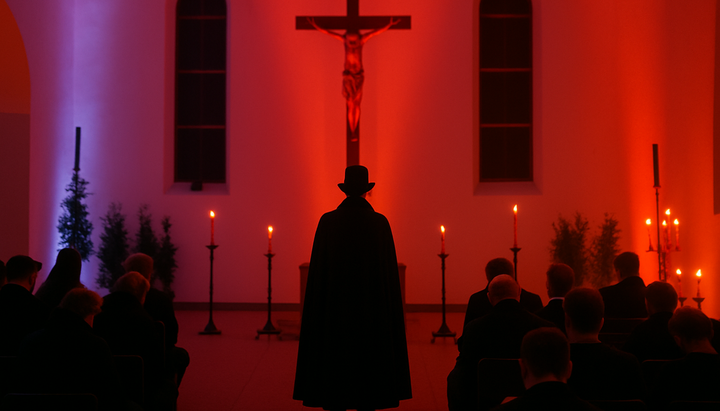
It may seem that all these are unrelated examples. They are united only by the desire to make the Church more “modern” and “understandable to the world.” However, this desire leads not to the growth of the Church, but increasingly to the loss of faith in God and the spiritual degradation of society as a whole.
Increasing Violence Against Christians
Attempts to "modernize" Christianity through provocations lead exclusively to anti-Christian sentiments and violence against Christians.
Thus, in November 2025, human rights activists published a report stating that in 2024, 2211 hate crimes against Christians were recorded in Europe. Among them were 94 church arsons, almost twice as many as the previous year. About a third of the arsons occurred in Germany. A high level of anti-Christian sentiment was also recorded in France, the United Kingdom, Spain, and Austria. All this points to a pan-European problem, not just isolated cases.
In addition to attacks on churches, 274 attacks on Christians were recorded in 2024. People are beaten for wearing a cross, praying, and openly professing their faith.
The authors of the report emphasize that official statistics underestimate the scale of the problem. Surveys in Poland and Spain (very religious countries) showed that almost half of the priests faced aggression, but most do not report it to the police due to distrust of the law enforcement system or fear of publicity.
It is also worth mentioning that in the United Kingdom, for example, people are held accountable for praying in "buffer zones" near abortion clinics or are prosecuted for refusing to call a transgender person a "girl". And there are hundreds and thousands of such cases throughout Europe, not to mention the rest of the world, where Christians remain the most persecuted denomination.
Paradox: The European Union has created mechanisms to combat anti-Semitism and Islamophobia, but the persecution of Christians is practically ignored.
Resistance from below
And yet, it cannot be said that all of Europe has completely abandoned its Christian roots. In many places, ordinary people disagree with the de-Christianization policy imposed "from above" and are ready to fight for their faith and traditions.
For example, in France, residents of the cities of Béziers, Perpignan, and other municipalities install Christmas cribs in public buildings despite court decisions. Courts prohibit Nativity scenes, citing the principle of state secularism, but people still set them up, inventing various ways to bypass the law.
In Béziers, people leave up to 25,000 signatures a year in the town hall's guestbook in support of the Nativity scene. In Perpignan, it was moved to a neighboring building connected to the town hall but not formally part of it. In Beaucaire, the Nativity scene was divided into parts to formally not violate the law on secularism.
In another French city, Asnières-sur-Seine, Mayor Manuel Aeschlimann achieved a significant victory: he was allowed to use the phrase "Christmas celebrates the birth of Jesus". It would seem, what could be more natural? After all, Christmas is the celebration of Christ's birth. But in modern Europe, even for such obvious things, one has to fight seriously.
Meanwhile, a CSA survey conducted for several major French publications shows that 79% of French people support the presence of Nativity scenes in city administration buildings, and among young people aged 18–24, this support is even higher at 92%.
The overwhelming majority of French people want to preserve their Christian roots, and even young people, who grew up in the era of secularization, support Christian traditions more strongly than the older generation!
Such facts completely refute the stereotype that the modern person is supposedly indifferent to faith in God.
In the same France, Orthodoxy is experiencing a real rise. From 2010 to 2024, the number of Orthodox churches increased by about a third (from 235 to 320), and the number of the clergy grew by almost 40%. Yes, it can be said that these numbers grew solely due to mass migration from Eastern Europe (not only from Ukraine but also from Romania). However, the number of parishes where services are conducted entirely or partially in French has increased by more than 50%. This fact indicates that Orthodoxy is becoming the religion of native French people, and not only of immigrants.
What comes next?
Thus, the official policy of many European countries seeks to push Christ out of the public space. But millions of ordinary Europeans perceive this as a betrayal, as a rejection of their own roots. They feel that the foundation of their lives is being taken away, and they are ready to resist. Therefore, to say that all of Europe has renounced Christ would be untrue. However, it is also impossible to deny that attempts to erase the name of the Savior are carried out systematically. So what should be done?
In our opinion, Christianity does have a future in Europe, but it depends on many factors. The first and foremost is whether the Church can be a preacher of Christ rather than an institution engaged in providing “spiritual services”. Will churches become places of prayer and encounters with God rather than venues for entertainment and performances?
The second factor, directly connected to the first, is whether we, people of the Church, can be an example for those who doubt or are still searching for God. After all, it is quite obvious that Orthodox churches in France or the United States are being filled with new believers not because there are pole dances there, but because there are people for whom faith is not an empty sound, but a way of life.
The third factor that should always be kept in mind is this: people do not need a church that tries to be “like everything else”, but a Church that offers what no one else can – an encounter with God.
Moreover, we must understand that the modern person is not as far removed from Christianity as it may seem. One simply needs to give them the opportunity to feel this, and then they will change.
Europe stands at a crossroads. The choice it makes in the coming years will determine not only the future of Christianity, but also the fate of European civilization itself. A civilization that renounces its spiritual roots is doomed.