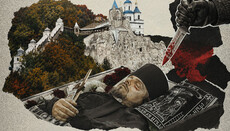

“The Savior isn’t a weakling”: On the new Christology from the OCU
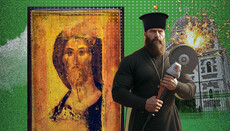
At the end of November 2025, the OCU “priest” Roman Hryshchuk, speaking before the audience of the OCU’s Volyn Theological Academy, essentially presented a new “Christology.”
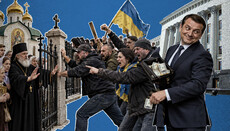
But before discussing its substance, attention must be paid to two important points. First – the personality of Hryshchuk himself. This is the man who organized and personally took part in the raider seizures of numerous Orthodox churches. These takeovers were marked by cruelty and brazenness. Angle-grinders and other tools were used. In his public remarks Hryshchuk openly promotes violence and insults people – not only Orthodox Christians, but even the Roman Pope.
For instance, in June 2025, during an attempted seizure of the Holy Spirit Cathedral in Chernivtsi, he declared that UOC believers were “zombies who helped defend Russia,” indirectly calling for their destruction. And when Pope Leo XIV expressed support for peace in Ukraine, Hryshchuk responded by saying the Pope “looked smart as long as he kept quiet,” adding: “This pope is broken too – bring in the next one!” and claiming that Catholics simply want to make money.
In other words, Hryshchuk is a highly odious figure, to put it mildly. And yet such a person is given a lectern at a theological academy that trains candidates for senior leadership positions within the OCU. In other words, he is considered worthy of teaching future OCU theologians, and his views – entirely acceptable. The head of the OCU, Serhii (Epifaniy) Dumenko, regularly decorates him with church awards. Put simply: if Hryshchuk’s “theology” is not yet the official doctrine of the OCU, it is already very close. And that is the second point requiring attention.
Are icons of Christ “wrong”?
Every lecturer strives to make his presentation vivid and memorable. But Hryshchuk clearly overdid it.
.jpg)
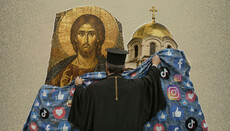
According to him, he came to the academy to shatter in his listeners “that image of Christ imposed by the Moscow Patriarchate and by Orthodoxy in its recent centuries’ version.”
“If you look at icons where Christ is depicted mostly as a refined person, with a disproportionately small head, a thin body, long fingers, small lips, and a large space where the brain and eyes should be – this is how we tend to picture Christ. In our mind, it’s a person with such features and with a necessarily bent spine, his head protruding forward. And from afar we already know this is your typical geek,” Hryshchuk said.
Many people enjoy shock tactics. But calling the Savior a “geek” is so far beyond the bounds of decency that even in patriotic pro-OCU circles it caused outrage. Critical articles appeared across numerous platforms, and the Volyn Academy quietly deleted its report on the lecture.
And it is not clear what Hryshchuk meant by accusing the Moscow Patriarchate of “imposing” a specific image of Christ. Nothing suggests that any unique artistic style of depicting the Savior exists exclusively in the Russian Church.
Apparently he simply needed a foil to introduce his own “Hryshchuk-style” image of Christ.
The essence of Hryshchuk’s new “Christology”
In short, Hryshchuk presents Christ as a kind of superhero who has no hesitation using force and who triumphs over all opponents. Quote: “The Savior was a strong, powerful, tough personality. His wisdom is His ability to enter into dialogues and emerge victorious from them. This is not avoidance of conflict – it is coming out on top.”
Hryshchuk believes that the image of Christ as a gentle, silent Lamb led to slaughter is wrong. Quote: “Christ was nothing like that, but physically strong, resilient, someone who never lacked a comeback.” He goes further, claiming that Jesus did not shy away from what “we today call profanity or even cursing.” This is how Hryshchuk interprets Christ’s rebukes of the scribes and Pharisees. And from the Gospel story of Christ cleansing the Temple, he concludes that the Savior did not avoid violence and knew how to wield a whip skillfully. Altogether it resembles something like Rambo and similar characters. And naturally, Hryshchuk urged future OCU “priests” to imitate this example.
Christ in Sacred Scripture
Where is the distortion? The distortion lies in replacing the meek and humble Christ – the Conqueror of hell and death, Who achieved His victory through crucifixion – with a militant champion winning earthly arguments and human quarrels. Hryshchuk and those like him try to impose upon Jesus Christ the role of a chieftain, a strong leader triumphing in worldly disputes. This is the very role the Jews attempted to impose upon Jesus of Nazareth – and the very role He explicitly rejected.
All of Sacred Scripture – Old Testament prophets and New Testament apostles – bears witness to the meekness, gentleness, and humility of the Savior. This is the exact opposite of what Hryshchuk promotes. For example, the Prophet Isaiah writes of Christ:
“For He grew up before Him like a tender plant, like a root out of dry ground; He had no form or majesty; and when we beheld Him, there was no beauty that we should desire Him. He was despised and rejected by men – a Man of sorrows, acquainted with grief. And we hid our faces from Him. He was despised, and we esteemed Him not. Surely He has borne our griefs and carried our sorrows; yet we considered Him stricken, smitten by God, and afflicted. But He was wounded for our transgressions, bruised for our iniquities; the chastisement for our peace was upon Him, and by His stripes we are healed” (Isaiah 53:2–7).
And here is what Christ says about Himself: “Learn from Me, for I am gentle and lowly in heart, and you will find rest for your souls…” (Matthew 11:29).
This is what He taught His disciples: “But I say unto you, do not resist the evil one. Whoever strikes you on your right cheek, turn to him the other also; and if anyone wants to sue you and take your tunic, let him have your cloak also…” (Matthew 5:39–40).
When the soldiers came to Gethsemane, Christ meekly gave Himself into their hands and even commanded Peter to put away his sword (Matthew 26:51–55). Where, then, is this superhero who, according to Hryshchuk, defeats everyone?
The Jews expected Jesus to become a mighty earthly king, leading a revolt against Rome and placing the Jewish people above all nations. They were deceived. Yet today the OCU is attempting to portray Christ as the same kind of “powerful, tough figure” – but now for the purpose of fighting “Moskals” and the UOC.
Why does Hryshchuk need a new “Christology”?
In his lecture, Hryshchuk denies not only Christ’s humility but also that of the saints. He cites St. George the Trophy-Bearer, St. Athanasius the Great, St. John Chrysostom, St. John of Damascus, and St. Nicholas the Wonderworker, emphasizing that they were not weaklings but strong personalities who bowed to no one and always defended their position. In doing so, he employs classic sectarian tactics – seizing convenient quotations while ignoring all that contradicts his narrative.
And his narrative is always the same: saints were not meek but embodiments of might and force.
“Which of you at forty-six can do fifty push-ups? And if you can’t do fifty push-ups and say, ‘I don’t fight with anyone,’ that’s not because you’re humble – that’s because you’re a weakling. The difference between a humble man and a non-humble weakling is that a humble man can fight back, but doesn’t. A weakling simply can’t,” Hryshchuk says.
Here we see the rationale for the violent seizures of UOC churches carried out by this man – and fully supported by the OCU leadership.
The lecture about a “strong” Christ and “strong” saints is nothing more than laying the ideological foundation for the large-scale work of the OCU, in which Dumenko’s clerics and activists seize churches by force, loot, and beat believers and clergy. If earlier they followed the motto of Porthos from The Three Musketeers: “I fight simply because I fight,” now they fight because, supposedly, the Savior teaches them to.
Addressing students and current OCU clerics, Hryshchuk exhorts them: “Forget that you have to be modest, forget that you must be silent, forget that a priest is some kind of spiritual weakling, a geek. No.”
Conclusions
First, attempts to portray Christ as a cool superhero are false and blasphemous. The Apostle Paul wrote: “We preach Christ crucified…” (1 Corinthians 1:23). Hryshchuk and those like him preach a completely different “Christ.” And for such cases we also have Paul’s command: “…if anyone preaches to you a gospel other than what you received, let him be anathema” (Galatians 1:9).
Second, Hryshchuk urges imitation of the militant image he has constructed – to be tough, strong, and to emerge victorious from every conflict. This indicates that such an ideology is being cultivated within the OCU. And we see how it is embodied in the violent seizures of parishes, the beatings of believers, and so forth.
To avoid such deviations from the pure teaching of Christ, one must first of all read the Gospel and measure all propaganda against it – all that pours upon us from every direction.