
Orthodox Church celebrates Feast Day of Holy Great Martyr Catherine
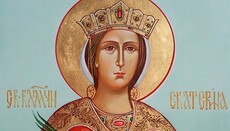
Saint Catherine the Great Martyr suffered for her faith in 305 AD.
On December 7, the Orthodox Church commemorates the Feast Day of the Holy Great Martyr Catherine (287-305 AD), whose martyrdom is attributed to the reign of the Roman Emperor Maximinus (or Maxentius).
The Holy Great Martyr Catherine was born in Alexandria, Egypt, in 287 AD and was the daughter of the ruler of this city during the reign of Emperor Maximinus Daza.
Living in the capital, the center of Hellenistic scholarship of that time, Catherine, endowed with rare beauty and intellect, received an excellent education, studying the works of the best ancient philosophers and scholars.
Young men from the most noble families of the empire sought the hand of the beautiful Catherine, but none became her chosen one. She declared to her parents that she would agree to marry only someone who surpassed her in nobility, wealth, beauty, and wisdom.
Catherine's mother, a secret Christian, took her to her spiritual father for advice. The priest said that he knew a bridegroom who surpassed her in everything. As a farewell, he gave Catherine an icon of the Mother of God with the Infant Jesus in her arms and instructed her to pray with faith to the Queen of Heaven, the Mother of the Heavenly Bridegroom, for a vision of Her Son.
Catherine prayed all night and was granted a vision of the Most Holy Virgin, who asked Her Divine Son to look at Catherine, kneeling before Them. But the Infant turned His face away from her, saying that He could not look at her because she was unworthy, like any person not washed by the waters of Holy Baptism and not sealed with the seal of the Holy Spirit.
In deep sorrow, Catherine returned to the elder. He lovingly received her, instructed her in the Christian faith, commanded her to keep purity and chastity, and to pray unceasingly, and performed the Sacrament of holy Baptism over her.
Again, Saint Catherine had a vision of the Most Holy Theotokos with the Infant. Now the Lord looked at her kindly and gave her a ring, betrothing her to Himself. When the vision ended and the saint awoke from sleep, a ring shone on her hand—a wondrous gift from the Heavenly Bridegroom.
At this time, Emperor Maximinus himself arrived in Alexandria for a pagan festival. The saint came to the festival and, identifying herself, confessed her faith in the One True God, exposing the errors of the pagans.
The beauty of the girl captivated the ruler. To convince her and demonstrate the triumph of pagan wisdom, the emperor ordered 50 of the most learned men of the empire to be summoned, but the saint prevailed over the wise men so much that they themselves believed in Christ.
Maximinus, no longer hoping to persuade the saint, attempted to seduce her with promises of wealth and glory. Receiving an angry refusal, the emperor ordered the saint to be subjected to cruel tortures and then thrown into prison.
The martyr was brought again to the tribunal, where under the threat of being broken on the wheel, she was offered to renounce the Christian faith and sacrifice to the gods. The saint steadfastly confessed Christ and approached the wheels herself, but an Angel shattered the instruments of execution, and they broke into pieces, killing many pagans.
Maximinus again attempted to entice the holy martyr by offering her marriage, and again received a refusal. Saint Catherine firmly confessed her fidelity to her Heavenly Bridegroom – Christ, and with a prayer to Him, she laid her head on the block under the executioner's sword.
The relics of Saint Catherine were transferred by Angels to Mount Sinai. In the 6th century, by revelation, the honorable head and left hand of the holy martyr were discovered and with honors transferred to the newly built church of the Sinai Monastery, constructed by the holy Emperor Justinian.
Previously, the UOJ reported that the Patriarch of Jerusalem stated that pastoral issues on Mount Sinai have been successfully resolved. The Patriarch noted that in the Monastery of Saint Catherine, which is under the special protection of the Jerusalem Patriarchate, organizational and pastoral challenges periodically arise. "These problems have been overcome by the grace of the Lord," he emphasized, adding that the brethren of the monastery continue their service in peace and unity.