
A 16th-century Lviv detective
Lviv craftsmen pooled their money to ransom a printing press, went to war with their own bishop, and created the finest school in Eastern Europe.
At the end of the 16th century, Lviv’s Orthodox population was excluded from civic life. The Catholic city magistrate confined Orthodox laypeople to a narrow enclave on Ruska Street, restricted their rights, and systematically pushed them out of the craft guilds. The local nobility preferred to integrate into the Polish system, while the church hierarchy was mired in legal disputes over property.
The initiative for resistance was taken up by people without famous surnames or noble coats of arms. Ordinary merchants, shoemakers, and saddle-makers decided to establish their own organization.
Among them were the Rohatynets brothers, master saddlers. They had developed a unique saddle design with deer-bone ornamentation, yet the local guild long refused to recognize their rights, until the city council intervened in March 1586. These men were accustomed to fighting their way through courts, guild prohibitions, and social exclusion.
In 1583, the first printer Ivan Fedorov died in Lviv. His property and printing equipment ended up in the hands of his creditors because of his debts. The magistrate expected Cyrillic type to disappear from the city forever. But the townspeople raised the enormous sum of 1,500 złoty for the time and bought back Fedorov’s printing equipment. The brothers purchased a stone townhouse on Ruska Street for 1,300 złoty and established the headquarters of the resistance there.
Princes and wealthy noblemen such as Adam Kisiel or Lavrentiy Drevynsky would join the brotherhood much later, once the organization had already gained considerable influence. Its foundation was laid entirely with money from the townspeople.
War with their own bishop
The main opponent of the Lviv craftsmen in the early days was not Polish officials but their own Orthodox hierarch. Bishop Gideon (Balaban) of Lviv saw the independent organization of laypeople as a threat to his feudal authority.
The conflict quickly moved beyond theological debate. In 1585, on the bishop's orders, the son of the first printer — Ivan Drukarevych — was thrown into a pit and starved to death. In 1589, Bishop Gedeon (Balaban) resorted to outright force. The bishop's servants raided the brotherhood's school, dispersed the students, and ransacked the printing house. The head of the printing operation, the monk Myna, was shackled by the bishop's servants, dragged through the streets, and thrown into an underground prison.
Realizing they could find no protection at the local level, the townspeople appealed directly to the Eastern Patriarchs.
On January 1, 1586, Patriarch Joachim V of Antioch issued a letter of blessing to the brotherhood. The document explicitly recorded the goal of the Lviv townspeople: "With God’s help, the Lviv burghers wish to establish a school to educate Christian children of every social estate... They have also purchased a printing press for printing in the Slavic and Greek languages, needed for the same school."
In 1588 and 1589, Patriarch Jeremias II of Constantinople confirmed the organization’s rights. In 1592, he exerted pressure on the ecclesiastical hierarchy and granted the Dormition Church stavropegial status, placing the brotherhood outside the authority of Bishop Gideon. Only in 1592, when the school had already been operating for six years, did King Sigismund III, following the petition of Prince Konstanty Ostrogski, grant the institution official status as a school of the liberal arts.
A partisan gymnasium for orphans and widows
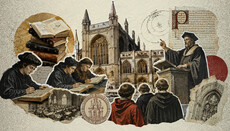
The school founded by the craftsmen differed fundamentally from the Jesuit colleges in its social accessibility. Its charter declared that education should be open to people of every social estate: "whether of the clergy, or of princely, noble, or gentry families, or of the common people, even down to poor widows." Orphans and children from impoverished families studied free of charge. Wealthier families were charged between 6 and 12 groszy per quarter, which covered only a small portion of the expenses. The rest was financed from the common treasury.
Strict requirements were imposed on teachers. A teacher (didaskal) was required to be "pious, wise, humble-minded, meek, temperate, not a drunkard, not a fornicator, not avaricious, not a lover of money."
A strict language regime operated within the school. The charter required students to completely abandon the vernacular dialect within the walls of the institution: "That they shall not speak among themselves in the common tongue, but only in Slavonic and Greek."
The educational process was structured according to a three-level system — from the alphabet and the Book of Hours to grammar, rhetoric, logic, and arithmetic. Senior students ("spudei") served as tutors for younger ones. The school was led by the foremost intellectuals of the era: the Greek Archbishop St. Arsenios of Elasson, Stefan Zyzaniy, and, in 1604, Ivan Boretsky, who would later become Metropolitan Job of Kyiv.
Double accountability for elders
The economic foundation of the entire system was a treasury known as the "kruzhka" ("mug") or "skrynka" ("chest"). Its keys were held by elected key-bearers, and financial accounts were reviewed at general assemblies with the participation of auditors.
The brotherhood members created the first mutual aid fund in the region. From the common budget, money was disbursed to impoverished brotherhood members, medical treatment was paid for, and a hospital for the elderly was maintained. The charter prescribed the mandatory participation of all brotherhood members in the burial of a deceased brother.
At the same time, strict discipline operated within the organization. For disciplinary violations or financial misconduct, an ordinary member was subject to standard punishment. But if an elder committed an offense, he was punished two or three times more severely "for the sake of honor." A leadership position conferred no privileges, but increased one's accountability before the community.
Over the course of two centuries, the Brotherhood’s printing press published around 200 titles, including the Adelfotes grammar and large print runs of primers that circulated from Moldavia to Lithuania. The typefaces and printing blocks used by Ivan Fedorov survived the fires of 1616 and 1628 and remained in use by publishers until the beginning of the nineteenth century.
The Lviv Brotherhood demonstrated that in times of crisis for public institutions, the Church survives not through the patronage of authorities or wealthy benefactors, but through grassroots self-organization by people willing to risk their property and freedom to preserve their identity.