
The underground that outshone the empire's palace
The Roman catacombs were not damp burrows for fugitives, but an underground city of the first Christians – complete with ventilation, shafts of sunlight, and walls covered in frescoes.
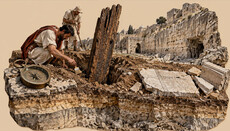
The pickaxe bites into the wall softly, almost as if into a wheel of dense cheese. The dull gray tuff yields easily, warm stone dust cascading from beneath the blade. A man wielding a dolabra – something between a pickaxe and an adze – works confidently and without haste, ten meters beneath the earth. His only light comes from an oil lamp flickering in a niche carved into the wall. The air, contrary to every expectation, is fresh. A faint current drifts down from somewhere above.
Tuff was ideal for precisely this kind of labor. Deep underground it remained soft and obedient; once exposed to air, it hardened and held its shape. It was within this forgiving volcanic stone that the first Christians carved out their subterranean Rome – a refuge that would serve them for generations during times of persecution.
The guild that buried its own with honor
The men who practiced this demanding craft were called fossors, from the Latin fodere – “to dig.”
It is important to understand that a fossor was neither a chained slave nor a mere gravedigger. He belonged to a respected guild of craftsmen whom the early Church counted among the lower clergy. He was at once an engineer, a surveyor, and often an artist.
The work was grueling and sacrificial. During summer months the deeper galleries trapped stale air. The earth exhaled the scent of decay, and each new level demanded more effort than the one before it.
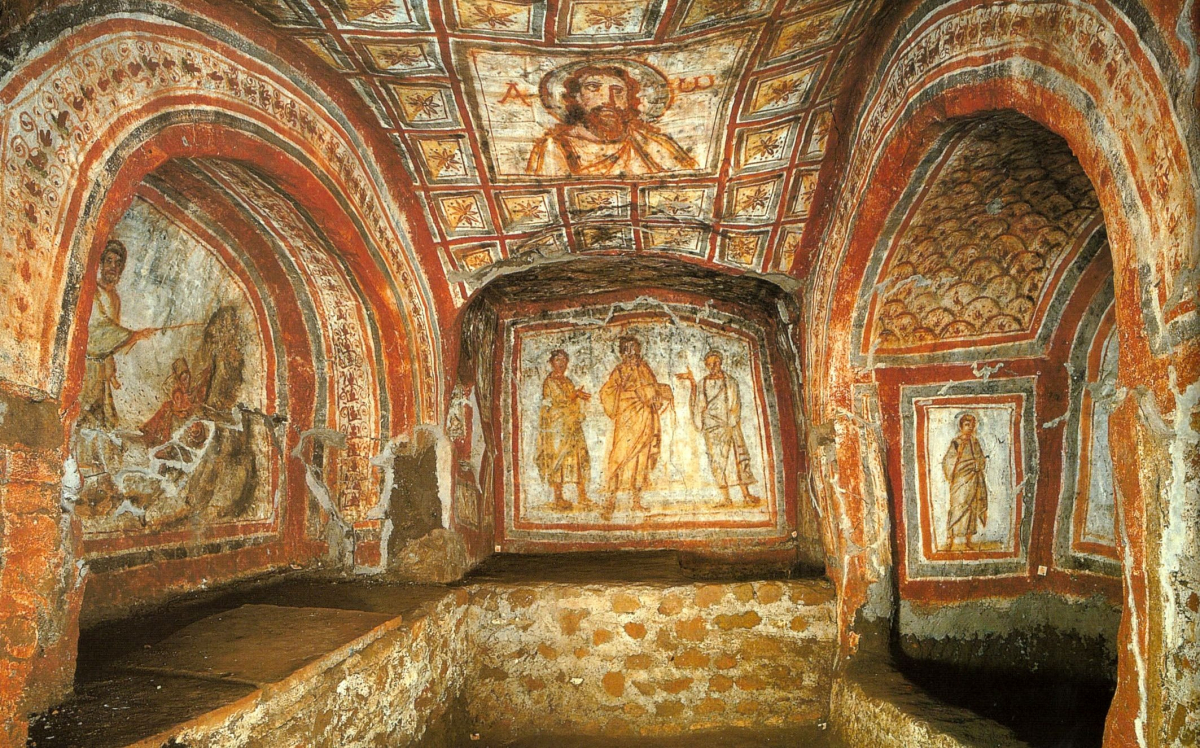
Those who spent their lives breathing foul air in order to prepare resting places for others were themselves buried with honor. Their portraits were painted on the walls of the catacombs, often with the tools of their trade resting upon their shoulders. Thus the fossor Diogenes was immortalized in the Catacombs of Domitilla, carrying the very dolabra with which he had spent his life carving the city of the dead.
More than fifty catacomb complexes are known beneath Rome. Their corridors stretch for well over 150 kilometers, and some estimates place the total length even higher.
The galleries descended level after level, sometimes reaching five tiers and depths exceeding twenty meters. Everything was done by hand, with pickaxe and lamp.
How the fossors cut a path for the sun
The greatest engineering challenge was not digging the corridors themselves, but providing air and light.
Without ventilation, the deep galleries would have become death traps. The craftsmen solved the problem by cutting vertical shafts from the underground chambers directly to the surface. These shafts, known as luminaria, functioned like chimneys in reverse. They drew stale air upward and brought daylight into the depths.
3.jpeg)
An eyewitness left us a remarkable description of what this felt like.
Around the year 400, the Spanish poet Prudentius descended to the underground tomb of the martyr Hippolytus. Later he described the experience in verse. First came a steep spiral staircase disappearing into darkness, where daylight faded with every turn. Then the darkness deepened into what seemed like perpetual night.
And suddenly, high in the vault above, openings appeared at regular intervals. Through these cuts in the stone, brilliant shafts of sunlight pierced the hill itself and streamed into the depths.
Beneath the earth, Prudentius wrote, one could still behold the very sun that had already vanished from sight above.
A qualification is necessary here, lest we romanticize the story.
The broad light shafts and comfortable stairways appeared mostly in the fourth century, when persecution had receded and crowds of pilgrims descended underground on the feast days of the martyrs. The great luminaria of Rome’s catacombs were not hacked out in panic between police raids. They were built deliberately, patiently, in more peaceful times.
The emperor who could not stop looking over his shoulder
Above ground, three centuries earlier, the world looked very different.
In the 90s AD, Rome was ruled by Domitian, a man whom fear had driven nearly mad.
Terrified of assassination and trusting no one, the emperor ordered the porticoes where he walked to be lined with a highly polished stone called phengite. The surface gleamed like a mirror. Wherever he went, Domitian could watch everything happening behind him, as if gazing into a primitive rearview mirror.
2.jpeg)
Imagine the ruler of the ancient world strolling through his marble palace beneath the open sky, unable to take his eyes off the cold reflective stone because he fears, above all things, that someone may approach from behind.
And beneath him, in the darkness of the tuff where he himself would never have dared descend, a warm shaft of sunlight poured through a man-made opening and fell upon a wall painted with the image of the Good Shepherd carrying a sheep upon His shoulders.
Not a tomb, but a bedroom
Amid the engineering marvels and dramatic contrasts of the catacombs, it is easy to forget their true purpose.
They were places of burial.
Yet the Christians themselves did not call them cemeteries. They called them koimeteria – Greek for “places of rest,” literally “bedrooms.”
The body of the departed was laid into a niche as one might place a loved one in bed. Wrapped in a linen shroud scented with myrrh, the body was sealed behind a stone slab.
In neighboring loculi of identical size there might rest an elderly nobleman and a newborn child. Above them would often be written nothing more than two simple Latin words: in pace [in peace].
Relatives came here to stand beside the niche where someone they loved was sleeping. Every descent underground was harder than the one before.
2.jpeg)
Above ground, Rome was rigidly divided by rank and status. Everyone knew their place.
Below ground, yesterday’s slave and yesterday’s aristocrat lay in identical niches beneath identical stones.
A kind of equality that no forum could ever provide was achieved here through the simple geometry of stone.
And one final detail shatters the myth of Christians cowering illegally in rat-infested holes.
Legally speaking, the early Christians were not hiding in forbidden spaces. Roman law protected burial grounds through the principle of the inviolability of graves. Christian communities organized themselves as burial associations and owned this land lawfully.
At times the state confiscated the land above the catacombs – under Decius, later under Diocletian. Then, almost as soon as another persecutor disappeared from the stage of history, everything was returned.
Domitian ultimately met the very fate he feared most.
Conspirators from his own inner circle murdered him. The polished stone in which he had placed such trust could not save him.
But the column of sunlight that the fossors carved through the hillside still descends at its appointed hour. It slips through the ancient shaft and finds the same Shepherd upon the wall – painted in darkness by men who later came to sleep here in peace, while the emperor above them could not sleep for fear.