
How Icarus drowned unnoticed
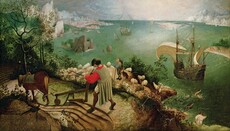
In the lower right-hand corner of Pieter Bruegel’s painting, two white legs protrude from the calm waters of the bay. Nothing else remains of Icarus. A splash, a few feathers floating on the water – and that is all. To find the central character in a painting called The Fall of Icarus, viewers have to look long and hard.

The plowman, by contrast, is impossible to miss. He stands at the center of the composition, bathed in sunlight, wearing a bright red shirt and guiding his plow as he looks down at the ground beneath his feet without ever raising his head.
What everyone is looking at
Ovid, whose mythological story the artist draws upon, described the scene differently. In his Metamorphoses, the plowman, shepherd and fisherman freeze in sacred awe at the sight of Daedalus and Icarus flying through the air, taking them for gods who have descended from heaven. In the ancient poet’s account, the encounter is filled with wonder and reverence.
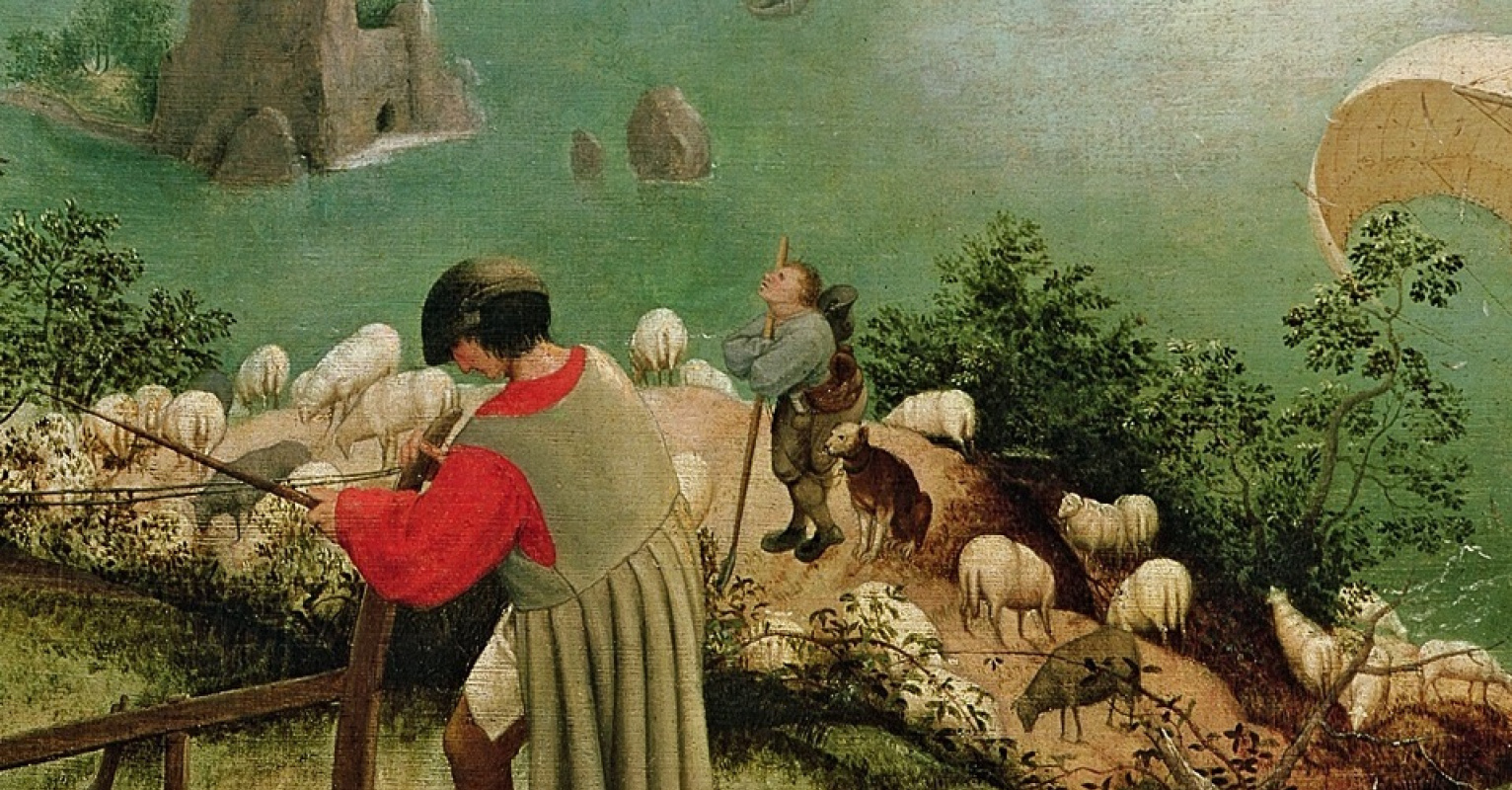
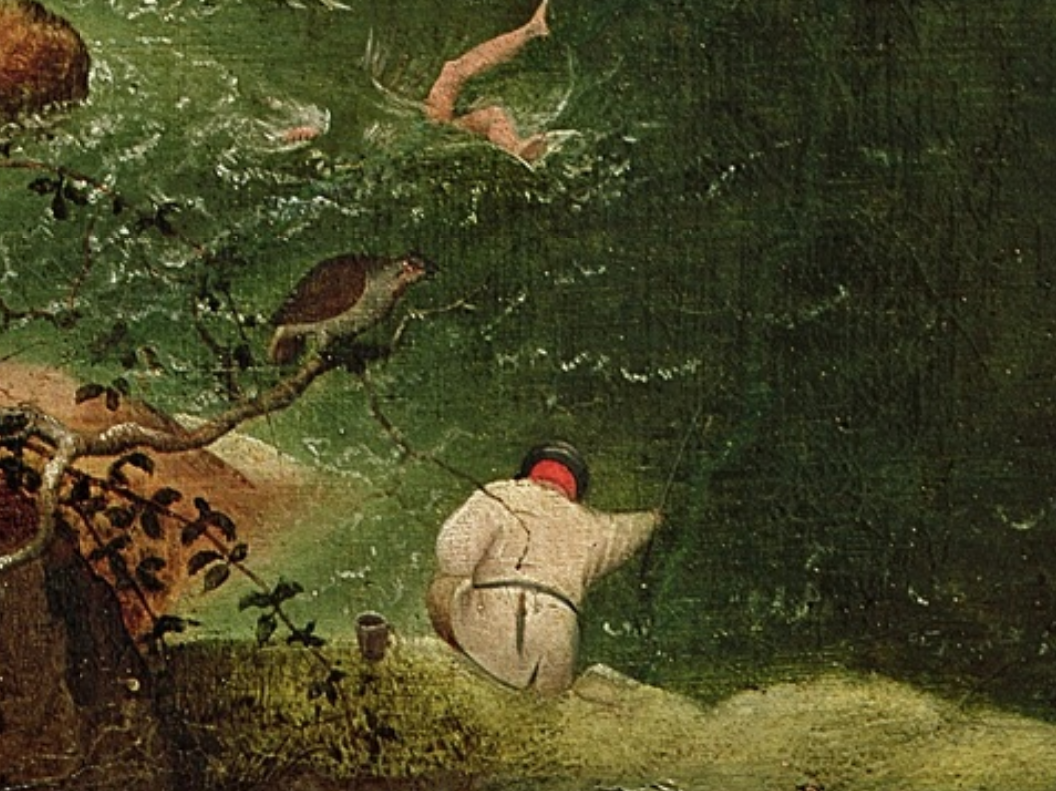
Bruegel presents something entirely different. The plowman looks at the furrow in the earth. The fisherman is absorbed in his line and float. A boy is drowning practically before his eyes, yet he does not notice him. The shepherd gazes dreamily up at the clouds rather than at the water where the tragedy is unfolding. It seems as though no one around them cares that a human being is dying nearby.
This was Bruegel’s artistic choice: working people were more accustomed to looking not at miracles, but at the work of their lives.
A body in the bushes
The painting has long been associated with a Dutch proverb: “And the farmer went on plowing.” It is usually quoted as a metaphor for indifference to another person’s suffering.
But the painting conveys more than indifference. It contains another easily overlooked detail. On the left side of the canvas, hidden in the shadow of the bushes, is the barely discernible pale head of a dead man.
Death in this painting is not an isolated event – it surrounds the figures. Yet the plowman’s plow keeps moving forward, and his work does not stop.
The plowman continues working not because he does not understand the price of death – he understands it better than many. Yet he refuses to abandon his labor even when a dead body lies nearby. Bruegel seems to remind us that in human life, work and death are always crossing paths.
Pride stripped of its grandeur
In the theology of the Northern Renaissance, Icarus embodies the sin of pride – humanity’s refusal to acknowledge its own limitations. The plowman stands at the opposite spiritual pole: he fulfills the commandment, “In the sweat of your face you shall eat bread,” without complaint and without aspiring to become something greater than he is.
Bruegel does not allow Icarus’ fall even a trace of tragic grandeur. The ship sailing past does not alter its course. No one rushes to save the drowning man. The catastrophe of the proud mind goes unnoticed – and, in the artist’s view, that is exactly as it should be. Icarus dies a deserved death.
The plowman of ecclesiastes
There is also a less obvious interpretation of the scene. In 2003, Dutch art historian Lyckle de Vries suggested in an article devoted to the painting that Bruegel’s plowman may refer not only to Ovid but also to the Book of Ecclesiastes – specifically to the passage about the persistent sower who does not allow himself to be distracted by the wind and clouds (Ecclesiastes 11:4).
If this interpretation is correct, the figure of the peasant carries not one but two cultural layers at once – classical mythology and Old Testament wisdom.
A canvas recreated
The painting has had a complicated history, and it is not even certain that Bruegel himself painted the surviving work. Research published in 2012 by Belgium’s Royal Institute for Cultural Heritage established that the existing canvas dates from around 1600 – roughly thirty years after Bruegel’s death. What we see is not the master’s own original, but a remarkably faithful copy of a lost work by him.
Does that mean what we are looking at is not Bruegel? No. What we see is Bruegel’s conception – one that outlived the artist himself by a third of a century.
Honest work matters more than showmanship
Three centuries after the painting was created, British poet W. H. Auden saw it in Brussels and wrote a poem about the way suffering can pass unnoticed amid the routines of everyday life: while one person is drowning, another simply carries on with his business.
Bruegel was writing in paint not only about the death of Icarus. He was showing that ordinary life continues in the midst of every catastrophe. That is a lesson especially important for us to understand today.
The plowman guides his furrow, the fisherman waits for a bite, and the shepherd gazes into the clouds. Not one of them allows himself to be distracted by the failed hero. Each simply carries on honestly with his work while another man’s pride collapses nearby.
The story teaches a simple lesson: flashy “superpowers” are no substitute for conscientious labor. True piety reveals itself precisely in everyday faithfulness to one’s work.