
The Holy Gate: the only witness no one questions
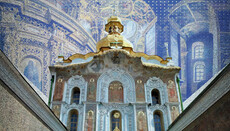
When pilgrims hurry into the Lavra through the main gate, they barely notice that they are walking inside the wall itself. Above them hangs a vaulted stone ceiling, and daylight reaches this passage only from the street and from the monastery courtyard. In the middle – half-darkness, cool air, the smell of old stone, faintly damp from the morning mist.
Above this tunnel stands a small church. It is older than every other building around it.
An entrance untouched by fire
On December 6, 1240, the troops of Khan Batu took Kyiv. By then, the city had already been burning for several days from arrows wrapped in flaming tow, and the smoke could be seen for miles. The Pechersk Monastery stood high above the Dnipro – impossible to hide, impossible to bypass.
The great Dormition Cathedral, built in the age of Yaroslav the Wise and painted by Greek masters, collapsed – its vaults could not withstand the heat, and the stone split in the blaze. The fortress walls were destroyed. The brethren scattered or perished. The chronicles record the devastation with grim brevity – “they took it and burned it.”
The gate church became one of the very few above-ground structures to survive pre-Mongol Rus physically – not in drawings, not in memory, but in stone. Why this happened remains unknown.
The chronicle describes the ruin in detail, yet says nothing at all about the gate that remained standing. Perhaps Batu’s horsemen spared it because they themselves entered the monastery through it. Perhaps for some other reason.
The masonry of the first tier: who built it, and why he stood at the gate
On the church’s northern and eastern facades, restorers have deliberately left patches of plaster scraped away. Through the 18th-century Baroque stucco, another material emerges. It is plinth brick – broad, flat brick fired in Kyivan Rus differently than in Europe and laid in a distinctive rhythm: one row of plinth brick, then a wide band of pink mortar mixed with crushed ceramics, then plinth brick again. In the exposed probe areas, the masonry feels warm to the touch – the brick holds the sun’s heat longer than plaster – and slightly rough. The Baroque ornament above it is made of an entirely different substance, smooth and white. Two layers of time meet here, pressed directly against one another without a seam.
The church was built by a man who gave away everything he possessed. His name was Sviatoslav Davydovych. A great-grandson of Yaroslav the Wise, a prince of Chernihiv – a man to whom cities, retinues, and treasury belonged by birth. In 1106, he renounced all of it willingly and took monastic vows at the Kyiv-Pechersk Monastery under the name Nikola.
This was the first recorded case of a Rus prince embracing monasticism not by compulsion, but by conscious choice.
Before his tonsure, he gave away his property. Then, with the money that remained, he built a stone church above the monastery’s main gate. After that, he accepted the obedience of gatekeeper at those very same gates and stood there for three years – a former ruler of a principality now entrusted with opening and closing the monastery door.
The Kyivan Cave Patericon recounts this without commentary, as though it were simply the normal order of monastic life: “And they commanded him to labor in the cookhouse for the brethren... And after that they appointed him to the monastery gates, and there he remained for three years, going nowhere except to church.”
Nothing extra. He cooked food, stood at the gate, and went to church – to the Trinity Gate Church, the very one he himself had built.
Shield and Liturgy
A gate church always serves two purposes. Below – the passage gate, the most vulnerable point in any fortress wall, the place an enemy will strike first. Above – a church with unceasing worship, sanctifying that line of defense.
To enter the monastery through the Holy Gate means to pass beneath a dome, with prayer and under prayer. It is not simply stepping across a threshold – it is passing through a liturgical space.
The architects of ancient Rus built both a watchtower and an altar into this one point, because they understood that the boundary between the world and the monastery must be upheld by both at once.
Today, the interior of the church feels extremely compressed. The four-pillar plan of a classic cross-in-square church has been fitted into the footprint of a gate tower – the pillars stand close together, the vaults are low. You can reach it only by a steep, narrow staircase cut directly into the western wall. In truth, it is more a slit in the stone than a staircase.
Those who regularly serve or pray here know this well: in such a tightly gathered space, prayer sounds different than it does in broad, open naves. Here it becomes especially concentrated.
New skin on old bones
What we see from the outside today is not the 12th century. The ornate gables, stucco decoration, pear-shaped dome with a narrowed neck, the white undulating cornices – all this appeared in the 1730s and 1740s, during the age of Ukrainian Baroque, when old walls throughout the Lavra were being clothed in a new form.
This Baroque is also called Mazepan – after Hetman Ivan Mazepa, under whom the style flourished on Ukrainian lands. It is joyful, lavish, slightly theatrical – white walls, gilded domes, foam-like ornament.
Yet beneath that froth, nothing changed. The masonry of the 12th century still bears the Baroque facade upon itself, the way bones bear skin. The builders of the 18th century added a new layer without disturbing the old one.
Each century left something of its own here without destroying what came before.
In the exposed probe areas, this becomes literally visible: one touch of the hand – and beneath the smooth plaster you can feel the ribbed surface of the plinth brick. Two textures within a single inch.
We stand beneath the gate, and above us is the same stone that stood here when Batu’s armies passed along this road. The same stone saw the Dormition Cathedral burn. The same stone then remained for eight more centuries while hetmans, architects, regimes, and wars changed all around it.