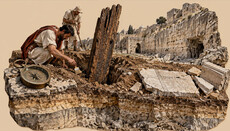

How the founder of the Kyiv Caves Lavra was expelled from the monastery

In 1069, Saint Anthony had to leave the monastery that he himself had founded. He went to Chernihiv and dug a new cave – and grace went with him there.
In the 11th century, the situation at the Lavra resembled the modern one very much. The cell of the monastery's founder was empty. The man who had laid the foundations of Rus’ principal monastery with his own hands was no longer present in the spiritual community he had created. The monastery walls still stood, and the daily rhythm of Lavra life continued as usual but the heart of this holy place was already far away, several days’ journey to the northeast, in a foreign land.

Why the prince expelled Anthony
To understand the scale of the story, one must separate the pious image of the saint from the living elder. At that time, the Venerable Anthony was nearly ninety years old. In his youth, he went to Mount Athos, took monastic vows there, and returned to Rus as an experienced monk. He settled in a cave on a Dnieper hill near Kyiv, and little by little a brotherhood gathered around that cave, from which the Lavra grew – a monastery that became the heart of Russian monasticism. Anthony was both its founder and living center: princes and paupers alike listened to him, and people from all over Rus’ came to him for counsel.
This popular respect became an obstacle. To understand why, one must recall the year in which all of this took place. In 1068, the Yaroslavichi were defeated by the Polovtsians in the Battle on the Alta River, and when Prince Iziaslav refused to give the people of Kyiv weapons for a new defense, the city rose in revolt. The prince fled to Poland, and the freed ruler of Polotsk, Vseslav, was placed on the throne after being released from prison. In the spring of 1069, Iziaslav returned with the Polish army of his son-in-law, King Bolesław. The return was bloody: the prince sent his son Mstislav ahead of him, and according to the chronicles, Mstislav executed about seventy participants of the uprising without any trial, and blinded many others.
In this atmosphere, Iziaslav's anger also fell upon Anthony. The chronicle speaks of this briefly and does not really explain the reasons: “Iziaslav began to be angered at Anthony because of Vseslav.” There is only one hint: the elder was suspected of sympathizing with the prince of Polotsk or with the defeated townspeople. Perhaps he had interceded for someone, or he was simply too independent to be tolerated nearby. The exact reason has not been preserved in the sources, and this must be acknowledged honestly, without inventing anything. One thing is clear: in a city where people had just been executed and blinded without trial, the threat to the elderly monk was entirely real.
What matters is something else – the way Anthony himself behaved in this situation. He did not write a single complaint. He neither appealed to an ecclesiastical court, nor rallied the brethren, nor reminded the prince who had actually built the monastery and whom it owed its existence.
The elder had every reason to demand justice – years of labor on the monastery's improvement, popular love, his own right of primacy. He didn't use any of these arguments.
Prince Sviatoslav of Chernigov, Iziaslav's brother, learning that he was seriously angered with the saint, sent escorts for him at night. The Patericon says that the prince, “having been informed that his brother Iziaslav was fiercely angry with Venerable Anthony, sent for the saint at night and took him away to Chernihiv.”
Why grace left with him
In Chernihiv, Anthony went up to the Boldyni Hills and took a spade in his hands. At ninety years of age, in a foreign land, he began digging a new cave in dense loess loam. Anyone who has been on those slopes knows: the soil there is difficult, and digging it is hard work – by evening one’s back may not even straighten.
Thus arose the Chernihiv cave monastery – the future Anthony Caves, which stand on the Boldyni Hills to this day. The elder lived there until the next change of power, and during these years around his new cave, the same thing was repeated that had once happened on the Dnieper hill: a brotherhood gathered, pilgrims came, and a monastery grew. One man with a spade founded a monastery for the second time – now in a different principality, without any support that a capital provides.
And here's what's most important in this story.
Spiritual life did not remain in the abandoned Lavra with its sanctified walls and princely patronage. It shifted to where the saint was – in a freshly dug cave in the Chernihiv clay.
It seems to us that the Church is buildings, domes, and documents of ownership. Take them away, and it feels as though the end has come.
St. Anthony shows that grace is not tied to an address. It cannot be forbidden by decree or locked away, because it goes deeper – underground, under the spade of an exiled monk.
More than six centuries earlier, another exile, Saint John Chrysostom, whom the imperial court drove from Constantinople, said what the Venerable Anthony later proved by deed: “There are many waves and a strong storm; but we are not afraid of drowning, because we stand on the rock. The earth is the Lord’s, and everything that fills it.” Not Kyiv’s, not Chernihiv’s – God’s earth. The whole planet entirely. And therefore, God cannot be taken away from a believer, just as it is impossible to forcibly relocate a person from Earth to another planet.