
Militarism distorts the image of Saint George the Victorious
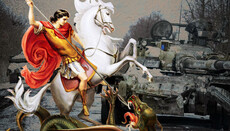
Why does the Church reject the cult of war? Let us discover the true meaning of the feat of the Great Martyr George and the main danger of the religious justification of violence.
On May 6, the Orthodox Church commemorates the Great Martyr George the Victorious. In connection with this event, we will discuss militaristic theology. The fact is that some Christians see in the icon of George the Victorious a defender of the idea of war as a means of achieving goals. But they forget that in reality everything is quite the opposite. The modern perception of St. George often suffers from an "optical illusion": behind the gleam of armor and the tip of the spear, people cease to see the Cross, which is in fact the true weapon of this saint.

Radical disarmament and the true victory of the saint
St. George was not merely a soldier; he was an elite officer, a favorite of Emperor Diocletian. In the context of Roman ideology of that time, "victory" meant triumph, taking spoils of war, and the suppression of the enemy by force of arms. When George declared himself a Christian, he performed an act of radical disarmament. He did not raise the legions in rebellion against the pagan tyrant, although his authority would have allowed him to do so.
His "victoriousness" begins at the moment when he removes his military belt (symbol of power and status) and voluntarily goes to torture. This is a victory not over an external enemy, but over the instinct of self-preservation and the temptation to respond to violence with violence.
If we look carefully at the canonical icon "The Miracle of the Dragon," we see an amazing paradox. George strikes the dragon, but his face remains absolutely calm, there is no rage, hatred, or bloodlust in it. In this icon, the dragon is not "another nation" or "political opponent." It is the personification of evil, lies, and diabolical chaos. The thin, almost weightless spear symbolizes the Word of God. The saint conquers not with the weight of metal but with the purity of his witness (martyria).
Militaristic theology always seeks justifications for killing in the name of "higher goals." But the life of St. George speaks of the opposite: the highest goal is achieved through readiness to be killed. In Christian understanding, St. George is the Victorious because he "overcame the world" (John 16:33) just as Christ did. His triumph is not the ruins of conquered cities, but an empty tomb and the triumph of life. Those who try to make him a "general for blessing cannons" commit a substitution: they return the saint from the Kingdom of Heaven back to the Roman barracks which he once consciously left.
Militarism demands sacrificing others. St. George sacrificed himself.
He refused a brilliant career, wealth, and his very life. Christian holiness is always self-sacrifice. As soon as St. George becomes an instrument for justifying aggression against one's neighbor, he ceases to be a Christian saint and becomes simply another pagan Mars dressed in Christian garments. St. George the Victorious is not a "saint of war," but a saint of resistance to war. His feat is a manifesto of freedom of spirit, which cannot be bought with honors or broken by the threat of death. He did not defeat "someone," he defeated the very logic of violence, opposing to it the logic of Love, which "seeks not its own."
Illusion of sin remission
The most terrible aspect of religious propaganda of violence is the illusion of sin remission. When a politician calls for violence, a person may doubt. But when a clergyman says that "this is God's will" or "this is a sacred war," he essentially issues an "indulgence" for murder. It is psychologically very difficult for a person to bear the burden of responsibility for violence. The clergy sanctioning violence offers dangerous comfort: "You are not a murderer, you are an instrument in God's hands." This paralyzes personal moral evaluation.
The Gospel call to "love your enemies" is the most difficult, almost "unnatural" commandment. It requires enormous spiritual effort and a revision of one's nature. Militaristic propaganda, on the contrary, appeals to Old Testament archetypes: "an eye for an eye," "sacred vengeance," "chosen people against pagans." It is much easier for people to return to an understandable tribal deity of war than to follow Christ, who forbids Peter to draw his sword in the Garden of Gethsemane.
Thus, faith is transformed from a living connection with God into part of national or group identity.
If Christianity becomes simply a "flag" or "shield," then the enemy of the nation automatically becomes the enemy of faith. At this moment, the Gospel ceases to be a text that judges us and becomes an instrument with which we judge others.
Fear as the foundation of propaganda
Propaganda is always built on fear: "if we don't get them, they will get us and our shrines." Fear shuts down critical thinking (the prefrontal cortex) and activates survival instincts. When the clergy fuel this fear, they turn the flock into a "besieged fortress." In such logic, any pacifism or call for peace begins to seem like betrayal or weakness.
The Apostle Paul wrote that "the word of the cross is foolishness to those who are perishing." It is difficult for the human ego to worship a "weak" God who was crucified. We want a strong, punishing God on a white horse, crushing enemies. St. George in the icon is an ideal target for this substitution. People choose to see in him a "triumphant victor" and consciously ignore that his main victory is the seven days of torture he endured without cursing his tormentors.
Why do people succumb? Because being a "warrior of light" destroying enemies is psychologically pleasant and understandable.
It gives a sense of superiority and the right to rage. But being a Christian who sees the image of God in every person (even in an enemy) and is ready to die for them but not kill them is incredibly difficult. This requires spiritual courage, which propaganda usually lacks.
Rejection of the value of life
The propaganda of militarism by political officers in cassocks is not just an error, it is an anti-gospel. It is an attempt to rewrite the history of salvation so that the cross becomes a sword again, and Christ becomes Caesar.
Using the image of a saint to justify aggression testifies to a deep crisis of church self-consciousness, in which political expediency absorbs theology. In this process, the icon ceases to be a "window to the Heavenly Kingdom" and becomes an ideological marker dividing the world into "friends" and "foes". When the Church agrees to the role of "ministry of ideology," it loses its unique subjectivity and timeless authority. This transforms Christianity from a global message of salvation for every person into a local instrument for serving national interests, where holiness is measured not by purity of heart, but by the degree of loyalty to the state sword.
The militarization of faith provokes a dangerous anthropological regression, returning man from evangelical freedom of responsibility to the archaic ethics of an obedient "cog."
Instead of spiritual maturation and personal search for answers to complex moral challenges, a person is offered a ready matrix in which cruelty is legitimized by authority from above. This is not just a distortion of the image of a particular saint, this is a rejection of the main achievement of Christian thought – recognition of the absolute value of every human life. Ultimately, the choice between "George the Martyr" and "George the General" is a choice between faith as a living path of personal transformation and religion as a form of collective hypnosis that blocks conscience for the sake of the triumph of force.