
What Christ’s tears at his friend’s tomb reveal about the nature of death
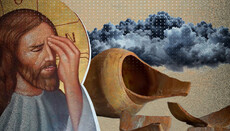
“Lord, by this time there is a stench, for he has been dead four days” (John 11:39).
Martha, the sister of Lazarus – Christ’s friend – speaks these stark, unbearable words simply because, in that moment, no other language is possible.
A heavy, disk-shaped stone seals the entrance to the cave, heated by the merciless sun. It is high summer in Judea. White dust settles on the garments of those gathered. And in response to this anxious, hurried human speech, Christ answers with a deep, weighty silence.
In the harsh climate of Judea, by the fourth day decomposition has fully set in. The linen wrappings and burial spices – myrrh and aloes, applied in abundance – can no longer restrain what is happening.
In modern medical terms, this is the release of putrefactive gases. In the language of the Gospel, it is expressed in a single, terrifying word: he stinketh. This is ordinary biology – the reality every human being must face.
And then something astonishing happens.
Jesus stands before the sealed tomb – and weeps.
Two verbs: silence and trembling
The Greek text of the Gospel of John reveals the hidden tension within this scene. Describing the mourners and Lazarus’ sister Mary, the Evangelist uses the verb klaio – loud wailing, ritual lamentation that tears through the air.
But when he speaks of Jesus’ tears, he uses a different word altogether: edakrysen – to shed quiet tears, without hysteria, without outward display.
This is something deeply interior, restrained, profoundly human.
And yet, alongside it stands another verb that has stirred debate among scholars for centuries. In many translations we read: “Jesus was deeply moved in spirit” (John 11:33). But the Greek word embrimaomai carries a sharper edge.
It suggests a heavy, almost violent agitation – a snorting, a surge of indignation. In ancient usage, it could evoke the image of a warhorse trembling before battle.
This nuance changes everything.
Christ is not only grieving.
He is inwardly shaken – even angered – at the very fact of death.
Death as distortion
We are accustomed to thinking of death as something natural. We call it the inevitable end of life, a process wisely inscribed into the fabric of nature. It is a comforting formula – one that helps us cope.
But this Gospel scene reveals something entirely different.
Protopresbyter Alexander Schmemann wrote: “Christ weeps because in the death of His friend He beholds the triumph of death in the world… death as ugliness… as the triumph of Satan.”
Here, the shift from biology to theology is immediate.
Death is not part of the Creator’s design. It is a rupture – an intrusion – a metaphysical deformation of being itself.
That is why there are no long philosophical consolations at the tomb. Christ does not soothe the crowd with reflections on the transience of life.
The eleventh chapter of John is not only a story of loss. It is the prelude to a revelation of divine glory. Standing before that narrow cave, Christ sees not only Lazarus – He sees the mass grave of all humanity, awaiting its destruction.
The fourth day – the point of no return
The detail of the fourth day is crucial.
According to Jewish belief of that time, the soul lingered near the body for three days. As long as the face remained recognizable, a fragile hope still flickered.
But the fourth day marked the absolute point of no return. This is why many Christian interpreters see purpose in Christ’s delay. He allows all human hope to be extinguished completely.
The miracle must be undeniable – not mistaken for a fainting spell, not explained away as a coma.
“Lazarus, come forth!” (John 11:43) – the command resounds at the mouth of the cave.
The body had been tightly bound in narrow linen strips – so tightly that even a single step should have been impossible.
And yet he comes out.
From the darkness emerges a man still bound hand and foot, his face wrapped in a burial cloth. Only then does Christ say to the stunned crowd: “Unbind him, and let him go.”
This is not metaphor.
It is a concrete, shocking event unfolding before human eyes.
The silence beyond the stone
What did Lazarus say about those four days?
The Gospel keeps a careful silence.
Church tradition – stepping beyond the text – says he later became a bishop in Cyprus. Another tradition claims that after returning to life, he never laughed again, carrying within him the weight of what he had seen.
What lies beyond that stone?
Perhaps one who has crossed that final boundary leaves no room for careless words.
We live in a culture that teaches us to come to terms with death. It offers therapy, acceptance, even the language of a gentle “transition.”
But the Gospel shows us something else entirely.
It shows us a God who does not accept death. A God who weeps quietly – and trembles with indignation – as He steps forward to confront what should not exist.
The raising of Lazarus is only a prelude.
In a few days, Christ Himself will ascend the Cross – and then emerge from His own stone-sealed tomb into the light of Pascha, leaving the burial cloths behind on the empty slab.
And as we stand, in imagination, before the opened grave of Lazarus, one question remains:
Are we ready to stop justifying death –
and to recognize it as an enemy already defeated by God?