
Should Filaret be called "patriarch"? Response to Archbishop Sylvester
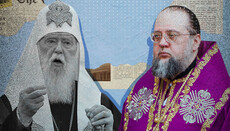
Bishop Sylvester calls Filaret a "patriarch" and presents him as an ideological fighter for an independent Ukrainian Church. We analyze how much this corresponds to reality.
On the ninth day after the death of Filaret Denysenko, Archbishop Sylvester of Bilohorodka, rector of the Kyiv Theological Schools, came up with a publication dedicated to his activities. The text appears so unusual that we decided to analyze it briefly.
First of all, it is striking that the bishop refers to Filaret as "patriarch." The archbishop himself clearly understands the effect of such a designation, so he begins the text by explaining why he chose to do so. He reminds readers that none of the Local Churches recognized Denysenko as having patriarchal status, including the Constantinople Church, where he was referred to only as "the former Metropolitan of Kyiv, now retired”.
The archbishop explains his use of the word "patriarch" in relation to Filaret by stating that "in dialogue between representatives of various Christian denominations and various church jurisdictions, there is a rule: to use titles and designations as they are accepted by each of the parties to the dialogue."
"This is a natural rule of courtesy. That is precisely why I here call the late Filaret (Denysenko) patriarch," the bishop emphasized.
Why for Bishop Sylvester Filaret is a "patriarch"
And here several perplexities arise.
First, it remains unclear with whom exactly Bishop Sylvester intends to engage in dialogue by referring to Filaret as a "patriarch".
As he already indicated, in Constantinople Filaret was not considered a patriarch, and in the OCU he was called exclusively "honorary patriarch." Officially, the phrase "Patriarch Filaret" is used today only in the Kyiv Patriarchate. But today this is a marginal, small structure that is about to be taken over by the OCU. And with it, the aforementioned designation will disappear.
If the bishop has the OCU in mind, it is worth recalling that the UOC at its Council in Feophania quite clearly outlined the conditions for dialogue with this structure. One of the three points (the easiest to implement) was a call to stop church seizures. We all know how Dumenko's structure "responded" – the seizures were intensified many times over.
Second, any aspiration for dialogue must be mutual, otherwise it makes no sense. In the OCU, they don't just seize churches – they engage in real persecution of the Church, calling the episcopate, clergy and faithful of the UOC "FSB agents," "Muscovites" and "spiritual occupiers."
Dumenko has repeatedly stated that he sees no point in dialogue with the UOC, and his ultimate goal is the "accession" of all its parishes to his organization. In such a situation, any statements about "dialogue" are not just meaningless – they are perceived by the opponent as a manifestation of weakness and an attempt to appease him.
Thus, Archbishop Sylvester's "courtesy" is essentially directed into the void.
In the Christian tradition, it is not customary to speak ill of the deceased. But distorting the truth for the sake of politeness is hardly justified. "I hope for the understanding of the parishioners of the Ukrainian Orthodox Church and their Christian love," writes Bishop Sylvester. However, his hopes are unlikely to be fulfilled. It will be especially difficult for those believers whose churches were taken away by Filaret's clerics to understand the bishop. After all, if it is appropriate in the UOC to call Denisenko patriarch, then what was the point of defending their shrines instead of simply joining his jurisdiction?
Thirst for power or "a sense of irreversible changes"?
It is well known that up until 1990, Filaret was a staunch opponent of Ukrainian autocephaly. He spoke extremely disparagingly about members of the UAOC, spoke exclusively in Russian and did not recognize the Ukrainian language as suitable for liturgical services. Everyone clearly remembers when the ‘turning point’ in the rhetoric and worldview of the former Metropolitan of Kyiv occurred – it was the 1990 patriarchal elections in the ROC, which Filaret, being the Locum Tenens of the Throne, hoped to win.
Returning to Kyiv after his defeat, Filaret Denysenko suddenly radically changed his position toward the autocephalous movement. Archbishop Sylvester describes this time as follows: "It is quite obvious that immediately after the proclamation of Ukraine's independence in 1991, Metropolitan Filaret understood that this was not something accidental. He sensed that what is called a 'tectonic shift' had occurred and that the world would never be the same as before."
According to the archbishop, Denysenko was some kind of progressive innovator who "throughout his life repeatedly became one of the first to sense irreversible changes in the state and society."
Well, the bishop has a right to his view. But let us ask the question: how sincere was such a sudden transformation? After all, there is much evidence where Filaret not only did not support the idea of Ukrainian independence but also rejected it in every way. And was Filaret the only one who at that moment suddenly "sensed irreversible changes"?
Of course, not. With Ukraine’s independence, many committed communists and supporters of the USSR suddenly found within themselves a rejection of the totalitarian Soviet past and an affection for the young Ukrainian state. It just happened so.
Did the ROC refuse to reconcile with Filaret?
Bishop Sylvester recalls the mysterious situation with Filaret's letter of November 16, 2017, addressed to Patriarch Kirill and the ROC, in which he wrote: "I, as your brother, concelebrant, ask forgiveness for everything in which I have sinned by word, deed and all my feelings, and likewise sincerely forgive everyone from my heart." The hierarch states that Filaret "sought reconciliation and was capable of making compromises for this purpose," and also "expected that the Council would decide to lift the canonical penalties from him and determine the further path to reconciliation."
"However, this did not happen. Moreover, publications appeared in the Russian media at the time that significantly complicated the process of possible reconciliation," writes the archbishop. According to him, Filaret "did not find understanding then from Patriarch Kirill and the Bishops' Council of the ROC" and therefore "made a decisive bet on negotiations with Constantinople, which ultimately proved successful."
"Whenever even the slightest hint of reconciliation appeared on the horizon, the leadership of the Russian Orthodox Church did everything to prevent it from happening," the bishop emphasizes.
These words need serious analysis.
Despite all justified complaints against the current ROC – its support for the war and controversial actions regarding the UOC – we must not allow ourselves to comment on historical events in a distorted light.
If we examine the situation with Filaret's letter in detail, it looks completely different from how Bishop Sylvester described it.
It should be recalled that the aforementioned appeal by Denysenko to the ROC was considered on November 30, 2017, at the Bishops' Council. Here is what was said about this in the Council's resolution: "After the sorrowful twenty-five years of discord, violence, mutual hostility, grievances and disorders that arose in Ukrainian Orthodoxy and Ukrainian society as a result of the schism, there finally appears a possibility to embark on the path of restoring unity."
At the Council, a commission for negotiations with the UOC-KP was immediately created. "If these negotiations are successful, we will certainly be able to think about further steps," stated the head of the DECR-MP, Metropolitan Hilarion (Alfeyev) at that time. Moreover, he also addressed the very issue of tactless publications in the Russian media, which Archbishop Sylvester had mentioned, specifically, articles by Interfax claiming that Filaret had asked Patriarch Kirill for "pardon".
"I would like to express my protest to the Interfax agency regarding a provocative publication that sparked a very outraged reaction in Ukraine. Because no pardon was mentioned either in the letter from the former Metropolitan of Kyiv, Filaret, or in the decisions of the ROC," Metropolitan Hilarion said.
Do we see that Filaret "did not find understanding" from the ROC, that its leadership "did everything to prevent reconciliation from happening"? No. Everything looked quite the opposite.
Unfortunately, already the day after the Council, when the Russian Orthodox Church’s commission for dialogue with the UOC-KP had not even begun its work, Filaret actually disavowed his letter. The reasons for such a decision he voiced were completely absurd. At a press conference on December 1, he stated that at the Bishops' Council that considered the letter, the hierarchs should have immediately lifted the anathema from him and restored eucharistic communion with him, and that he himself had no intention of repenting for anything.
It goes without saying that expecting such a thing was fundamentally impossible.
What Filaret's letter actually meant remained a mystery. The press service of the Kyiv Patriarchate wrote that it was supposed to be the beginning of recognition of the UOC-KP as a local Church of Ukraine (which nominally happened a year later under the name OCU).
"Despite everything, the Kyiv Patriarchate welcomes the desire on the part of the Moscow Patriarchate to conduct dialogue," the statement said. "However, the goal of such dialogue cannot be either 'repentance' before the ROC or administrative accession to it in any form. The UOC-KP sees the sole ultimate goal of such dialogue exclusively as recognition of the autocephaly of the local UOC, the Kyiv Patriarchate, and the unification of Ukrainian Orthodoxy."
We do not know why Filaret then sharply changed his stance. But it is hardly correct to blame the ROC for the fact that his letter remained without attention.
On the "disrupted dialogue" in 2009
In his publication, Bishop Sylvester mentions another date – 2009. According to him, that was when the first attempt at dialogue between the UOC and the UOC-KP was made: "Then, due to harsh intervention by the Moscow Patriarchate, the dialogue between the UOC and UOC-KP was disrupted." The archbishop emphasizes that in 2009, as in the 1990s and in 2017, the decisions of the Russian Orthodox Church leadership "were always aimed not at overcoming the schism, but at preventing the Church in Ukraine from truly gaining independence."
The dialogue between the UOC and the Kyiv Patriarchate was indeed initiated in 2009. However, there is no publicly available information about any "harsh intervention" by the Russian Orthodox Church. On the contrary, in 2010 the Synod of the UOC-KP announced "shifts in overcoming church division in Ukraine that occurred as a result of the activities of working groups of the Kyiv Patriarchate and the UOC (MP) in preparation for dialogue."
However, perhaps Bishop Sylvester meant the appeal of the ROC Synod of July 26, 2010, "to Orthodox Christians of Ukraine who remain outside unity with the Holy Church." It contained a call for reunification with the UOC, where, in particular, the question of mechanisms for recognizing the sacraments of the UOC-KP and UAOC was raised.
Filaret rejected this appeal as "manipulative." But even this appeal can hardly be correctly viewed as "harsh intervention by the Moscow Patriarchate in the dialogue between the UOC and UOC-KP." Moreover, such intervention was fundamentally impossible due to the autonomous status of the Ukrainian Orthodox Church. All internal questions in the UOC were and are decided independently.
However, speaking of Filaret's activities, one cannot fail to recall the events of 2008, when Patriarch Bartholomew came to Kyiv, intending to legalize the UOC-KP and UAOC. The situation was practically identical to what happened ten years later, with one significant exception: Filaret changed his mind at the last moment.
There are letters to Patriarch Bartholomew from Filaret Denysenko and the then leader of the UAOC Methodiy Kudriakov with a request to accept their united structures into the Constantinople Patriarchate as a metropolis with the prospect of gaining autocephaly.
When it seemed that all formalities had been settled and the only thing standing between the emergence of the new "Church" and reality was the absence of signatures on the completed document, Filaret suddenly refused. Later, the head of the UAOC Methodiy Kudriakov wrote to him in an open letter:
"When you learned that the election of the Primate of the Ukrainian Church would proceed on alternative principles and you had no one hundred percent guarantee of election to this post, the negotiations were actually disrupted... You simply do not want to give up your power and position. In the election procedure you saw a potential threat to your own power in the UOC-KP, which today is actually unlimited. Thus, caring for your own power in the Church, you completely negated the possibility of canonical legitimation and obtaining canonical autocephaly for the Ukrainian Church in the near historical perspective."
Note: these are not the words of representatives of the UOC or ROC. Methodiy cannot be suspected of working for Moscow – he was one of the leaders of the Ukrainian autocephalous movement even when Filaret, being an exarch of the ROC, fiercely criticized it.
The events of 2018 only confirmed Kudriakov's rightness. Filaret agreed to the creation of the OCU not because he was interested in the emergence of a recognized Ukrainian Local Church, but because Denysenko was promised that he would lead it. He was promised but deceived.
"The fact is that we spoke about this with the former president in the presence of Epifaniy even before the Council. And the president told me: 'You will lead the Church as you did, and Epifaniy will represent the Church externally,'" Denysenko later complained.
As we know, having discovered the deception, Filaret without hesitation left the "recognized autocephalous Ukrainian Church" – a structure he himself called the work of his life – and began to rebuild the Kiev Patriarchate anew, where he could remain an absolute ruler.
***
In summary, one can agree with Bishop Sylvester that Filaret Denysenko "was a strong-willed, determined personality." But it is hardly worth evaluating him as a person who fought primarily for the idea of a local Church. Yes, he indeed fought, but Church interests were not his main motive. The facts testify: his highest goal was always absolute power, and where exactly to rule was not so important for Filaret. In one interview he himself admitted that if he had been elected patriarch of the ROC in 1990, the fate of the "Ukrainian Church" would not have interested him.
Therefore, we do not agree that this person should have been called "patriarch," even for the sake of courtesy.
However, Archbishop Sylvester quite rightly calls us to remember Christ's commandment about "the necessity of offering prayers for all – even for those we consider our enemies and offenders."
Therefore, let us join the archbishop and wish the newly departed Filaret to rest in peace: "Now his earthly path is is subject not to human judgment but to God’s. So let us ask our Lord Jesus Christ to show His mercy to the newly departed. And let us hope that when we ourselves appear before God, the Lord will show His mercy to us as well. Let us remember the words of the Apostle James: 'Judgment without mercy will be shown to anyone who has not been merciful. Mercy triumphs over judgment' (James 2:13)."