
Feofania anniversary: Four bishops on the Council, pressure, and unity of UOC
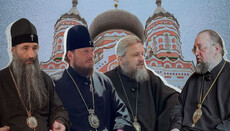
As the anniversary of the Council in Feofania approaches, rumors about impending changes in the UOC have resurfaced. Here is what the hierarchs who participated in those events themselves say.
On May 27, the Ukrainian Orthodox Church will mark the fourth anniversary of the Council in Feofania. Throughout these years, despite mass church seizures and persecution by the state, the UOC has continued its ministry. New churches are being built in place of those taken away, the number of parishioners has not diminished, and the Church has preserved its internal unity.
At the same time, around a dozen Russian and Ukrainian Telegram channels have, since the Council in Feofania, carried out systematic attacks against the UOC – calling it “schismatic” and devoid of grace, while portraying the Council itself as a “betrayal of the Mother Church and the Patriarch.” Ahead of the anniversary, these resources have once again become active, persistently spreading rumors that the UOC is supposedly on the verge of making some fateful decision – restoring communion with Constantinople, appealing to the Phanar for exarchate status, or even unilaterally proclaiming autocephaly.
Against this backdrop, statements by several hierarchs have emerged that help clarify how truthful such claims really are.
Why the Council in Feofania was convened
Speaking about the events of four years ago, Metropolitans Yevlogiy of Sumy, Varsonofiy of Vinnytsia, Victor of Khmelnytskyi, and Archbishop Sylvester of Bilohorodka are unanimous: convening the Council amid the outbreak of war was unavoidable. The key reason behind its convocation was the position of Patriarch Kirill. After the Russian invasion of Ukraine, he behaved in a way entirely different from what the clergy and faithful of the UOC had expected. The hierarchs stress that the Council was not the decision of one person, nor a response to outside pressure.
They emphasize that the initiative came “from below.” In Sumy, it was the clergy themselves who first declared they would cease commemorating Patriarch Kirill, and only afterward sought Metropolitan Yevlogiy’s blessing. In Vinnytsia, Metropolitan Varsonofiy gathered the deans and diocesan council, where a vote among clergy resulted in 84% supporting the cessation of commemoration. Metropolitan Victor of Khmelnytskyi, who at the beginning of the war served as a vicar of the Kyiv Metropolia, noted that among the thirty priests of his vicariate, only two continued commemorating the Patriarch.
The hierarch said that both he and many other clergymen believed that had the Primate of the ROC taken a different stance at the time, the Council might never have taken place.
“What would have happened if the Patriarch had risen above this bloodshed? If he had said that his flock is in Russia, Ukraine, and Belarus alike? Had such words been spoken, we could even have defended ourselves by his name, defended him, supported him, and said: here is a hierarch who is not afraid to raise his voice and defend the suffering people of Ukraine. But what happened, happened. And unfortunately, I repeat the words of the Council of the UOC, which expressed disagreement with the Patriarch’s position. This was recorded in the decisions of the Council of the UOC held in 2022. It is a sorrowful and hard fact, but it happened and has taken its place in history,” the hierarch said.
According to Metropolitan Victor, before the Council Metropolitan Onuphry prayed intensely and prepared carefully.
“He invited diocesan bishops with administrative experience, spoke with them, wanted to hear their opinions, to synthesize everything and understand what decisions should be made next. So the Council was not spontaneous. Those who came to His Beatitude for lengthy meetings helped him sense the situation in the dioceses,” the hierarch emphasized.
We would add that we remember that period well – the waves of clergy meetings in dioceses, the growing tension on social media. Priests wrote that parishioners demanded the cessation of commemoration of the Patriarch because they could no longer call him their lord and father. The tension became so intense that ignoring it would have endangered the very unity of the Church.
Why the gathering was called a Council
One of the main arguments of critics is that what happened in Feofania on May 27, 2022, was not a Council at all, but merely a meeting. Delegates, they claim, were not elected according to all the rules, the agenda was not announced beforehand, and therefore everything that happened was uncanonical and illegitimate. This thesis is actively promoted by certain Russian Telegram channels and by part of the clergy within the UOC itself.
Metropolitan Victor, who at the time headed the administrative apparatus of the Kyiv Metropolia and was in constant contact with His Beatitude, explained the mechanism from within.
“The delegates who were chosen in the dioceses, even for a meeting, were selected in such a way as if they were later to participate in a Council. Not in every diocese, but this was the case,” the hierarch said.
According to him, once it became clear during the meeting that the episcopate, clergy, and faithful were prepared not merely to converse and disperse, but to adopt a conciliar decision, Metropolitan Onuphry, in accordance with the Statute of the UOC, proposed putting to a vote the question of granting the gathering the status of a Council of the UOC. All present – bishops and lay delegates alike – supported the Primate’s proposal by majority vote.
“According to the Statute, the procedure for electing delegates is determined by the Holy Synod of the Ukrainian Orthodox Church, which convened that very same day. So, I stress once again, there was a meeting of the Synod, a Council of Bishops, and the Council of the UOC. And beforehand, the issues later brought before the Council and reflected in its resolutions had already been discussed at the Council of Bishops,” Metropolitan Victor emphasized.
Archbishop Sylvester particularly stressed that all hierarchs voted twice – first at the Bishops’ Council and then at the Local Council. Therefore, claims that someone “did not understand the agenda” or “did not realize what they were voting for” simply do not correspond to reality.
Metropolitan Yevlogiy adds a simple observation: those who today declare the Council illegitimate remained silent at the Council itself. Anyone could take the microphone, anyone could vote against. “There was a spirit of freedom,” the hierarch says. “It was not one of those councils where everything is prearranged and everyone already knows what they are supposed to say.” Those who were silent then are speaking now. In the archbishop’s view, that is more eloquent than any canonical argument.
We would add:
The Statute of the UOC does not prescribe an exact procedure for electing diocesan delegates to a Council. In some dioceses elections were held; elsewhere delegates were appointed by the bishop. But one thing is certain: even if delegates to the Council itself had been elected from the outset rather than to a meeting, the result would not have changed. The same people would have gone to Kyiv.
Was the Council held under pressure?
Another common accusation is that the Council was organized and conducted under pressure from the Ukrainian security services – figuratively speaking, “at gunpoint.” The essence of the claim is simple: bishops were allegedly forced to attend, the SBU pressured the clergy, and therefore any decisions adopted are illegitimate. The hierarchs who participated in the Council reject this thesis – and not merely with denials, but by examining its logic.
The first question concerns motive. Metropolitan Varsonofiy formulates it sharply: “If we were herded there at gunpoint to adopt autocephaly, why was autocephaly never adopted? It simply makes no logical sense.” Metropolitan Victor raises the same point differently: most bishops did not know before May 27 what decisions would ultimately be adopted. There was no agenda. The Council emerged through living discussion, not according to a prepared script. To drive people “at gunpoint” toward an unknown result would be absurd.
All the hierarchs describe the atmosphere in the same way.
Metropolitan Yevlogiy: “I saw freedom of spirit. Everyone could speak, everyone could say what they wished. There were diametrically opposed opinions. His Beatitude listened to everyone.”
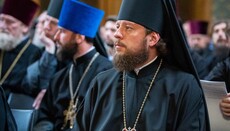
Metropolitan Victor recalls a living queue at the microphone – laity, priests, bishops – with no one rushing or silencing anyone. “The heated discussions, which at times even rose to raised voices, show that this was not a prearranged decision,” he says. The voting statistics confirm this: 73 in favor and 2 against, 72 in favor and 3 against – not the sort of numbers usually produced under coercion.
We would add:
It is worth remembering that four years have passed since the Council, and time itself has answered the question of whether it was convened under pressure from the security services.
The logic is simple: if the hierarchy had merely been fulfilling a government order, why did that same government later begin unprecedented persecution of the UOC? Why seize the Kyiv-Pechersk Lavra, assist OCU supporters in church takeovers, fabricate criminal cases, and launch a massive media smear campaign? The answer is obvious: either there was no coercion in organizing and conducting the Council in Feofania, or there was pressure, but the results turned out entirely different from what the authorities had expected.
Did the UOC become “schismatic” after the Council?
Accusations that the UOC fell into schism after Feofania come mainly from certain clerics and media resources in Russia and are linked to the cessation of commemorating Patriarch Kirill. The hierarchs address this thesis from several angles.
The first argument is historical. Archbishop Sylvester points out that the Russian Church itself endured long periods without a patriarch altogether.
“How did the Church exist during the two hundred years of the synodal period, when there was no Patriarch of Moscow?” he asks. “St. Seraphim of Sarov, St. Theophan the Recluse, St. Ignatius Brianchaninov – all belonged to that period, when only the ‘presiding member of the Holy Synod’ was commemorated. The idea that without the name of the Patriarch of Moscow the Holy Spirit does not descend upon the sacraments is theologically untenable.”
The second argument concerns ties with world Orthodoxy. Critics claim the UOC has become isolated. Archbishop Sylvester rejects this outright.
“If I travel to the Bulgarian or Romanian Orthodox Church, none of the bishops there will call the Moscow Patriarchate to ask whether they are allowed to concelebrate with Sylvester.”
The hierarchs also point to the recent participation of a UOC delegation in memorial services following the repose of Patriarch Ilia and in celebrations surrounding the election of the new Primate of the Georgian Church.
Another example is the recent Council of Bishops of the Serbian Church, at which “the suffering of the Ukrainian Orthodox Church at the hands of the current authorities in Kyiv was discussed and remains relevant.” The same situation exists with other Churches. The hierarchs emphasize that Ukrainian clergy concelebrate in all Churches except those that recognized the OCU. Clergy from those Churches travel to Ukraine to serve. On the anniversaries and name days of His Beatitude Metropolitan Onuphry, the Primates of Local Churches annually send him greetings. Thus, among the Local Churches, no one doubts either the grace-filled nature of the UOC priesthood or the validity of its sacraments.
Metropolitan Yevlogiy adds to this the concept of reception. He stresses that the Council truly took place – not only juridically, but in the sense that matters even more than legality: the people of God accepted its decisions.
“That this Council was according to the will of the Holy Spirit we now see in the reaction of the people of God, who have embraced all the decisions of this Council.”
And here a separate comment is needed, because critics of the UOC claim the opposite – that the faithful never accepted the Council’s decisions. What can be said in response?
Very simply:
If the reception of Feofania had truly failed, we would see the signs of a real schism – a sharp collapse in church attendance, the formation of separate “anti-Feofania” communities attracting believers, the emergence of parishes without priests, similar to the priestless Old Believers, and rejection of the Primate.
Do we see anything like that? No. One need only look at how many people gather for the services of Metropolitan Onuphry, or at the crowds attending services in the Pochaiv Lavra.
And this is the best answer to those who continue on social media to insist that after the Council the UOC became devoid of grace. Some critics go even further, urging parishioners not to attend its services at all. Metropolitan Viktor said of such people:
“Can we change them? Certainly not. Can we prevent them from saying what they say? Of course not. But nevertheless we must know our own path, we must listen to one another, unite with one another, and preserve the unity of our Ukrainian Orthodox Church.”
Should the UOC convene a new Council?
Discussions continue over whether the decisions of Feofania require confirmation by a new Council. Is this so? Archbishop Sylvester calls it “one of the common canonical and historical myths.” According to him, a subsequent Council honors the decisions of the previous one – not in order to reapprove them, but to demonstrate continuity of tradition.
“Let us carry the argument to absurdity: the Seventh Ecumenical Council would then have had to be confirmed by an Eighth. But no such council existed. Does that mean the Seventh remains unfinished?” he asks.
He adds that the Council of 1917, which restored the Patriarchate in Moscow, was likewise never confirmed by any later council.
Metropolitan Victor frames the matter differently – through obedience. He stresses that according to the Statute, the Council’s decisions are binding for the entire fullness of the UOC.
“The overwhelming majority of the Church accepted this decision, and we must fulfill it. If the next Council adopts something else, adds or removes something – I speak hypothetically now – then I will be among the first bishops to obey it. Some things I may like, others I may dislike, but the Church’s decision must be accepted and fulfilled.”
Metropolitan Varsonofiy puts it even more bluntly: “There will be another Council – then we will continue the discussion.” Until then, disagreements should be resolved within the Church, not through public pressure and Telegram channels.
The main thing for the Church is unity
Behind all the canonical disputes, arguments about legitimacy, and discussions of another Council, all four hierarchs return to one thing – unity. Not as an administrative concept, but as a spiritual imperative.
Archbishop Sylvester points out that conciliarity cannot be replaced by dependence upon a single individual who, by human nature, is capable of making mistakes. “Do not become slaves of men, for you were bought at a great price,” he quotes from the Apostle Paul – not as an abstract theological citation, but as practical guidance: unity is built not around a name, but around Christ.
Metropolitan Varsonofiy speaks of unity through obedience to the conciliar decision: “The Council in Feofania made its decision, and we must follow it together, rather than forcing through personal disagreements. All questions must be resolved through the conciliar mind.”
Metropolitan Yevlogiy speaks with the deepest pain – from frontline Sumy. He calls on believers to preserve peace of soul and “hold tightly to the hand of Christ.”
Metropolitan Victor summarizes:
“There may be different opinions, but we must preserve our unity. Unity in Christ, unity of our Orthodox Church in Ukraine, where we live together, labor together, and pray together. We must do our work – the work of Christ: labor, work, pray, weep, grieve, rejoice, live in Christ. And the Lord Himself will order all the rest.”
A Church purified by fire
If one steps away from Telegram channels, from disputes over formulations and canonical nuances, and looks at the Ukrainian Orthodox Church through the eyes of an ordinary believer, something remarkable becomes visible. A Church whose churches are taken away does not despair, but builds new ones. A Church whose bishops are interrogated and put on trial does not flee in fear or lock its doors, but fearlessly serves the Divine Liturgy. A Church slandered daily by hundreds of information resources prays for those who revile it. A Church systematically targeted for division both from outside and within remains united.
It is difficult to escape the thought that today we are witnessing something we previously read about only in patericons and saints’ lives. Throughout the centuries, the Church was known not by prosperity, but by persecution.
The Holy Fathers said: the blood of martyrs is the seed of the Church. And that seed sprouts not where life is quiet and safe, but where it is dangerous and painful, where one must choose. Where confession of faith is paid for with freedom, health, and sometimes life itself.
Is there today another Orthodox Church in the world pressed with such persistence? One against which the authorities issue laws, declare it a threat to national security, and drive its priests beneath the wheel of mobilization? And despite all this – no schisms, no mass apostasies, no empty churches.
On the contrary, the rural priest whose church was seized yesterday serves today under a canopy, in a tent, in someone’s home – and the people gather around him. The elderly woman who was shoved and insulted returns the next morning to the Liturgy in precisely the Church for which she was beaten and humiliated the day before.
Those who remain in the UOC today have done so not out of inertia or convenience, but at the call of conscience. This is no longer nominal Christianity, but true confessorship – the kind of faith in which saints are born and grow. The pressure meant to destroy is purifying. The persecution meant to scatter is embracing. The slander meant to disgrace is separating the faithful from the accidental.
This is precisely the grace-filled soil spoken of by the Holy Fathers: a time when there is not a single external reason to remain in the Church except Christ Himself. When everything superfluous falls away – habit, family tradition, social status, political advantage – and only He remains. And whoever remains in the Church at such a time remains with Him.
Perhaps this is the most important result of the four years after Feofania. Not arguments over canonical procedures, nor voting statistics, but the fact that today the Ukrainian Orthodox Church is, without exaggeration, one of the most living Churches in the Orthodox world. Living because people suffer for it. Living because people pray in it not out of habit, but out of necessity.
When on May 27 the churches of the UOC commemorate the Council in Feofania, the chief feeling with which one should approach this date is not triumph, not resentment, not the desire to prove something to someone. Rather, it is quiet gratitude that the Lord has counted us worthy to belong to this Church precisely now. That we were not born in an age of splendid, safe, and authoritative Orthodoxy, but were granted to witness how the Holy Spirit acts in a persecuted Church before our very eyes. Gratitude for every hierarch who remained with his flock, for every priest who did not abandon his parish, for every layman who today crosses himself before entering a church, knowing that for this they may be condemned and deprived of earthly well-being. For all this, we must thank God.
And if during these four years the UOC has neither broken, nor split, nor retreated, then the step taken was the right one. Then we are walking the very path the Lord foretold for His followers – not easy and peaceful, but hard and thorny, yet the only path leading to Life.