
Ilia and Filaret: One era, one magnitude, two different destinies
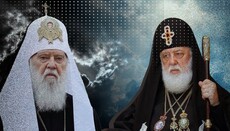
Both lived extraordinarily long lives. Both carried immense weight in the Church. Both were granted a rare place in history. One became the father of his people – the other, the face of schism. Why did it happen this way?
Truly remarkable people are often obscured by events, conflicts, titles, and those around them. But death usually puts everything in its proper place. This week, Patriarch Ilia II and Filaret Denysenko both departed this life – two hierarchs of the same era, nearly the same age, and of immense ecclesiastical stature. Both shaped the destiny of their peoples. Both were given a rare historic opportunity at a turning point for their nations.
What is the final reckoning? All of Georgia is bidding farewell to Ilia as to the dearest and closest of men, while Filaret’s death has drawn a response chiefly from officials. They speak of his historical legacy – powerful, conspicuous, yet in essence profoundly divisive.
One era, one scale, one historic chance
Filaret Denysenko was born in 1929. After finishing school, he entered the Odessa Theological Seminary. In 1950 he took monastic vows; in 1952 he graduated from the Moscow Theological Academy and remained there as a lecturer. From 1957 he served as rector of the Kyiv Seminary; from 1968 – as Metropolitan of Kyiv and Galicia, Exarch of All Ukraine. In 1990, after the death of Patriarch Pimen, he became locum tenens of the Patriarchal Throne in Moscow and the leading candidate for the patriarchate. Yet Alexiy (Rüdiger) was elected Patriarch of Moscow, and Filaret returned to Kyiv.
Ilia II was four years younger: he was born in 1933, graduated from the Moscow Theological Seminary in 1956 and from the Moscow Theological Academy in 1960. In 1963 he became a bishop, in 1969 a metropolitan, and on December 23, 1977, he was elected Catholicos-Patriarch of All Georgia.
Both emerged from the Soviet era. Both graduated from the Moscow Theological Academy. Both possessed intelligence, resolve, and ecclesiastical authority. At the moment of the Soviet Union’s collapse, Ilia and Filaret stood at the head of Churches in newly independent states: one in the status of autocephaly, the other of autonomy. From that point on, the paths of these two men diverged.
The moment of divergence: ministry or primacy
At the decisive moment, Ilia and Filaret made two different inward choices.
When Georgia descended into a coup and civil strife in 1991–1992, Ilia did not try to place himself on one side or the other. He did not wager on any political victor. He did all he could for dialogue and reconciliation, understanding that the Church stands above political ruptures and is called to unite a people, not carve new lines of division through it.
Filaret, in those same years and amid strikingly similar circumstances, acted otherwise. After Ukraine proclaimed independence, he began pressing for full autocephaly for the UOC. In itself, that was not blameworthy. The problem lay elsewhere: he knew perfectly well that the idea lacked the support of the majority of clergy and church people and therefore would inevitably produce division. Yet he resolved to press on to the end. And not because he was moved by some principled commitment to full independence. No – what drove him above all was the thirst for power.
The price Filaret was willing to pay included even perjury. Before the Cross and the Gospel, he gave his word that he would resign – and an audio recording of that promise survives – and then he broke it. When, in May 1992, the bishops of the UOC gathered in Kharkiv and elected Metropolitan Volodymyr (Sabodan) as the new primate, Filaret took the entire church treasury and joined forces with part of the schismatic Ukrainian Autocephalous Orthodox Church to create a new ecclesiastical body. Thus the UOC-Kyiv Patriarchate came into being.
History repeated itself a quarter of a century later
That Filaret’s chief “engine” was the desire for power was finally confirmed by the events of 2018–2019. At the end of 2018, he stood closer than ever to realizing the goal he had proclaimed for years – the creation of an autocephalous Ukrainian church. But after he was outmaneuvered and another man was placed at the head of the new structure, Filaret immediately abandoned it in order to remain first in the by-then marginal UOC-KP.
The “new-old” Kyiv Patriarchate – like his “patriarchate” itself – was recognized neither by the Patriarchate of Constantinople nor by anyone else. But this did not trouble Filaret. He began once again to “ordain” bishops and construct his own church structure. In other words, having received from the state and from Constantinople the very thing he had pursued for decades – an autocephalous Ukrainian church – Filaret once again chose rupture as soon as it became clear that he himself would not be first in that church.
The cost was immense: a split within the OCU, yet another fracture in Ukrainian society, the loss of almost all parishes and dioceses, and the need to begin again from nothing – at ninety years of age. But even that was a price Filaret was ready to pay for his primacy.
The father of a people and the face of schism
With time, the difference between the two hierarchs became still more stark. For Georgia, Patriarch Ilia ceased to be merely a primate. Under him, the Church became the most respected institution in civil society, and he himself became the man nearly everyone trusted. Sociological surveys recorded this for many years. Beginning in 2008, Ilia personally baptized the third and subsequent children in families; by the summer of 2025, the number of his godchildren had reached roughly fifty thousand. In this way, he became for the people not metaphorically but almost literally a father. Today, as the whole country bids farewell to its primate, the stream of people flowing to Holy Trinity Cathedral in Tbilisi continues around the clock.
The outcome of Filaret’s life proved different. His name became indelibly bound to one word – schism. The break with the UOC in 1992, the break with the OCU in 2019. In neither case did he make any attempt at reconciliation. In October 2025, he even wrote a spiritual testament forbidding the “hierarchs” of the OCU to take part in his funeral service. Most of them were men he himself had formed, “ordained,” and advanced through the ecclesiastical ranks. Yet he died estranged even from them.
And so the essential thing became fixed in the public memory: Ilia gathered the people around himself, while Filaret again and again left behind a line of division.
The repentance that was awaited – but never came
For all the suffering and conflict caused by Filaret’s schism, the UOC regarded him not so much as an opponent as a man in special need of prayer, a man for whom the door of the Church had not been shut. Long before the Tomos, the same conviction was repeatedly voiced in church circles: unity in Ukraine could come not through political combinations and not through the legalization of schism, but through repentance and the return of those who had fallen away to the Church. The primates of the UOC – His Beatitude Metropolitan Volodymyr and His Beatitude Metropolitan Onufriy – spoke of this more than once. In the UOC, they waited for Filaret. They prayed for his return.
But repentance never came. And the point is not that someone supposedly “did not allow” Filaret to return, though that may have seemed plausible in 2017, when he wrote a letter to the Bishops’ Council of the Russian Orthodox Church and then effectively disowned it. In the ecclesial sense, repentance is not mere regret in words, nor some vague appeal to reconciliation. It is the renunciation of the schism one has created and a return to the Church from which one fell away.
This is not some private “wish” of the UOC – it is the true meaning of repentance in schism. Thus, in 2020, Metropolitan Seraphim of Piraeus of the Church of Greece – which as a whole recognized the OCU – stated that Filaret ought to have returned to the UOC, repenting of the schism he had brought about.
Filaret’s inner tragedy lies in the fact that he never found the strength to step over his own “patriarchal project.” In the UOC, they waited for that step to the very end. But the man who had spent so many years struggling for primacy could not renounce it even at the threshold of death.
Death as the sum of a life
The difference between Ilia and Filaret is seen most clearly in the way society has responded to their deaths. In Georgia, Ilia’s repose at once took on the character of a national grief: mourning was declared until his burial on March 22, Holy Trinity Cathedral was opened nearly around the clock for the faithful to come and bid farewell, public transport in Tbilisi was made free, additional free buses and trains were launched from the regions, and the human river flowing toward the cathedral has not run dry. Tens of thousands of the Patriarch’s godchildren held a separate procession in his memory. Without exaggeration – all Georgia mourns its father.
The reaction to Filaret’s death looks different. Statements and condolences have come from public officials: President Volodymyr Zelensky, Verkhovna Rada Chairman Ruslan Stefanchuk, and the head of the Presidential Office, Kyrylo Budanov. The leadership of the OCU ignored Filaret’s testament and declared that it would itself take charge of the farewell and burial. In all these statements, the emphasis falls on Filaret’s contribution to Ukrainian statehood, “spiritual independence,” the creation of a Local Church, and resistance to Russian aggression. His death is being presented as the passing of a major historical and political figure.
This does not mean that no one grieves for Filaret: the farewell has only begun, and people will undoubtedly come. But even now the enormous difference is plain. Ilia’s death evokes in each Georgian the sense of a personal loss. Filaret’s death evokes above all a stream of judgments about his historical role. In the first case, a people bids farewell to a man as to one of its own family. In the second, society and the state render their verdict on an extraordinary yet deeply contradictory biography. This contrast, better than any words, reveals the difference between these two lives.
Conclusion
The story of the life and death of Patriarch Ilia and Filaret Denysenko is a reminder to each of us. A man may be gifted, influential, live a long life, and leave a visible mark on history. But the final measure is not determined by any of these things. A person’s true greatness is measured not by rank, not by power, and not by historical influence, but by the ability to renounce himself for the sake of Christ. That is why the Church calls us to repentance not on our deathbed, but today – while the heart is still capable of humility, while the door is not yet shut, and while the road back has not been cut off by our own hardening. “Behold, now is the accepted time; behold, now is the day of salvation” (2 Corinthians 6:2).
Looking at these two lives, one can only pray both for the departed and for ourselves – that we may not postpone the choice between humility and self-love, between life and death, between Christ and ourselves.