
DESS expert review overturned by court: why this matters more than it seems

The appellate court did not halt the process of banning the UOC. But it did recognize as defective the very document on which the authorities built their campaign against the Church.
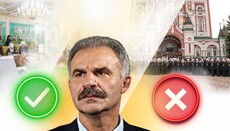
On April 6, 2026, the Sixth Administrative Court of Appeal issued a ruling in case No. 320/26027/23 on the claim of the Kyiv Metropolis of the UOC against the State Service of Ukraine for Ethnopolitics and Freedom of Conscience (DESS) and its head, Viktor Yelensky, annulling the DESS order that had approved the 2023 “expert review” declaring the UOC part of the ROC.
It is important here to avoid both euphoria and underestimation. The court did not cancel the broader process of banning the UOC: it did not repeal the anti-Church law, did not terminate liquidation suits, and did not forbid DESS from conducting new “studies.” But it did rule defective the procedure by which the very document was approved – the document that underpinned the entire legal, ideological, informational, and coercive campaign against the UOC.
A brief chronology
December 1, 2022. Volodymyr Zelensky announced a decision of the National Security and Defense Council to submit to the Verkhovna Rada a bill prohibiting the activity in Ukraine of religious organizations affiliated with centers of influence in Russia. This marked the starting point of the current phase of pressure on the UOC. The Cabinet was tasked with drafting the law, inspecting the Kyiv-Pechersk Lavra, and DESS was instructed to conduct a “review” of the UOC Statute.
December 23, 2022. DESS issued an order initiating the “religious studies review” of the UOC Statute. The “experts” appointed were largely individuals who had publicly expressed hostility toward the UOC.
January 10, 2023. The Kyiv Metropolis of the UOC filed a motion to recuse members of the expert group, pointing to their possible bias. DESS did not consider the motion, proceeded with the “review,” and by Order No. N-8/11 of January 27, 2023 approved its conclusions. Those conclusions were effectively predetermined: “The status of the UOC as a structural subdivision of the ROC… remains unchanged.”
After the publication of the “review,” a convenient formula took hold in the public sphere: “A state review has proven that the UOC is a Moscow church.” Legally, the “review” did not liquidate the UOC, but it became the document authorities relied on to convince society that the Church was an enemy and should be banned.
August 20, 2024. Parliament adopted the Law “On the Protection of the Constitutional Order in the Sphere of Activities of Religious Organizations,” aimed at banning the UOC. The President promptly signed it, and it entered into force on September 23, 2024.
Under this law, DESS conducted a new “study,” effectively continuing the logic of the 2023 “review.” Based on its findings, DESS declared signs of affiliation between the governing body of the UOC – the Kyiv Metropolis – and the ROC. The corresponding order was published on July 8, 2025. Once again, the key arguments were drawn from ROC documents: decisions of its Council and Synod, and provisions of its statute.
July 17, 2025. DESS issued an instruction to the Kyiv Metropolis to eliminate alleged violations by August 18, 2025. On August 27, 2025, it declared that the Metropolis had failed to do so and recognized it as affiliated with the ROC.
The next step was a lawsuit by DESS to terminate the activities of the Kyiv Metropolis of the UOC.
September 3, 2025. The Sixth Administrative Court of Appeal opened proceedings in case No. 855/11/25 on terminating the Kyiv Metropolis. The case did not lead to a quick ruling – hearings were repeatedly postponed, which is telling in itself.
And now, on April 6, 2026, that same court, in a different case – No. 320/26027/23 – rescinded the January 27, 2023 DESS order approving the conclusions of the “expert review.” The court noted that DESS had failed to consider the motion to recuse the experts, recognized this as unlawful inaction, and ordered a new review.
In turn, DESS has filed a cassation appeal with the Supreme Court, though this does not negate the force of the ruling.
Reaction of UOC opponents: “nothing happened” or “betrayal”?
On the one hand, DESS is trying to downplay the significance of the annulment. Its arguments boil down to three points: the court did not cancel the substance of the review, only identified a procedural flaw; the separate July 8, 2025 order on signs of affiliation remains in force; and a cassation appeal has already been filed. Member of the DESS expert council Andriy Smyrnov complained that the court acted “without delving into the correctness of the contested conclusion.”
In other words, officials are telling the public: nothing serious has happened, everything is under control, the process continues. But politicians who have long demanded a ban on the UOC reacted very differently.
MP Oksana Savchuk called the ruling “a betrayal” and “a shock for all sane citizens,” stating: “This is not only about religion. It is about security.” In other words, she repeated the familiar claim that the UOC poses a threat to Ukraine’s security.
MP Ihor Huz went even further. He complained that the court had annulled the only document on which authorities could base the liquidation of UOC structures, accused the judges of working for the enemy, and declared: “Moscow, through its agents, is saving its religious network.” No evidence was offered.
Why, then, do DESS officials say nothing serious happened, while anti-UOC politicians sound the alarm? To answer that, we need to understand the role the 2023 “review” played.
The role of the “expert review”
DESS insists that annulling the 2023 “review” does not cancel the 2025 “study” or undermine the order on affiliation. Formally, that is true. But the formal distinction does not eliminate their internal connection. The second document is a direct continuation of the first.
In 2023, DESS argued that the UOC had not severed canonical ties with the ROC despite its council decisions. In 2025, it said essentially the same thing: the Kyiv Metropolis, as part of the UOC, remains within the structure of the ROC, and ROC documents outline its authority over it.
In both cases, the logic is identical: the status of the Ukrainian Church is “proven” through internal ROC documents. But if the ROC continues to claim in its statute that the UOC is part of it, that reflects only the ROC’s claim. Why does the Ukrainian state accept that claim as evidence against the UOC?
If an aggressor state writes in its documents that Crimea or Ukrainian regions are its territory, does that make it so for Ukraine? Why, then, does the logic change in the religious sphere? Why do ROC documents suddenly become grounds for persecuting a Ukrainian religious organization?
And yet this very argument formed the core of the “review,” and it then carried over into the 2025 “study,” which became the basis for the lawsuit to ban the Kyiv Metropolis.
But it is important to understand that the 2023 “review” was not needed only for the courts. It was also a tool of public messaging. It was not a court ruling, did not dissolve the UOC, did not shut down parishes or transfer churches. Its role was different – and perhaps even more dangerous.
It became the document that allowed authorities, officials, MPs, media, and activists to say: “The UOC is an enemy organization on Ukrainian territory. This is not just an opinion – it is proven by a state body.” After that, any statement by the UOC about its independence was dismissed as false, and any attempt to defend it was framed as defending “Moscow.”
The label “Moscow church,” attached on the basis of this “review,” did more than launch the banning process – it became a convenient formula for public harassment of UOC believers, a way to inflame hostility, and a moral justification for seizures of churches and other abuses.
The “review” has now been annulled. If this were a mere technicality, why does Savchuk call it “betrayal”? If nothing changes, why does Huz complain that it is now nearly impossible to shut down UOC structures? If it is just procedure, why such a nervous reaction?
Politicians understand perfectly well:
the court did not simply cancel a minor document over a technicality – it removed a symbol, a document that for years served as a state seal on the accusation that the UOC was “pro-Moscow.”
Why now?
We cannot say with certainty that this ruling marks a shift in state policy. It may simply be that the judges saw an obvious violation: a recusal motion was filed, no decision was made, yet the conclusions were approved anyway. In a normal legal system, that alone is enough to invalidate the procedure.
But Ukraine’s recent reality invites a broader question. Why now? Why did the judicial system, which had largely followed the authorities’ line in cases against the UOC, suddenly act otherwise?
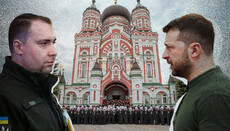
One possible explanation is that the authorities are cautiously reassessing their position and hedging against possible political changes or future elections. Notably, the court issued its ruling even before a high-profile statement by the head of the President’s Office, Kyrylo Budanov, who said that labeling the UOC as part of the Moscow Patriarchate is a manipulation.
But it is far too early for believers to breathe easy. The anti-Church law is still in force, the 2025 “study” still carries legal weight, and the cases seeking to shut down Church structures remain open. Most importantly, the religious hostility that the authorities have stirred up in society has not gone away.
Yet one thing can already be said: the annulment of the DESS “review” is conceptually important. It shows that even within the system there is an understanding that you cannot build a campaign against the largest religious organization in the country on a document approved in violation of basic procedure.
There is also another important point. If accusations against the UOC based on Russian documents are eventually deemed untenable, if the political situation shifts, someone will have to answer for the clear abuses being committed today. And it will almost certainly not be those who made strategic decisions, but those who carried them out – those who signed orders, ignored recusal motions, approved questionable conclusions, and turned a scholarly procedure into a political tool. This court ruling may be a warning to officials: violations of the Constitution and human rights cannot go unpunished forever.
The main conclusion
But the main conclusion of this entire story is not legal or even political.
Believers should not deceive themselves: our hope is not in the appellate court, nor in the idea that the authorities will suddenly come to their senses. The situation can change very quickly in either direction.
Our hope is in Christ.
And the Lord did not promise His disciples a life free from hardship, protection from slander, or the favor of the authorities. On the contrary, He said plainly: “In the world you will have tribulation; but be of good cheer, I have overcome the world” (John 16:33).
The Lord has overcome the world – all those in power with their armies, state machinery, media resources, and so on. He overcame by humility and by fulfilling the will of the Father to the end. That is the only way Christians can overcome.
Christ allows persecution, but He gives a promise: “I will build My Church, and the gates of hell shall not prevail against it” (Matthew 16:18).
All forces may rise against the Church, all the power of the state may be turned against it – and everything can collapse in a single moment over something seemingly small.
Perhaps even over the fact that DESS failed to consider a motion to recuse members of its own “expert group.”