
Why Hieromartyr Macarius is not a standard-bearer of the OCU
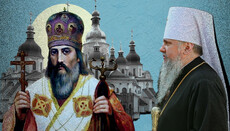
The head of the OCU turns a 15th-century saint into an instrument of his propaganda. We refute another speculation by Serhiy Dumenko.
On May 1, 2026, the feast day of Hieromartyr Macarius, Metropolitan of Kyiv and All Rus’, the head of the OCU, Epifaniy Dumenko, published a text in which the memory of the saint became not so much an occasion for a sermon as for historical and political speculation. On the official OCU website, the sermon appeared under the headline: “Saint Macarius Was Ordained and Installed Not Simply as Metropolitan of Kyiv, but as Metropolitan of All Rus’.”
Saint Macarius did indeed bear the title Metropolitan of Kyiv and All Rus’. But first, that title meant something entirely different in those days than it does now. And second, Dumenko builds upon it an entire propagandistic narrative: that the Moscow Church was supposedly always an external enemy, that Kyiv was always fighting for ecclesiastical independence, and that the modern OCU is the direct continuation of this ancient struggle.
Do historical sources support the picture painted by the head of the OCU? Of course not. The reality is far more complex. In fact, many historical facts do not support Dumenko’s propagandistic narratives at all – they undermine them. Let us examine the matter in detail.
The world in which Saint Macarius lived
To understand the story of Macarius, one must first imagine what the real 15th century looked like. This was not an age of nation-states in the modern sense, not an era of “Ukraine,” “Russia,” the “OCU,” or the “ROC” in today’s categories. It was a world of the fragmented inheritance of Rus’, the Grand Duchy of Lithuania, Poland, Moscow, Constantinople, Rome, the Crimean Khanate, and the Great Horde – a world of constant military threats and uncertain borders.
By that time, Kyiv had long ceased to be the political capital of ancient Rus’. After the Mongol invasion of 1240, the city suffered catastrophic decline. In the 14th century, Kyiv and the surrounding lands came under the rule of the Grand Duchy of Lithuania; in 1471, the Principality of Kyiv was finally transformed into the Kyiv Voivodeship.
In the days of Macarius, Kyiv was merely a frontier city of the Grand Duchy of Lithuania, standing at the edge where Lithuanian authority ended and the Crimean steppes began. Neither a “Grand Prince” nor a “Metropolitan of Kyiv and All Rus’” truly resided there any longer – only the titles remained. The reality was different: desolation, the Tatar threat, desecrated shrines, and dependence upon Lithuanian-Polish lords.
The main ecclesiastical factor: The Florentine Union
Dumenko completely ignores this factor, yet without it the ecclesiastical history of the mid- and late 15th century cannot be understood at all.
The Council of Ferrara-Florence took place in 1438–1439. There, representatives of the Church of Constantinople effectively betrayed Orthodoxy and acknowledged the supremacy of the Pope of Rome. The Byzantine people rejected the union. But Isidore, newly appointed Metropolitan of Kyiv and All Rus’, became one of its most active supporters. Despite bearing the title “Metropolitan of Kyiv,” Isidore did not go to Kyiv at all – he went to Moscow and from there traveled to the council in Florence. After accepting the union, he returned to Moscow, but Grand Prince Vasily II expelled him because the union was not accepted there. For some time Moscow hesitated to appoint a metropolitan independently, yet appealing to Constantinople was impossible because no one could say with certainty whether the patriarch there remained Orthodox or had become a Uniate.
In 1448, at the initiative of the Grand Prince, a council of Russian bishops in Moscow appointed Jonah as metropolitan without Constantinople’s approval. Later, in correspondence with Constantinople after the Florentine Union had collapsed, the Russian hierarchs wrote that they had consecrated a metropolitan independently not out of evil intent, but “out of necessity.” Moreover, Vasily II had previously wished Jonah to become metropolitan, but the Greeks had appointed Isidore instead, promising that Jonah would become the next metropolitan.
The thesis that the “Muscovites desired autocephaly” simply does not correspond to the facts. No one proclaimed autocephaly. The Russian bishops were compelled to appoint a metropolitan independently because there was no one in Constantinople to whom they could appeal: the patriarchate that had signed the Florentine Union could no longer be regarded as Orthodox.
How a separate Kyivan Metropolia emerged
After the devastation of Kyiv in 1240, two centers of power gradually formed in Rus’: the Galician-Volhynian Principality and Vladimir-Suzdal. Yet the metropolia remained united until approximately 1303, when Prince Yuri Lvovich of Galicia persuaded Patriarch Athanasius to grant him a separate metropolitan. Thus the Galician Metropolia was established, and the Greeks transferred to it the dioceses of Peremyshl, Volodymyr-Volynskyi, Lutsk, Kholm, and Turov. The first western Rus’ metropolitan was Niphont. At the same time, the eastern Rus’ metropolitan was Maximus.
It was Maximus – an ethnic Greek – who transferred the actual residence of the Kyivan metropolitans to Vladimir-on-the-Klyazma. And it was he who bore the title “Metropolitan of Kyiv and All Rus’.” In fact, the phrase “and All Rus’” was added retrospectively in later tradition. Byzantine sources refer to him simply as “Metropolitan of Kyiv” and state that he was “appointed to Rus’.” Niphont, meanwhile, officially bore the title “Metropolitan of Galicia.”
Therefore,
the first division of the metropolia was not a struggle between two equal “Kyivan metropolitans” for the title “of All Rus’.” It was the creation of a separate Galician metropolia because the Galician-Volhynian princes did not wish to depend on a metropolitan who effectively resided in the northeast of Rus’.
After this first division, the two parts of the once-united Kyivan Metropolia were reunited and divided again several times. The division that existed during Metropolitan Macarius’ lifetime emerged in 1458, when Patriarch Gregory III Mammas of Constantinople installed Gregory the Bulgarian on the Kyivan see. Mammas himself was a Uniate who had already been expelled from Constantinople and was living in Rome. Thus, Gregory the Bulgarian’s appointment was essentially a fiction. Its purpose was to subject the Kyivan Metropolia to the Pope of Rome – something that had failed under Isidore.
But Moscow already had Metropolitan Jonah and refused to recognize the Uniate Gregory. Only some Orthodox bishops in Poland and Lithuania accepted him. Yet the faithful had little desire to embrace the Florentine Union, and Gregory was soon forced to return to Orthodoxy and recognize the Orthodox Patriarch Dionysius I of Constantinople. Thus, two Orthodox metropolias once again emerged within Rus’.
It is therefore incorrect to portray the western Rus’ Kyivan Metropolia of the 15th century as some historical analogue of today’s OCU, while depicting the Moscow Church as a usurper of чужой history. In reality, both lines emerged from one vast crisis, when the unity of the Church of Constantinople itself was shattered by the Florentine Union.
The Polish-Lithuanian factor: what Dumenko prefers mot to mention
Dumenko carefully avoids an inconvenient fact: the principal source of suffering for the Orthodox lands of western Rus’ in the 15th century was not Moscow at all, but the Catholic rulers of Lithuania and Poland.
Orthodox Christians were forbidden to build new churches or even repair old ones. Secular authorities brazenly interfered in the appointment of bishops and abbots. Church discipline deteriorated: the metropolitan exercised little real authority over the bishops, while the clergy often depended more upon secular patrons than upon ecclesiastical hierarchy. Members of the nobility were frequently elevated to episcopal office for whom the episcopate was a career rather than service to God.
Who was Saint Macarius?
Saint Macarius was the archimandrite of the Holy Trinity Monastery in Vilnius. Almost nothing is known about his origin or early life. After the death of Metropolitan Jonah Glezna in 1494, Macarius was appointed Metropolitan of Kyiv.
The manner of his appointment differed little from the way Metropolitan Jonah had been installed in Moscow in 1448. Macarius was appointed metropolitan without prior approval from Constantinople, and only afterward were envoys sent to the patriarch requesting a “blessing” and explaining that the metropolitan had been appointed “out of necessity.” The patriarch gave his blessing, though with the condition that this would be the final such case. Most likely, the patriarchal letters of blessing arrived only after Macarius’ death.
Although Macarius presided over the western Rus’ metropolia, he enjoyed the favor and trust of Grand Prince Ivan III of Moscow. On February 15, 1495, Macarius greeted Ivan’s daughter Elena Ivanovna upon her arrival in Vilnius for her marriage to Grand Duke Alexander Jagiellon of Lithuania. Ivan III wanted Macarius himself to perform the marriage ceremony, but Alexander rejected this demand.
The circumstances of Macarius’ death
Dumenko claims that Macarius sought to return to the “true spiritual throne of all Rus’.” This is simply absurd. In the second half of the 15th century, the Kyivan metropolitans scarcely visited Kyiv at all. Their residence was in Novogrudok, and later in Vilnius.
Kyiv had been devastated back in 1240. Thereafter the Tatars repeatedly raided the lands of Rus’. One such raid occurred in 1482, during which the Kyiv Caves Monastery and Saint Sophia Cathedral suffered terribly. In the spring of 1497, Macarius set out for Kyiv, as the source says, “for the sake of helping the Church of Holy Wisdom.” He was not going there to establish his see in Kyiv, nor to challenge Moscow, but simply to aid Saint Sophia Cathedral in its restoration and strengthen the long-suffering clergy of Kyiv.
On May 1, 1497, Metropolitan Macarius was killed by Crimean Tatars near the village of Stryhalovo, five miles from Mozyr, while traveling toward Kyiv. His companions were either slain or taken captive. The metropolitan’s remains were brought to Kyiv and laid to rest in Saint Sophia Cathedral.
These are established facts. Yet Dumenko goes further. He says that “some historians” believe the Tatar attack was not accidental, that the saint’s enemies had “incited the Tatars.” This is pure speculation.
First, there is no evidence whatsoever for such claims. Second, as already noted, Macarius enjoyed the trust of Grand Prince Ivan III of Moscow. Third, Moscow derived no benefit from the murder of Macarius. If anyone stood to gain from his death, it was actually the clergy of Vilnius.
After becoming metropolitan, Macarius sharply altered his relations with Vilnius. He visited the city far more often than his predecessors and each time collected entrance fees. He increased certain ecclesiastical taxes, claimed half of memorial donations and prayer offerings, and curtailed the rights of townspeople in parish churches. Naturally, he had many dissatisfied opponents. But to accuse the clergy of Vilnius of involvement in his death is conjecture. To accuse the Muscovites is conjecture doubly so.
The Tatar threat and the raid of 1482
To be fair, historians do have reasons to believe that Muscovites at times encouraged Tatar raids. But this concerns not the murder of Metropolitan Macarius in 1497, but the devastation of Kyiv by Crimean Khan Mengli Giray in 1482 – fifteen years earlier. Historians genuinely debate whether Mengli Giray’s campaign against Kyiv was inspired by the Moscow grand prince and how Moscow’s interests intersected with the ambitions of the Crimean khan. Yet no final conclusion has been reached.
In those centuries, Tatar raids upon Rus’ were tragically common, varying in scale and motive. For several centuries, our land became the arena of rivalry among the Polish-Lithuanian Commonwealth, Muscovy, and the Crimean Khanate. These powers alternately competed and cooperated with one another and with Ukrainian princes – and later hetmans – in endlessly shifting combinations. It was the common people and the Orthodox clergy, as an inseparable part of them, who suffered most from this politics.
Where the manipulation lies
Dumenko takes several genuine historical facts and then transforms them into propagandistic myths. It is true that Macarius was Metropolitan of Kyiv and All Rus’. It is true that before 1240 Kyiv had been the center of Rus’. It is true that after 1448 Moscow, speaking in modern terms, emerged from under the jurisdiction of Constantinople. It is true that Metropolitan Macarius was traveling toward Kyiv and was killed by Tatars.
But from there Dumenko turns to outright manipulation. In his narrative, Macarius’ title “Metropolitan of Kyiv and All Rus’” supposedly proves the legitimacy of the modern OCU. The ecclesiastical crisis caused by the Florentine Union becomes evidence of the Moscow Church’s “schism.” The martyrdom of Saint Macarius at the hands of Tatars becomes a hint at a conspiracy by the saint’s “enemies.” And the complicated, contradictory world of the 15th century is reduced to a 21st-century slogan: the Moscow Church was always the enemy, Kyiv was always the victim, and the OCU is the lawful heir of the ancient Kyivan Metropolia.
But the real 15th century confirms none of these narratives.
Moscow during that era was indeed strengthening, pursuing a hard political course and entering into alliances, including with the Crimean Khanate. The Grand Duchy of Lithuania – and later the Polish-Lithuanian Commonwealth – pursued its own policies, which were far from friendly toward Orthodoxy. The Catholic environment of Poland and Lithuania sought to oppress the Orthodox faith. Constantinople was reeling from the consequences of the Florentine Union and its conquest by the Ottoman Turks in 1453. Rome sought to use the union to expand its influence. Crimean Tatars ravaged Ukrainian lands and carried countless people away into slavery.
And amid all this, the Kyivan Metropolia struggled simply to survive.
The memory of Metropolitan Macarius must be freed not only from “Moscow myths,” but also from the new myths now being created by the OCU. The memory of a hieromartyr cannot be turned into an agitational poster. One cannot impose upon him slogans that arose five centuries after his death.
The historical truth about Macarius is stronger than any propaganda. He was not a symbol of an “eternal war between Moscow and Kyiv,” but a hieromartyr of a divided and suffering Church.
Holy Hieromartyr Macarius, pray to God for us.