
Patronal Feast with His Holiness
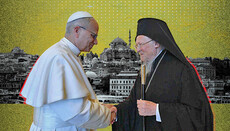
The Greek branch of the UOJ has published an archival article by priest and theologian Anastasios Gotsopoulos, written on December 1, 2014. It concerns the events that took place during the visit of then-Pope Francis on the Patronal Feast of the Ecumenical Patriarchate. The article also contains a reference to an earlier visit of Pope Benedict XVI to Constantinople.
“Unfortunately, what is described in the article published eleven years ago remains relevant, because this year, during the visit of Pope Leo XIV to Constantinople on the Feast Day of St. Andrew, the same things occurred as in 2006 and in 2014,” the editorial board of the Greek branch of UOJ writes.
When the supernatural sacrament is used to serve expediency…
We have once again witnessed what took place at Saint George’s Church in Constantinople on the Feast Day of Saint Andrew (November 29–30, 2014). and, apparently, we will see it again and again so that we gradually become accustomed and, without resistance, move toward the restoration, as His Holiness put it, of “full communion” with the “primatial sister Church of Rome,” “presiding in love” if we refer to the Fathers.
The fact that this tempts some of our Orthodox brothers does not concern us too much: we easily label them “fanatics,” “fundamentalists,” “provincials,” mock them and that is enough for us. Especially since we have allies in this endeavor – the media and politicians of all stripes, who are undoubtedly interested in the care of Bartholomew and Francis for the “restoration of the Temple of God, that is, the Church,” as revealed to us by the “brother, Bishop of Rome” Francis!
I will not analyze the words about “full communion” spoken by the Ecumenical Patriarch. A profound theological text, “The New Ecclesiology of Patriarch Bartholomew”, has already appeared, pointing to serious deviations from the faith. But does anyone doubt that the Patriarch’s address to the Pope on Saturday, November 29, 2014, in the Patriarchal Church signifies full acceptance of the Dogmatic Constitution “On the Church” and the Decree “On Ecumenism” of the Second Vatican Council (1962–1965)?
“Brother” Francis went even further, explaining the thoughts of his “brother” Bartholomew and referring in considerable detail to the Decree “On Ecumenism”. As a true Jesuit, he naturally remained silent about another document of the same Council – the Decree “On the Eastern (Uniate) Churches”. Nevertheless, a careful listener can easily perceive that His Holiness has this in mind and is proposing precisely this model for the unification of Catholics and Orthodox Christians. It is no coincidence that Cardinal Leonardo Sandri, Prefect of the Congregation for the Eastern Churches, was present in his retinue…
I suppose that after all this, the Great Council of the Orthodox Church, if it ever takes place, should – on the recommendation of the relevant Chancery in Constantinople – recognize the Second Vatican Council as the Eighth Ecumenical Council! This is becoming an urgent necessity: some high-ranking Orthodox hierarchs need to acquire at least some consistency and ecclesiological justification, which the Seven Ecumenical Councils – outdated, as practice shows – fail to provide.
Since the “Patronal Feast with His Holiness” has already been performed in the same settings, I will turn to my archive, to what happened in the same place in 2006. At that time, I wrote:
“The described practice [of joint prayers] is applied not only within the framework of the World Council of Churches. Overall, a certain strange disregard for theology (especially ecclesiology) and the development of an ecumenical ‘ecclesiology,’ intended to ‘theologically’ justify anti-canonical behavior, combined with the introduction into church life of PR methods, have led to practices that leave a deep bitterness among the People of God. Particularly illustrative is what occurred during the last visit of the Pope to Constantinople for the Patronal Feast of the Ecumenical Patriarchate on November 30, 2006. This is not about meetings and events outside the Patriarchal Church of Saint George – conversations, joint statements, greetings from the balcony – but about what took place inside the church, going beyond a simple joint prayer with the non-Orthodox.
The Pontiff is greeted with the words: ‘Blessed is he who comes in the name of the Lord.’”
Is it acceptable to address a heretical leader with a form of greeting that refers exclusively to the person of the Lord? To address him as the canonical Pope and Bishop of Rome, or to pray for him?
Of course, at a meeting, the head of the Roman Catholic Church will be called the “Pope and Bishop of Rome” although, strictly speaking theologically, these titles do not belong to him, since he is a heretic. Both titles are used here as technical terms or polite forms of address for the guest, without theological or ecclesiological significance. In the same sense, non-Orthodox communities are referred to as “Churches” but not in the strict ecclesiological sense, for the Catholic Church was, is, and will remain one. In church tradition, alongside precision, there exist courtesy and economy: Saint Cyril, sharply condemning Nestorius for his errors, still addressed him as “honorable,” “most honorable,” “most pious bishop,” and called him “Your Holiness”.
However, it is an entirely different matter to sing hymns and commemorate a heretic as the canonical Pope and Bishop of Rome during a service in the Patriarchal Church, on an equal footing with the Patriarch of Constantinople!
Can this be called courtesy, or are we facing an implicit recognition of heresy by the Church of Christ, and its leader as a canonical hierarch? Is such an understanding not alien to the patristic tradition, and does it not undermine Orthodox ecclesiology?
From simple joint prayer to concelebration
Unfortunately, the joint prayer in Constantinople did not remain a simple act of supplication but grew into an incomplete concelebration. At the official Patriarchal and Synodal Divine Liturgy of the Patronal Feast, the Pope was granted the right to recite the Lord’s Prayer; he was censed as a canonical bishop; and most importantly, he received from the Patriarch the liturgical kiss of peace before the Holy Anaphora and responded in kind. All of this is permitted only to concelebrating priests and hierarchs! He did not enter the Holy Altar – yet. He was even granted the ambo, and he took the opportunity to proclaim papal primacy in the very Patriarchal church!
We will allow ourselves a few questions.
– When serving with the Ecumenical Patriarch, if a cleric – whether a priest, bishop, or even the Primate of an Autocephalous Church – does not concelebrate but only prays in the Holy Altar, would the officiating Patriarch exchange the liturgical kiss of peace with him? Of course not: according to the liturgical order, it is permitted only between concelebrating clergy. So how, then, is it offered to the Pope? Does he concelebrate with the Patriarch?
– Is it permissible to use the liturgical kiss of peace, the highest moment of manifest unity in truth and love, contrary to liturgical tradition, reducing it to an act of social courtesy, emotional sentiment, or church politics?
– Is the liturgical kiss of peace a self-sufficient act, or a prerequisite for “confessing with one mind” the Trinitarian dogma as formulated in the Creed? If there is no confession of shared faith – as there is no shared theology – what meaning does the liturgical kiss have between an Orthodox hierarch and a heretical leader?
– Since when is a heretic permitted to pray at a service as a canonical Orthodox Christian?
– Can a heretic, much less the head of a heresy, represent the Orthodox faithful at the Divine Liturgy, reciting the Lord’s Prayer as their Primate?
– To say the “Our Father,” is unity of faith not required? Does such unity exist with the Pope?
– “Our Father” is the principal prayer, preparing the faithful for the “daily bread” of the Divine Eucharist. Can one who is categorically forbidden from receiving the Holy Gifts ask for this Bread during a Divine Liturgy celebrated by Orthodox Christians? What meaning can such a prayer have?
– If the Pope did not merely attend but actively participated in the Divine Liturgy, why was he ultimately not admitted to Communion? Some might answer: the statutes of our Church do not permit it, since he is of another faith. But was everything else he did truly permissible?
Which canonical provision, which saint of our Church allows a heretic, during the Divine Liturgy, to recite the “Our Father,” to receive censing as a concelebrant and exchange the liturgical kiss of peace, yet forbids him to receive Communion?
– How does all this align with the clear position of Ecumenical Patriarch Bartholomew: “Communion in the sacraments is not permissible until full unity in faith is achieved… The path to unity through Eucharistic communion is a step backwards… Eucharistic communion without unity of faith is like banknotes without gold backing”? Or does “communion in the Sacraments” refer only to the moment of Holy Communion, and not to the entire Divine Liturgy of the faithful? Is such a theological partitioning of the Liturgy permissible?
– What can be said about granting the ambo to the head of heresy for preaching? Can we, as Orthodox, remain indifferent, untroubled, or unmoved when, in the Most Holy Patriarchal Church, the Pope preaches papal primacy with his head uncovered? From the pulpit of Saints Alexander, Gregory, John Chrysostom, Photius, and Philotheos, error is proclaimed! Is this not a desecration?
– Finally, should we not, with all due reverence, ask the presiding hierarch of that Divine Liturgy:
Which canonical provision is behind the practice that allows a heretic — and, by the unanimous judgment of the saints and the Councils, the Pope is precisely such — to actively participate in the Orthodox Divine Liturgy, when the entire tradition of our Church, all the Fathers, and all the Local and Ecumenical Councils, without exception, categorically and explicitly forbid this, under threat of severe canonical punishment?
Can one tolerate and justify the above as “noble conduct” or mere “formal expressions during the service”?
Or, perhaps, this could be excused by oikonomia? Is even a partial concelebration of the Pope and the Patriarch permitted under oikonomia? The answer is categorical: no! Never, anywhere, has any saint allowed a condemned heretic, much less the head of a heresy, stubborn in error, to actively participate in the Divine Liturgy.
And what irresistible necessity demanded a “concelebration” with the Pontiff? For what “higher attainment,” unattainable by other means, was the ecclesiastical order violated? Ultimately, what benefit for the Church could justify praying together with the Pope? Thus, there exists not a single condition under which oikonomia could legitimize the Pontiff’s active participation in an Orthodox service.
Moreover, Ecumenical Patriarch Bartholomew has spoken explicitly about “Eucharistic communion” with the non-Orthodox:
"This question is essentially ecclesiological, and for the sake of ecumenical dialogue, it would be appropriate and useful to state unambiguously… that the Eucharistic communion sought by some between Orthodox and non-Orthodox Christians amid the ongoing schism cannot be accepted by the Orthodox Church, even under oikonomia."
And, of course, “Eucharistic communion” does not begin with the words “approach with the fear of God, with faith and love” and does not end with “Save, O God, Your people”…
Therefore, it would not be an exaggeration to apply the words by St. Theodore the Studite to the joint prayer of the Patriarch and the Pope: "This is no longer, forgive me, a matter of oikonomia, but a duty of lawlessness and violation of the divine canons."
Or, applying this to contemporary practice, one might echo the Athonite monks: "But are we to do this under the guise of oikonomia? And how can oikonomia permit the desecration of the sanctuary? …And what could be more ruinous than such an ‘oikonomia’? It is clear communion with them, an abandonment of all good, and a subversion. For he who receives a heretic is subject to his accusations, and he who communes with the excommunicated is himself excommunicated, as one who violates the canon of the Church."
This concern is by no means caused by “stubborn false brothers, forming groups of fanatical defenders of the so-called foundations, captives largely of religious unbelief, neo-Manichean fundamentalism, projected metaphysical guilt, and a casual approach to living like sectarians, peddlers of ‘pure religion’”. (How sad it is to hear such characterizations from an Orthodox hierarch in the presence of the Patriarch, delegations of Autocephalous Orthodox Churches, and non-Orthodox on the Patriarchate’s Feast Day, indiscriminately thrown at all believers who maintain any reservations regarding dialogues!) On the contrary, these practices are condemned even by the proponents of inter-Christian dialogue and the ecumenical movement themselves as theologically unfounded and ultimately undermining the very basis of theological dialogue.
Archbishop Stylianos (Harkianakis) of Australia, a hierarch of the Ecumenical Patriarchate and for twenty years co-chair of the Official Theological Dialogue with the Roman Catholics, mentions in his speech of May 10, 1985, the “tragic errors”:
“First of all, an excessive friendliness with Rome prevailed, expressed irresponsibly and theologically completely unchecked… Many hierarchs, unfortunately, hurry to embrace at the most sacred moment of the Divine Eucharist, when we proclaim ‘let us love one another…’. This is the moment when we express the highest and deepest unity only of those who are concelebrating.
Ministers are not permitted even to kiss co-faithful hierarchs and clerics present in the Holy Altar. Nevertheless, there are Orthodox hierarchs, whose names I will not mention, who, well-intentioned but unaware of the weight of theological responsibility, kiss non-Orthodox clerics, although this has no sacramental grounding and is done irresponsibly: from the common Chalice they will not receive Communion. So why kiss them at all?
Another error, no less tragic: in an effort to be polite to one another, many Orthodox hierarchs, unfortunately, call the Pope “the first bishop of Christianity”. This is yet another theological falsehood. The Pope… in divided Christendom is neither first among equals nor even equal among equals! The Pope should stand after the last Orthodox bishop, as he now remains in schism and heresy. This is so obvious that it hardly needs stating… The Roman Throne in its present state cannot, according to Orthodox theology, be called “presiding in love”. When such things are said, they are irresponsible words. Regrettably, they stir up much fuss and inflict harm, all the while providing us with no tangible gain. In this way, we give the impression that we are hastening to establish Intercommunio, Eucharistic communion with the non-Orthodox… By addressing the Pope or Rome with patristic titles full of specific meaning, we only undermine the dialogue and offer it no support. This is simply a lie – such forms of address are a theological falsehood.”
In this context, it is worth noting a particularly significant address by the Abbot of the Holy Monastery of Xeropotamou, Archimandrite Joseph, during Patriarch Bartholomew’s visit to the monastery on August 21, 2008. The Abbot spoke, with due reverence but also exceptional clarity:
“Here, Your Holiness, allow us, your children, who approach you with filial boldness, to speak on two matters that trouble our hearts and tempt our monastic consciences, as well as the consciences of very many devout Orthodox Christians who turn to us.
The first matter concerns the ongoing recognition by Your Holiness – through official speeches and joint prayers in church and on television – of representatives of a thoroughly secularized and unrepentant modern papism.
Your Holiness, together with Saint John Chrysostom, we, humble and unworthy, beseech You: ‘Do not accept any foreign dogma under the pretext of love.’ Both recently and in earlier times, Holy Mount Athos has testified and assured You, and we, the miserable monks of Xeropotamou, together with the devout faithful who share our concerns, ‘remain faithful to the faith of the holy Apostles and holy Fathers, out of love also for the heterodox, to whom it is truly helpful when the Orthodox, by maintaining a consistent Orthodox stance, point out the extent of their spiritual illness and the way to its healing.” We earnestly and reverently request that henceforth “the theological dialogue be in no way accompanied by joint prayers, participation in liturgical and worship gatherings of one another, or other actions that could create the impression that our Orthodox Church recognizes Roman Catholics as a full Church, and the Pope as the canonical Bishop of Rome. Such actions mislead both the fullness of Orthodoxy and the Roman Catholics, creating in them a false impression of what Orthodoxy thinks of them…” Since we cannot deny that we share “the same spirit of faith” with Your Most Divine Holiness, “as it is written: I believed, therefore I spoke”, so “we also believe, therefore we speak…” In Your fatherly love, forgive us this confessional digression and look upon the faces of our humble brotherhood, which regards You with the greatest reverence.”
In his response, the Ecumenical Patriarch did not consider the concerns exaggerated or malicious and even praised the abbot for his words and his concern, and “reassured” him: “We commend your sensitivity, we commend in a fatherly way your love of truth and sincerity, and we reassure you, briefly repeating: the guardians are aware.”
Of course, it would be better if such “patriarchal” assurances were not needed to “reassure” us. Who bears responsibility for the fact that part of the Orthodox faithful is concerned about the “guardians” and has the gravest reservations regarding some of their actions? Are the “guardians” themselves truly not accountable for this situation?
P.S. Some may think that I am right, yet consider my words too “harsh” or “disrespectful.” However, I would ask such people, together with their remarks about the “harshness” or “disrespectfulness” of my words, to also present their own proper, respectful protest against that which is ecclesiologically and canonically unacceptable and which again occurred in Constantinople on 29–30 November 2014.