
Online users mock Education Ministry’s ignorance on church matters
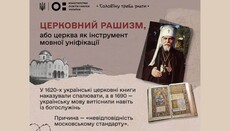
The Ministry of Education claimed that in the 1690s the Ukrainian language was pushed out of liturgical use.
Online users have ridiculed the Ministry of Education and Science for what they called ignorance in church-related issues. Tetiana Yevsieieva, a researcher at the Institute of History of Ukraine of the National Academy of Sciences, criticized a Facebook post by the ministry titled “Church Rashism, or the Church as an Instrument of Linguistic Unification.”
In the post, the ministry claimed that “in the 1620s Ukrainian church books were ordered to be burned, and in the 1690s the Ukrainian language was even pushed out of worship.” It also stated that the Uniate cardinal Yosyf Slipyj (20th century – Ed.) “founded UCU and gave the Ukrainian language back its voice in the Church and the world.”
The historian reminded officials of basic facts that, judging by the post, they do not know. Yevsieieva noted that speaking of “church rashism” in the 1620s is absurd – the Treaty of Pereiaslav was signed only in 1654, Moscow received permission from the Ecumenical Patriarch to ordain the Kyiv Metropolitan only in 1686, and Peter I’s synodal reform took place later still, in 1721.
Yevsieieva also recalled that from 1458 to 1619 the Kyivan and Moscow metropolias maintained neither written nor Eucharistic communion – precisely because of Moscow’s isolationism. As for the decree cited by the ministry – Tsar Mikhail Romanov’s 1622 order to burn Kyrylo Tranquillion-Stavrovetsky’s Teaching Gospel, printed in Ukraine – it was a strictly internal Muscovite affair and had neither force nor any relevance to the Polish–Lithuanian Commonwealth, which included the Ruthenian voivodeships.
“This is simply second-hand embarrassment – to spread such sloppy work in the name of the Ministry of Education,” the historian concluded.
Yevsieieva was also supported by commenters under the ministry’s Facebook post, who sharply criticized its content. “In Orthodox worship, ‘the Ukrainian language’ was not used in the modern sense. The language of worship is Church Slavonic, with different regional recensions,” wrote Olha Dichko.
“Umm… excuse me, but who wrote this? And this is going out to the public from the Ministry of Education?” wrote Taras Tymo.
Earlier, the UOJ reported that the Institute of National Memory declared Dostoevsky and Tolstoy to be Russian propagandists.