
Orthodoxy is a way of life founded on absolute love – German priest
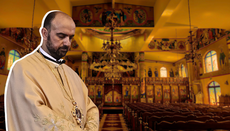
Archpriest Nicholas Esber emphasizes that where there is no love, there is no truth – and there is no Orthodoxy.
Archpriest Nicholas Esber, rector of the Church of the Holy Apostles Peter and Paul in Butzbach (Hesse), under the jurisdiction of the Antiochian Patriarchate, spoke in an interview with UOJ in Germany about the growing interest of Germans in the Orthodox faith and about what draws them to Orthodoxy.
According to Fr. Nicholas, interest among Germans in the Orthodox faith has increased markedly in recent years. The Church of Saints Peter and Paul has become an important center for everyone wishing to learn about Orthodoxy in Hesse. “I have personally accompanied several people on their path to Baptism. They attend the Divine Liturgy every Sunday, as well as our weekly Bible study group. They also bring their non-Orthodox friends, so that they too can learn more about Orthodoxy,” the rector says.
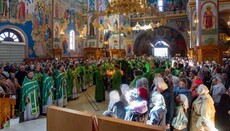
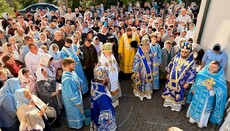
At present, a large group of people regularly comes to him while preparing for Baptism. The reasons for the community’s appeal include the use of the German language in sermons and services, as well as a welcoming atmosphere and brotherly love. “Our church has become an important point of attraction not only for Germans, but also for Orthodox Christians from other Churches, thanks to the friendly atmosphere and the brotherly love that every guest feels,” the priest explains. Every Sunday, representatives of more than twelve different nationalities gather under the roof of the church for the Divine Liturgy, and this trend continues.
Answering the question of how people can return to true values in a world where power matters more than truth, the priest stresses the central importance of love in Orthodoxy. “I often hear from people who were recently baptized in our church: ‘I was searching for the truth, and I found it in Orthodoxy,’” says the archpriest. Yet this raises an important question: how can Orthodoxy bear witness to the truth in a world where Orthodox nations and Churches are in conflict with one another?
“Where there is no love, there is no truth – and there is no Orthodoxy. For Orthodoxy is, in short, the revelation of Christ Himself,” Fr. Nicholas explains, citing Christ’s final commandment: “A new commandment I give to you, that you love one another; as I have loved you, that you also love one another. By this all will know that you are My disciples, if you have love for one another” (John 13:34–35). The Apostle John, in his First Epistle, summarizes the entire Orthodox understanding of love when he writes: “Beloved, let us love one another, for love is of God; and everyone who loves is born of God and knows God. He who does not love does not know God, for God is love” (1 John 4:7–8).
When asked about the importance of ancient Church canons, Fr. Nicholas replies: “In Orthodoxy there is nothing old and nothing new. Orthodoxy is the revelation of Christ, and Christ is the same as He has always been.” The only real difference of modern times, in his view, is the absence of love. “Even if ancient Church laws and prescriptions are practiced without love, we are nothing more than ‘a sounding brass or a clanging cymbal’” (1 Cor. 13:1).
The number of Orthodox Christians in Germany continues to grow. The priest explains this as follows: “Orthodoxy is not a religion or a sect, but a way of life founded on absolute love – and therefore it is the only effective answer to the endless challenges we face in this world.” For this reason, Orthodox communities are playing an increasingly visible role in society, since their faith is based above all on deeds that flow from love for one’s neighbor. Here the words of the Lord are fulfilled: “You are the salt of the earth. You are the light of the world.” It is precisely this role, according to Fr. Nicholas, that true Orthodox Christians fulfill in today’s world.
Earlier, the UOJ reported that the number of Orthodox Christians in Germany has risen sharply due to Ukrainian refugees.