
Resurrection light in the depths of a perishing world
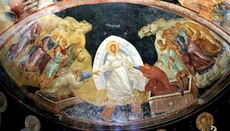
The most triumphant image of Christ's Resurrection was painted by the Byzantines not in the golden age but in a declining empire – on the wall of a burial chamber.
Christ seizes Adam by the wrist — the very place where one checks the pulse of someone who has lost consciousness — and drags the limp body upward, out of a stone tomb. Eve is seized in the same way, her hand hanging lifelessly, like that of a child carried out of a burning house before she has had a chance to wake. Here, those who cannot even comprehend that they are being saved are rescued.
We are standing before the fresco “The Descent into Hades” ("Harrowing of Hell") in the Chora Monastery on the outskirts of Constantinople. The narrow side chapel, the parekklesion, was painted between 1315 and 1321. Its vault is small, and therefore the figure of the Risen Christ, bursting out of the blue mandorla, seems almost constrained in this space.
And this space is a burial chamber. The chapel was built as a funerary chapel. Beneath the most jubilant scene of victory over death in all of Byzantine art, niches were prepared for coffins. And the first of them was intended for the man who designed and funded it all.
The city under siege
To understand what this paschal joy cost the artists, one must look back at the history of the ancient empire. Byzantium in those years was living out its final days. Asia Minor had lost its former strength — the Turks were pressing toward the strait, and all that remained of the Asian territories was a narrow coastal strip opposite the capital. The treasury had been so depleted that the gold hyperpyron had lost its value and ceased to be the stable currency of Mediterranean trade.
Thrace was being devastated by former mercenaries: the Catalan Company, hired by the emperor to fight the Turks, turned into a band of marauders after the murder of their leader, burning and looting the very lands they had been called to defend. The historian Nikephoros Gregoras left testimony of that decline — a picture of a state stripped of its future before it had even had time to realize it.
The Empire was shrinking to the size of Constantinople, Thessaloniki, and a handful of scattered islands, and every educated person could see: this was the end. And yet in this city, in these drafts of history, the Church composed the loudest and most piercing hymn to life it had ever known.
The patron who lost everything
The patron of the Resurrection fresco was named Theodore Metochites: Grand Logothetes, the first man at the court of Emperor Andronikos II, one of the wealthiest men of his age. His pupil, the very same Gregoras, called his teacher a "living library": Metochites was a statesman by day and a writer by night, who gave the Chora Monastery his precious collection of manuscripts and wished posterity to remember him not as a thinker rather than a minister.
His brilliant career was cut short in a single year. In 1328, the elderly emperor's grandson deposed his grandfather. Metochites was stripped of his property and sent into exile.
Theodore was only able to return home at the end of his life — as a penniless monk who had taken the name Theolyptos, to die within the walls of the monastery he had once restored from ruins.
Having lost his home, wealth, and power—cut off from everything that had given his life meaning—Metochites worries in the lines of his writings that the mob that plundered his palace might also reach Chora. Remarkably: the man whose future had been taken away feared at the end of his life only for the preservation of the fresco above his own tomb.
White on black
Let us return now to the vault of the monastery church. The Saviour's garments are painted in white. Not the customary red and blue, but a dazzling white — the very white in which the glory of the Transfiguration appeared to the apostles. The mandorla behind Him appears as a deep black-and-blue abyss, studded with golden stars, and against this darkness the whiteness of His robes is so blinding that it hurts the eye. The cloak of the Risen Christ is thrown back as if to emphasize the swiftness of His descent into the underworld.
For He did not descend into hell in an orderly manner; He burst into it swiftly and decisively, to save His creation from the bondage of death.
Beneath His feet lie the gates of hell, torn from their hinges and laid crosswise. And lower still, in the darkness, are scattered locks, keys, nails, and chains – all the twisted, now useless iron debris with which death had locked away its prey. This iconography traces back to an ancient apocryphal text, the Gospel of Nicodemus, in which the Lord commands that the eternal gates be lifted, and the bronze cannot withstand His voice. The artist of Chora showed that hell here is not a cave, but a broken storehouse from which everything of value has been carried out, leaving only scattered metal on the floor.
A curious thing: a peaceful age produces a different kind of art. When the state stood firm, under Justinian, the mosaics were heavy, solemn, and motionless.
But when power had died, the image suddenly broke free: asymmetry appeared, flowing garments, and this excessive spiritual energy that no longer fit within the vault of the church.
As if, having lost its earthly foundation, the Church had ceased to stand at attention before the state and, for the first time, looked toward the end times – toward a place where no imperial power would carry any weight.
Sacred meaning
So what is depicted in the fresco at Chora? A gesture of despair from a man who has nothing left to hope for on earth or the supreme power of a faith capable of laughing at death while standing at the edge of the grave?
We will not attempt to answer this question. Perhaps the boundary between the two is thinner than we would like to believe. Metochites commissioned from the artists an image that would look upon his decaying remains. And for this he chose not a fateful skull above a tombstone but the hand of God, reaching into the black pit of death and seizing the dead man by the wrist.
The joy in this fresco was earned through the collapse of an entire world and the personal catastrophe of the one who paid for it. It is a bright ray of light seen from the depths of hopelessness.
The city beyond the monastery walls was living out its final decades. The patron of the fresco was spending his last days in a monastic robe, having changed both his name and his fate. And above his head, the white figure of Christ, without loosening His grip, drew from the darkness all those who, without the Savior's help, could no longer rise on their own.