
Gethsemane: the olive press that crushes God
In Gethsemane, Christ does not shrink from pressure – He accepts it freely. Beneath the crushing weight of abandonment, what lies hidden within human nature is laid bare.
Crushed olives are packed into coarse woven baskets, stacked one atop another into a swaying, precarious tower. A heavy wooden beam is lowered сверху, and from its far end massive stone weights are hung in turn. The pressure builds slowly, relentlessly, by sheer dead weight. The fibers strain and crack, the dry wood groans like a living thing – and from the pulp begins to seep a dark, viscous oil. It runs along channels carved into stone, gathering carefully in deep reservoirs.
Gat Shmanim – in Aramaic it sounds like a harsh, technical term: “oil press,” a crushing place. People did not come here to stroll or to contemplate eternity – they came here to press, to squeeze, to break. And on this final night before the Crucifixion, that ordinary, workmanlike word becomes a terrifyingly precise blueprint of what is happening inside a living Man – betrayed and abandoned by all.

Topography of betrayal
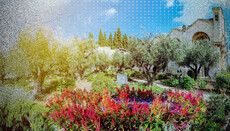
From a topographical point of view, the floor of the Kidron Valley is a perfect trap. To the west looms Jerusalem, heavy and immovable, with the massive retaining wall of the Temple Mount. To the east rises the bare slope of the Mount of Olives – open, exposed, visible in moonlight from any watchtower. One can slip into the garden by merging with the shadows of ancient trees, but to leave it quickly and unseen is impossible. Any group that descends here cuts off its own retreat, sealing itself inside a stone snare.
Judas knew this terrain intimately. The Evangelist John records it with cold precision: the betrayer knew the place, because Jesus often met there with His disciples. And so he led the armed band exactly where escape was impossible. His calculation was exact to the smallest detail.
There was no way out – the trap was closing.
But Jesus came here first. He knew every bend of the ravine no less than Judas. He descended into this valley Himself, freely, deliberately – waiting for those who would bind Him and lead Him to judgment.
Circles of loneliness
They enter the garden. Eight remain at the edge, like the first, fragile ring of a perimeter. Three of the closest go with Him deeper, among the black, twisted olive trees. Then He withdraws from them as far as a stone’s throw. The space tightens, presses in. The mute walls of the valley, the gnarled trunks, the sleeping friends – and He stands utterly alone at the center of this narrowing funnel.
The three disciples fall asleep. Their bodies refuse to serve when their souls are paralyzed by fear and the foreboding of inevitable disaster. Luke chooses a devastatingly exact word: from sorrow. The human psyche cannot bear such pressure – and it yields.
Heavy, measured steps descend from the city gates. The strike of hobnailed sandals against stone, the metallic clatter of weapons – all of it carries through the night long before the flicker of torches ignites between the trees. The Lord hears them approaching step by step. There is still time to flee. One desperate ascent into the darkness of the Judean wilderness – and He could be gone.
But He remains.
The test of pressure
Luke, a physician, records a detail of terrible significance: His sweat became like drops of blood falling to the ground. This condition – known in medicine as hematidrosis – marks the extreme limit of human strain. The smallest capillaries burst under unbearable inner pressure, and the body itself bears witness: the soul is drinking this bitter cup to the dregs. The wooden beam lowers. The press does its work, squeezing out the last strength of the Man – but it cannot break His will.
The detachment draws near. Judas prepares to identify Him – to fulfill his part of the bargain. But Jesus steps out of the shadows Himself, toward the torchlight, and speaks first:
“Whom do you seek?”
At His word alone, the armed band recoils and falls to the ground. Only afterward, shaken by their own weakness, do they rise, brush off the dust, and gather themselves again. The arrest unfolds not according to their plan – but entirely according to His will.
Gethsemane draws everything into its orbit: darkness you can almost touch, friends sunk in sleep, the iron echo of soldiers on the march, the open slope behind Him. And over this entire scene hangs an unseen stone press, coming down inch by inch, with merciless certainty. The ground itself feels alive – raw rock underfoot, dread thick in the air, and every approaching step of the executioners striking the night like a sentence.
A press extracts from the olive what is hidden beneath its skin. And under the unbearable pressure of abandonment and fear, what flowed from Christ was absolute love – and boundless mercy for those who came to kill Him.