
Physical evidence No. 2: what the piece of linen from Oviedo testifies to
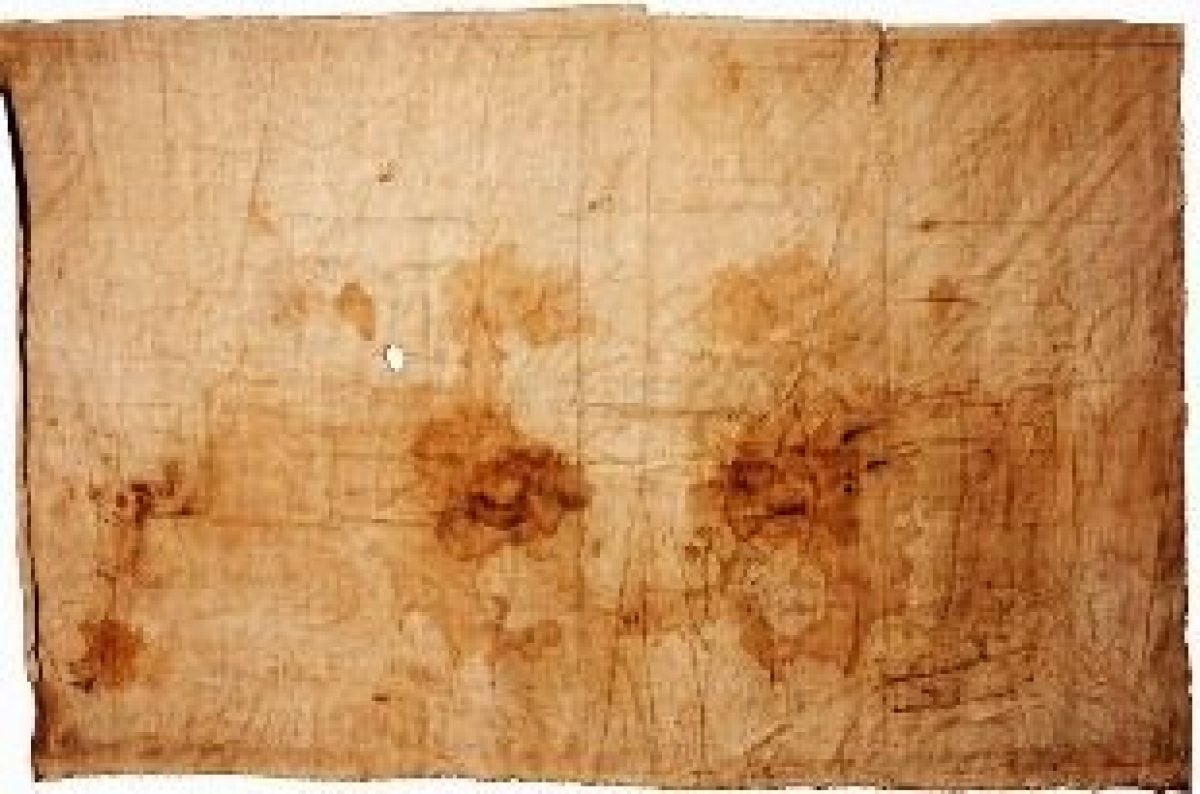
A cloth measuring 84 by 53 centimeters with chaotic, asymmetrical stains. No expert who has examined this piece of linen has been able to explain them other than by the authenticity of the Gospel.
When forensic pathologist José Villalaín first took in his hands the laboratory analysis results of the sudarium of Oviedo, what lay before him was not a religious relic. It was a map of a violent death by asphyxiation so detailed that it allowed the biomechanics of a person’s final hours to be reconstructed down to the head inclination.”
The Spanish Center of Sindonology began comprehensive study of this linen cloth in 1989. Nearly forty years have passed since then, several research groups have changed, and they all came to the same conclusion: the fabric covered the head of a person who died by suffocation, after severe physical trauma, in a vertical position. The face was wrapped twice. The right cheek bore traces of a brutal blow. On the back of the head, there are traces of multiple punctures.
Composition of stains: blood, fluid and flow direction
Blood type – AB. This was the first thing established in the laboratory. The second was the ratio of fluids in the main stains. One part of blood corresponds to six parts of pulmonary edema fluid: the very fluid that accumulates in the lungs during asphyxiation and flows from the nose and mouth after death.
For a person who died in bed from pneumonia, such a ratio is impossible. For a person who died in a vertical position from suffocation with preceding trauma – it is the only possible ratio.
The geometry of the flows tells the following story. Blood and fluid from the nasal and oral cavities did not flow in one direction: their trajectory changed. The angle of displacement indicates that the body was in a vertical position with the right arm extended upward, and the head tilted forward and to the right by approximately seventy degrees. After about forty-five minutes, the body was moved to a horizontal position – and the flows shifted accordingly.
The stains on the occipital part of the sudarium are exclusively venous blood, without admixture of pulmonary fluid. This is a different source of bleeding – punctate, symmetrically located skin punctures.
The fabric is sewn with thread having Z-twist, twisted clockwise. This is a characteristic of Middle Eastern weaving looms of antiquity.
Medieval European fabric has S-twist — counterclockwise. In the linen fibers, pollen of Gundelia tournefortii was found, a plant that grows in Palestine and blooms in spring. There are also traces of myrrh and aloe, applied after the blood had already soaked into the fabric.
Before us is not a European forgery. Before us is fabric from the Middle East that contacted a body in the first hours after death — and was subsequently treated with aromatic substances mentioned in Jewish burial rituals.
Route of physical evidence
The history of the sudarium can be traced documentarily from the 7th century. In 614, the Persian troops of King Khosrow II captured Jerusalem. Christian communities began evacuating their relics. The oak chest containing the sudarium, according to the data that reached us through a 12th-century chronicle compiled by Bishop Pelagius of Oviedo, was transported by the presbyter Philip. The route: Jerusalem → Alexandria → Carthage → the Iberian Peninsula. First Cartagena, then Seville, finally Toledo.
In 711, the Moors entered Spain. Christians went north, to the mountains of Asturias, the only territory of the peninsula that the Reconquista never lost. The ark went with them.
In 840, King Alfonso II built the Cámara Santa chapel in Oviedo specifically for storing the ark. Around the chapel subsequently grew the Cathedral of San Salvador, where the sudarium has been kept to this day.
The key date is March 14, 1075. King Alfonso VI, in the presence of Rodrigo Díaz de Vivar, the very one whom history knows as El Cid Campeador, officially opened the ark. A legal act was drawn up with an inventory of contents. The sudarium was recorded in the document.
120 points of coincidence: how two pieces of linen became one proof
In 1988, three independent laboratories — in Oxford, Zurich, and Tucson — conducted radiocarbon analysis of the Turin Shroud. Result: the fabric was dated 1260–1390. Then press releases about the apparent "debunking" spread around the world, but one question remained unanswered.
If the Turin Shroud is a medieval forgery, created no earlier than the 13th century, how does it contain blood of a type matching the blood on the sudarium from Oviedo? And the sudarium was documentarily recorded in Spain in 1075 – two centuries before the earliest date of the Shroud's carbon analysis.
Mark Guscin, researcher at the Spanish Center of Sindonology who worked with both artifacts, recorded the following: "The geometry of blood stains on the Sudarium and on the Turin Shroud has more than 120 points of absolute coincidence. This largely proves that both fabrics covered the same head at the same time."
One hundred twenty points — this is a biometric key.
The pattern of punctures on the back of the head, the geometry of the blood stain on the right cheek, the arrangement of flows in the nasal area — all this is reproduced on both fabrics with millimeter precision. To forge such a coincidence, a 13th-century falsifier would have had to have access to the sudarium kept in Spain, and with mathematical precision reproduce its three-dimensional map of stains on another fabric – without overlaying them, without having a photograph, and without using any modern tools. But this is forensically impossible.
Professor of forensic medicine Alfonso Sánchez Hermosilla, who presented research results at a 2015 conference, formulated the conclusion without equivocation: "They covered the corpse of the same person."
What remains off camera
Where the sudarium was kept for the first six centuries – from the moment of death of the person whose head it covered until 614, when Presbyter Philip took it out of Jerusalem – sources are silent. Six centuries are documentarily untraceable anywhere.
The Apostle John, describing the morning of the Resurrection, recorded what Simon Peter saw in the empty tomb: "Then Simon Peter came along behind him and went straight into the tomb. He saw the strips of linen lying there, as well as the cloth that had been wrapped around Jesus’ head. The cloth was still lying in its place, separate from the linen" (John 20:6-7).
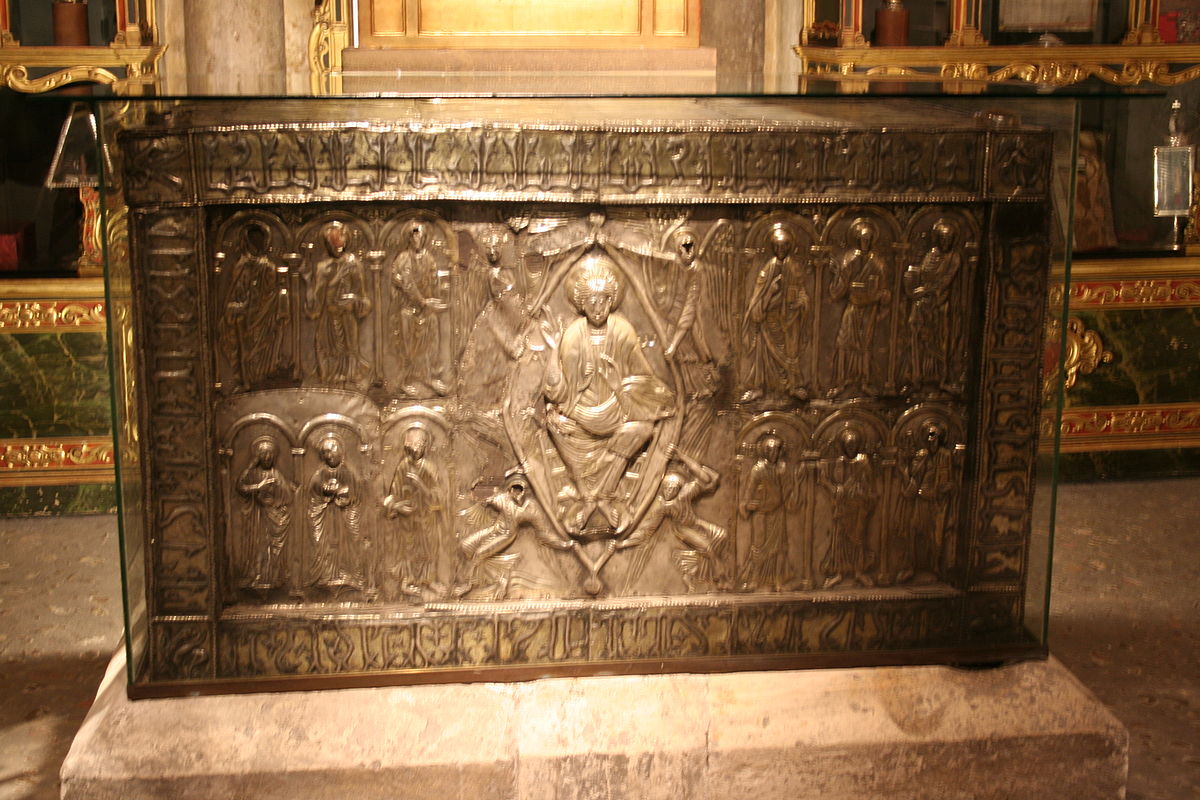
The cloth lay separately. Someone had removed it and put it aside. Then it ended up in an oak ark. Then – on the road through Alexandria and Carthage. Then – in the mountains of Asturias. Now – in the Cathedral of San Salvador, behind the silver plates of the Arca Santa.
Three times a year – on Good Friday, September 14 and 21 – it is brought out for veneration for twenty minutes. Then it is carried back as a banner of the fact that the inquiring human mind will never be able to penetrate the mystery of Divine Providence about salvation, but its proofs remain unshakeable to this day.