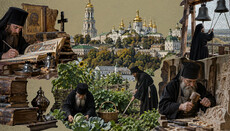

The blessed rock no assault could take
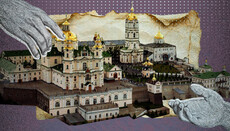
In the Ternopil region, there rises a limestone hill from which, on a clear day, the horizon stretches for thirty kilometers. Upon it stands a monastery that has never once been closed.
The road to the main gates of the Pochaiv Lavra winds upward in a steep serpentine, climbing seventy-five meters. From below, across the Volhynian plain, the monastery walls seem to grow straight out of the rock – and in a sense, they do. The lower tier of the Lavra is hewn into limestone; walls several meters thick are fused into the very body of the hill. In the oldest masonry, narrow slanted loopholes for muskets are still visible.
No fortress was ever built on this rock. A monastery was built here. Yet history has shown that the difference between a sanctuary and a bastion can be vanishingly small.
Fugitives from a burned Kiev
In the winter of 1240, the armies of Batu Khan stormed Kyiv and burned it to the ground. Some of the monks of the Kyiv-Pechersk Monastery fled westward through the forests. In Volhynia, they found a rocky hill with caves and settled there. Another tradition says that even earlier, in 1228, an Athonite monk, Methodius of Pochaiv, had already founded a skete here – and the refugees simply came to him.
However it began, the story of the Lavra was born out of devastation and flight.
Since then, the rock has scarcely changed. The monastery rises above the plain, its golden domes visible for thirty kilometers in clear weather. Such a vantage point ensured that any army approaching Pochaiv could be seen long before it arrived.
Fifty thousand against a wooden palisade
In the summer of 1675, the war between the Ottoman Empire and Poland reached Volhynia. On August 2, a fifty-thousand-strong Turkish-Tatar force under Khan Nureddin surrounded Pochaiv from all sides. Villagers fled to the monastery. At that time, the Lavra was not enclosed by stone walls, but by a rough wooden palisade. All who could bear arms – monks and refugees alike – took up the defense.
For three days, the attackers stormed the hill from three directions. The wooden buildings around the monastery were burned. On the night of August 5, Khan Nureddin ordered a general assault. There was no hope of relief.
The monastery chronicle records that the brethren began to sing the Akathist before the wonderworking icon of the Most Holy Theotokos. The monastic tradition describes what followed:
“And suddenly, above the great church, the Most Holy Mother of God appeared… spreading her radiant white omophorion… And the Tatars… loosed their arrows at the Most Holy Theotokos. But the arrows turned back and struck those who had fired them.”
The besiegers fled in disorder. The defenders pursued them and took captives. Some of the prisoners later received baptism and remained in the monastery as novices.
Historians have offered other explanations for the sudden retreat of a fifty-thousand army from a wooden palisade: an urgent order to march on Lviv, a surprise attack by Polish winged hussars. The sources remain silent about the number of defenders inside the monastery. Polish chronicles carefully record the size of the attacking force – but say nothing of those who held the hill.
A war without a single shot
Three centuries later, the Lavra faced a different kind of assault. At the turn of the 1950s and 1960s, Soviet authorities laid siege without artillery – using far subtler means. They confiscated ten hectares of farmland, the apiary, orchards, drying facilities, and the bishop’s residence. One of the monastic buildings was turned into a psychiatric hospital.
His Beatitude Metropolitan Onuphry, who served here as abbot in the late 1980s, later recalled the pale faces of patients behind barred windows, gazing out at the monastery grounds. Pilgrimages were banned. The water tower and well were seized – the monks were forced to collect rainwater from rooftops and carry it in buckets from hidden sources at night.
Monks were driven out into forests and fields, stripped of residency permits, then arrested for violating passport regulations. Elders and healers were sent to psychiatric institutions.
In 1962, Abbot Joseph (Holovatyuk), revered throughout the region, drove a police detachment out of the Holy Trinity Cathedral when they came to seize the keys. He was arrested, forcibly shorn, and transferred to a psychiatric hospital in Budaniv. Later, he took the great schema with the name Amphilochius and was glorified as a saint – today known throughout the Orthodox world as St. Amphilochius of Pochaiv.
In 1961, the Lavra had 140 monks. A few years later – only 35.
The brethren wrote an open letter, circulated in samizdat as the “Pochaiv Letters,” which reached Western radio stations and international organizations. In March 1964, at a rally in Paris, Nobel laureate François Mauriac declared: “When Christ is crucified in Moscow, we hear His groan on the Cross in Paris.” That same year, the International Committee against Religious Persecution in the USSR was established.
The persecutions ceased. Nikita Khrushchev was removed from power in October of that year – on the Feast of the Protection of the Most Holy Theotokos. The monastery stood firm once more, yielding not a single line.
Another assault
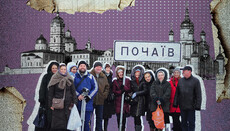
In October 2025, unidentified individuals, backed by police, cut the locks on one of the Lavra’s buildings with an angle grinder and attempted to force entry. The attack was again repelled – not without the prayerful aid of ascetics past and present. Before that, there had been court cases seeking to terminate lease agreements, criminal proceedings against residents, and sustained administrative pressure.
The golden domes of the Pochaiv Lavra rise above the plain just as they did in 1240, in 1675, and in 1962. The serpentine road remains just as steep, the limestone beneath the walls unchanged.
And the defenders of the monastery remain the same as well – faithful to the Church, resolute, unafraid.
The monastery itself endures, to this day, an unshaken stronghold of canonical Orthodoxy in Western Ukraine.