
"Rome" operation: The battle for Senate seats
Forged documents, fraud with letterheads, and two councils in one city. Continuation of the investigation into the most cynical betrayal in the history of Eastern European Christianity.
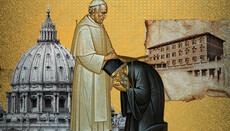
Rome, the Apostolic Palace, the Hall of Constantine. December 23, 1595, an hour before dawn. Two men in traveling cloaks are kneeling before a man in white. Hypatius Pociej, Bishop of Vladimir, have traveled here across all of Europe, changing names at inns and fearing interception on the roads. They thought they were coming as partners for negotiations. They were wrong.
Pope Clement VIII receives them not standing, as equals, but sitting on his throne, extending his foot. They understand the gesture and fall prostrate, kissing the red shoe. In this kiss lies the entire essence of what will happen nine months later in Brest. This is not a union of equal churches. This is capitulation, formalized as reunification. A few days later, in the bull Magnus Dominus, Clement uses the word “reductio” (“return”) meant not for equals but for runaway slaves.
But Terlecki and Pociej remain silent. They have already received what they came for: a written guarantee from King Sigismund III about granting them seats in the Senate of the Polish–Lithuanian Commonwealth. For that, one can swallow both humiliation and changes in wording. The deal is done.
But for this scene to become possible, a cynical bureaucratic operation was launched several years earlier.
The blank forms scam: how consent is forged
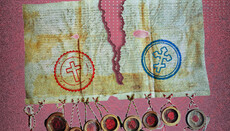
1593–1594. Cyril Terlecki travels around the dioceses with a stack of blank sheets of paper. He tells his fellow bishops that signatures are needed for a collective appeal to the king, seeking protection of church lands from encroachment by Catholic magnates. The story is plausible: land disputes were indeed an acute problem at the time. The bishops sign the forms without reading any text, because there is no text yet. The page is blank, bearing only a signature at the bottom and a seal.
A few months later, Terlecki and Pociej write in these blank forms a completely different text – a petition for accepting union with Rome. Legally, the document looks impeccable: genuine signatures, and genuine seals.
In fact, this is forgery that will go down in history as one of the most brazen cases of documentary fraud in church life.
When the bishops learn about this, it will be too late: their signatures are already in Rome, and their names are in papal bulls.
But even among the conspirators, not all hold out to the end. Gedeon Balaban, Bishop of Lviv, who signed the first declaration in Belz, changes his position in 1595. In Lviv, the brotherhoods are too strong, the pressure from the flock is too great. He withdraws from the conspiracy. Terlecki and Pociej declare him a traitor. The logic of betrayal is always paradoxical: those who betray the people accuse those who refuse to betray completely.
Thirty-three points: bargaining for souls
June 1595. The bishops draft the Articles – thirty-three conditions on which they agree to accept the union. This is a business document, written in the language of a contract, not a theological treatise. Point one: preservation of the Eastern rite. Point twelve – the key one: granting bishops seats in the Senate of the Polish-Lithuanian Commonwealth with voting rights equal to Catholic bishops. Point eighteen: preservation of all church property in the hands of bishops without the crown's right to secularization.
This is not a union of churches. This is an exchange of sovereignty for privileges. The bishops are selling the canonical independence of the Orthodox Church for political weight and material guarantees.
King Sigismund III, a fanatical Catholic raised by Jesuits, signs the guarantees. He understands: if the Orthodox hierarchy goes under Rome, millions of his Ruthenian subjects will find themselves in the orbit of Catholic influence. This is a geopolitical gain worth paying for with several seats in the Senate.
The Pope also agrees. Clement VIII does not demand immediate Latinization of rites. He plays the long game: first submission, then, after a generation or two, once the memory of Orthodoxy has faded, the rites can be changed. This is a strategy of absorption through assimilation. But for the bishops, what matters now is that they gain what they never had under Orthodoxy – political power and judicial immunity.
The moment of exposure
Prince Konstanty Ostrogski learns about the trip to Rome. Sources differ on who exactly leaked the information – either one of the bishops who dropped out of the conspiracy, or spies in the royal entourage, but the fact remains: the secret is out.
Ostrogski writes an angry circular letter, read aloud in churches across Ukraine and Belarus. He calls the bishops “wolves in sheep’s clothing,” accusing them of betraying the faith of their ancestors for “greed and vanity.” He publishes a list of the conspirators and urges the people not to obey them.
This is the moment when the secret operation turns into an open conflict.
The bishops can no longer retreat – their names have been named, their reputation destroyed in the eyes of the Orthodox. They can only go to the end, hoping that royal power and papal authority will outweigh popular resistance.
Brest: Two Councils in one city
October 1596. Brest. The official date of the Union proclamation. But something strange happens: two Councils simultaneously gather in Brest. One – Uniate, under the chairmanship of royal commissioners and conspiring bishops. The second – Orthodox, where those bishops who refused the Union gathered (Gedeon Balaban, Michael Kopystensky), representatives of brotherhoods, delegates from the Constantinople and Alexandria Patriarchs.
The Uniate Council takes place in one building, the Orthodox in another, a few hundred meters away. They do not communicate with each other. They mutually anathematize each other. The king recognizes only the decisions of the Uniate Council and declares the Orthodox Council an illegal gathering of rebels.
This is legal and ecclesiological absurdity: in one city, on one day, two mutually exclusive realities are proclaimed.
The Union is declared accomplished, although half the bishops and most laypeople rejected it. But the Uniates have what the Orthodox do not: administrative resources. The king issues a decree by which all churches pass under the control of Uniate bishops. Orthodox priests are driven from temples by force. What follows is what historians will call the “religious war in the Polish–Lithuanian Commonwealth,” a conflict that will last nearly two centuries.
The price of betrayal and its fruits
Terlecki and Pociej received their seats in the Senate. They became "spiritual princes," equal in status to Catholic bishops. Terlecki died in 1607, Pociej in 1613. Both passed away in wealth and honors, but in complete isolation from their people. They were guarded by royal soldiers, for it was dangerous to walk the streets unprotected – the people hated them.
The other Uniate bishops did not enjoy their privileges for long either. The next generation of Uniate clergy no longer remembered Orthodoxy and easily adopted Latin practices. By the mid-17th century, nothing remained of the “preservation of rites” promised in the Articles. Uniate churches became replicas of Catholic ones – with organs, statues of saints, and clerical celibacy. It was assimilation in its purest form: first subjugate, then dissolve.
The history of the Union of Brest is not just a church conflict. It is a playbook for betrayal.
Here is everything: secrecy ("the people won't understand"), document forgery ("they signed it themselves"), external guarantees ("Rome will protect us"), isolation from the flock ("we know better what they need"), use of administrative resources ("the king is on our side").
And there is another lesson that is often forgotten: elite betrayal does not mean the death of the people. The Church survived in 1596 not thanks to the bishops but despite them. It was saved by those who weren't even mentioned in the Articles – laypeople who refused to consider that faith is the private property of the hierarchy, which can be traded behind closed doors.