
The mystery of Bethlehem Icon: the only image with smiling Theotokos
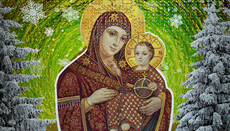
One step away from the birthplace of the Savior is an icon that breaks the canons. Why does the Mother of God shine with joy here – in the pre-festive cycle "Artifacts of Christmas".
The path to God in Bethlehem begins with a forced bow. You stand in the Manger Square under the harsh, color-bleaching sun. Around you, the eastern city buzzes, smelling of coffee and heated limestone. In front of you is a solid wall, resembling a fortress bastion. This is the Church of the Nativity. The only temple in the Holy Land spared by both Persians and Arabs, and time.
But you won't find a grand entrance. Instead of majestic gates, there is a stone masonry with only a dark opening slightly over a meter high. These are the "Door of Humility".
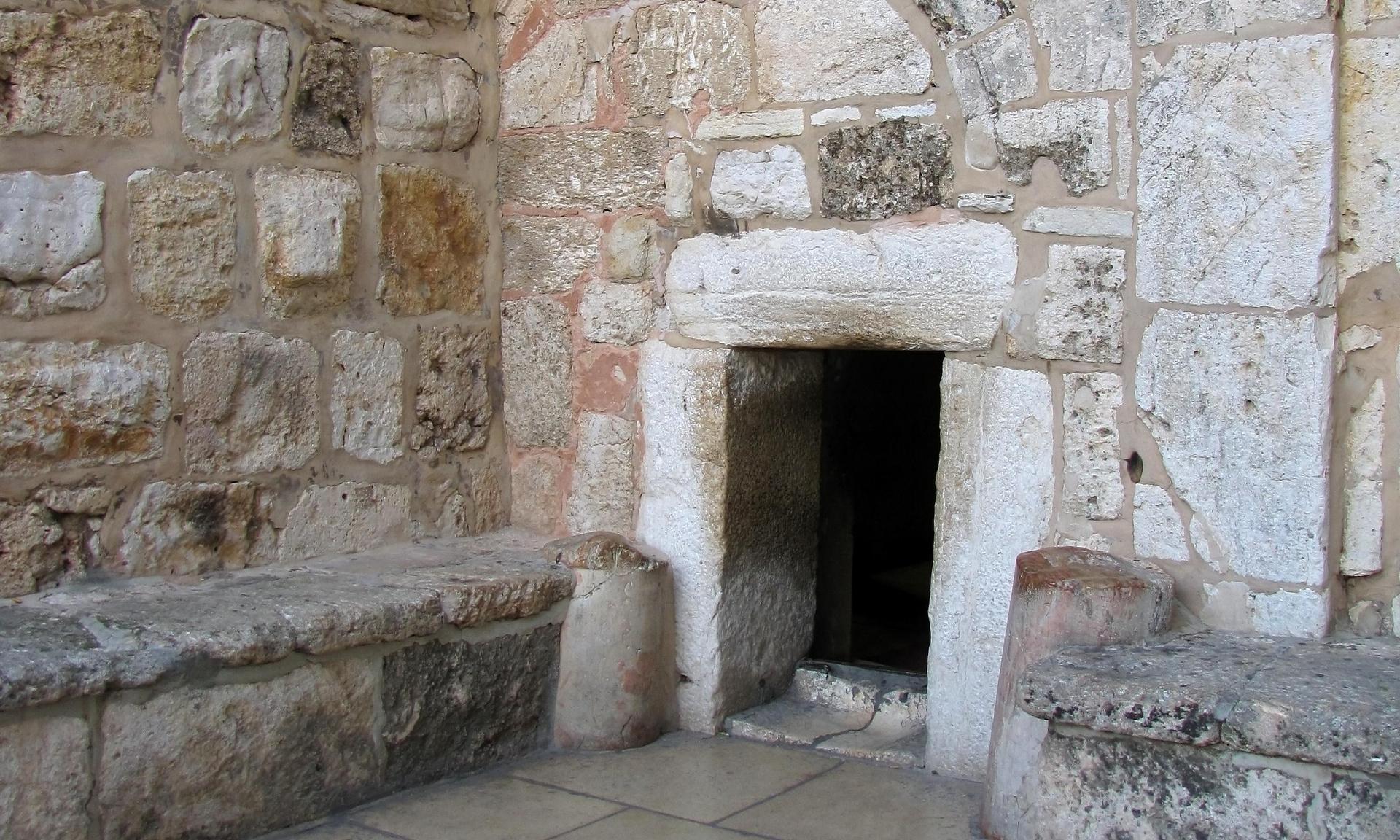
The guide will tell you about safety: the passage was narrowed in the Middle Ages so that invaders could not ride into the sanctuary on horseback.
But here, in the Holy Land, architecture always reflects the inner state.
You cannot enter the place of Christ's Birth with a straight back. You have to bend. Only in this way, in the pose of a weary traveler, can you step from the blinding light into the ancient semi-darkness.
Stone forest
Inside the Basilica, the air is of a different density. It is thick, infused with centuries of prayer, old wax, and incense. The external noise is instantly cut off by the thick walls.
Your eyes adjust to the gloom. From the darkness emerge columns of pink stone. This "stone forest" has stood here since the time of Justinian. Underfoot are fragments of mosaics: birds, geometric knots, and Byzantine gold worn down by millions of soles.
The central nave leads to the altar.
There, below, is the Cave of the Nativity – a cramped crypt where a silver star marks the starting point of our era.
But before descending there, the pilgrim inevitably stops at the right column of the southern descent. There, in a wooden kiot behind glass, She meets us.
Breaking the rules
This is the Bethlehem Icon of the Mother of God. There is always a dense circle around it. Arab Christians, Greeks, Ethiopians – all reach for the glass, leaving palm prints on it.
Formally, we have the Hodegetria type. The Infant Christ is sitting on the Mother's left hand, holding a globe, a symbol of power. Everything seems canonical and strict.
But a step closer – and you see what you did not expect. She is smiling.
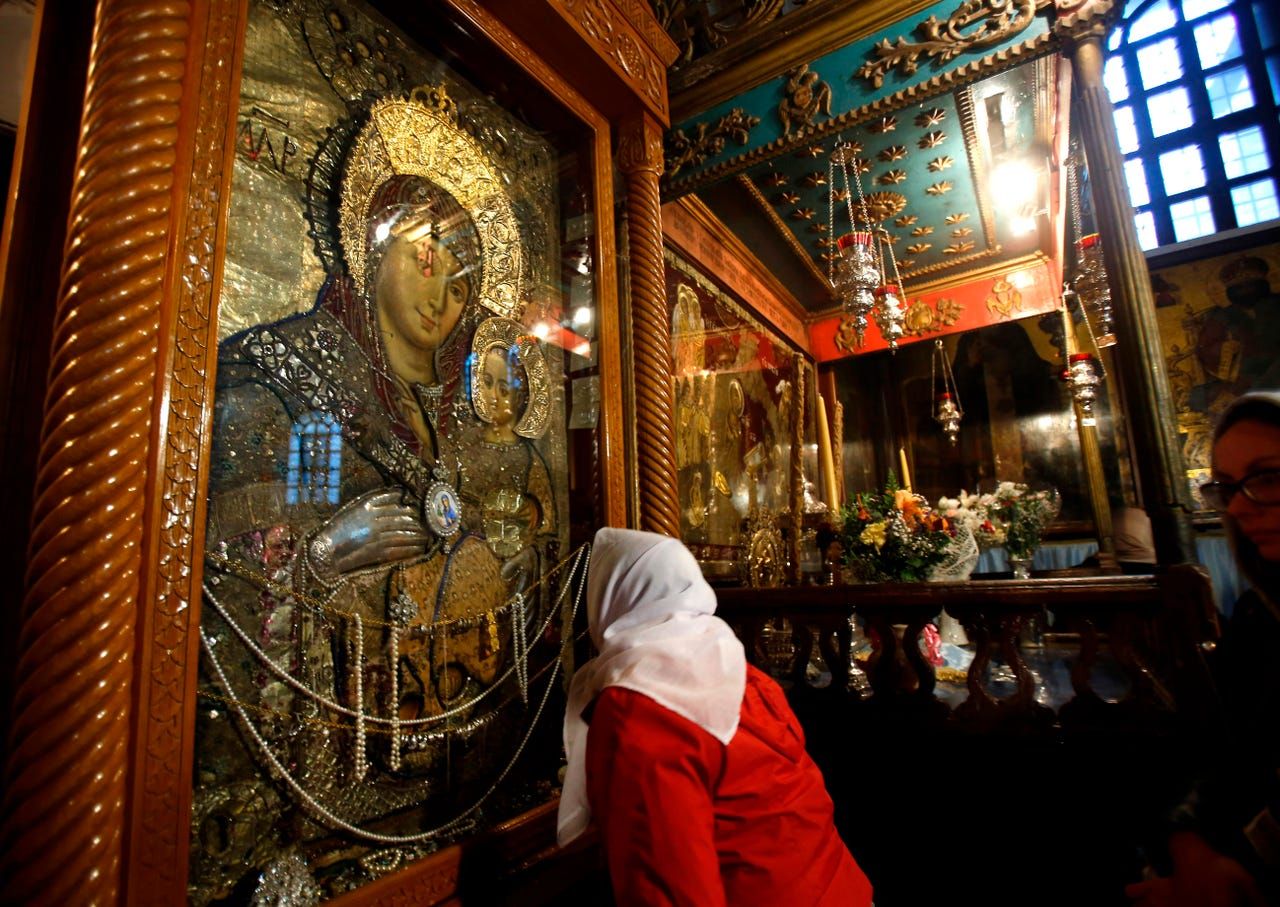
For the Byzantine tradition, this is a rarity, almost a challenge. We are used to seeing the Mother of God on icons as detached or sorrowful. Iconographers usually depict Her as knowing the future: She holds the Infant but sees Golgotha. In Her eyes is the acceptance of the inevitable sacrifice.
The Bethlehem image falls out of the time of the Passion. Here, time has frozen at the point of absolute joy. God has just arrived. Death is not yet present. There is only the Miracle of the encounter. And the Most Pure One smiles at us as if saying: "Breathe out. Do not fear. God is with us."
The Gift of a Martyr
This icon has a remarkable history. Art historians see in it the features not of Greek but of northern iconography – warm, realistic, characteristic of the 18th century.
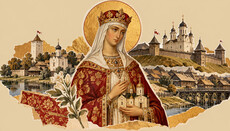
This image is a gift offered with love. But there is one detail that makes it especially dear to the heart. The riza adorning the icon was made from the dress of the holy venerable martyr Elizabeth.
The fate of this woman is striking. A grand duchess who lost her husband to a bomb, she did not grow bitter. She exchanged her ball gowns for the habit of a sister of mercy, her palaces for hospital wards for the poor, and she ended her life as a martyr in a mine shaft.
And now her dress embraces the image of the smiling Mother of God.
The sacrificial love of an earthly woman met here with heavenly joy.
The icon has survived much. The temple burned, the walls blackened with soot, eras and flags over the city changed. But the Face remained bright. This smile shone through the smoke of fires just as it shines now through the darkness of our daily anxieties.
Therapy of joy
Why do we go to Bethlehem? Why do we stand in lines, bend over three times at the entrance? Not for archaeology. We seek hope.
The world today is eerily similar to Judea of the first century. The same uncertainty. The same rumors (and not just rumors) of wars. The same feeling that you are a chip in the flow of history. And suddenly we meet this gaze.
In the Bethlehem icon, there is no reproach. No strictness. The Mother of God here does not demand a report. She is simply glad that you came to Her.
This is the "Smile of the Incarnation". Theologians will say that the icon thus testifies to the victory over hell. But for the person standing at the southern column, it means something simpler and more personal: we are not orphans.
The icon is just steps away from the descent into the Cave. There, below, a silver star on the floor marks the place where Heaven touched the earth. And here, above, the Mother of God confirms: the touch has occurred.
We often think that faith is only sorrow for sins and penitential weeping. This is true, but not the whole truth. The foundation of our faith is Joy, which "no one will take from you" (John 16:22).
And if the Most Pure One finds the strength to smile at us through two thousand years of human history, full of pain, maybe we should smile back at Her? Even if only with the corners of our lips. Through fatigue. They say this is where the real Christmas begins.