
A smartphone instead of morning prayer
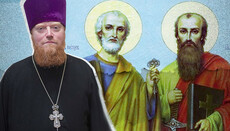
The summer fast is often called a burden during the holiday season. Archpriest Feodor Rusan, spiritual father of Kyiv’s Darnytsia deanery, speaks about overcoming screen addiction.
Our conversation is with Archpriest Feodor Rusan, an experienced priest who has long carried out the obedience of spiritual father of the second Darnytsia deanery, a cleric of Kyiv’s St. Olga parish, and a pastor who now guides many spiritual children. Suffice it to say that before the Liturgy, Father Feodor always comes to church long before the service begins in order to pray for everyone who asks him to do so, taking particles from the liturgical prosphora and commemorating both the living and the departed.

The meaning of summer abstinence
“Father, it is symbolic that immediately after the birth of the Church of Christ on the day of Pentecost and the descent of the Holy Spirit upon the apostles, the Holy Church established a fairly long fast, depending on whether Holy Pascha falls early or late in the year. It would seem, why call people to fast and pray immediately after such a great event? After all, Christ’s disciples received divine grace, and that means all of us too, having asked for the gifts of this grace in prayer during the days of the Holy Trinity, are called to pray zealously, fast zealously, and bring forth the fruits of repentance. Why is this so?”
“In this summer fast, which we call the Fast of Saints Peter and Paul, or the Apostles’ Fast, the Church calls us to follow the example of the holy apostles, who, having received the Holy Spirit on the day of Pentecost, prepared themselves through fasting and prayer for the worldwide preaching of the Gospel. But we too are called to preach – if not in churches and public squares, as the apostles did, then by the preaching of our Christian life, so that the people around us, looking at us, might be able to say with confidence and approval: ‘These are true Christians!’
“To transform ourselves, our soul, our personality, overcoming sinfulness and passions, is possible only through repentance – and repentance is simply impossible without fasting.
“Believers know this from experience. Fasting is, first of all, an important spiritual labor, not a mere restriction in food, as it is often interpreted.”
A reasonable balance of rest
“Father, what does spiritual labor in fasting mean, and is there not an element of extremism here? Some people even call our fasts self-torture, abuse of the nature of the body, and even fanaticism. Summer is a season of holidays, travel, contact with nature, water, and sun. And suddenly – a fast! The Catholic Church, as we know, has practically abandoned fasting as such. Catholics are allowed to eat before receiving the Holy Gifts, abstaining for only some 60 or 30 minutes...”
“That is precisely why in developed European countries, which we so eagerly strive to resemble, Christianity as a religion is practically disappearing. The Holy Church does not restrict a person in anything – especially someone living in the world.
“We may travel, rest, and spend time in nature. But we must do so reasonably, with benefit for both body and soul.
“Let us recall how the holy fathers instruct us. St. John Chrysostom, whose words were recorded as far back as the fourth century, says: ‘Fasting with faith greatly strengthens a person, for it teaches great wisdom, makes a man an angel, and even strengthens him against the bodiless powers... The one who prays as he should and also fasts needs little, and the one who needs little will not be covetous. And the one who is not covetous loves to give alms. The one who fasts becomes light and winged, prays with a cheerful spirit, extinguishes evil desires, propitiates God, and humbles his proud spirit. That is why the apostles always fasted.’”
The hygiene of digital space
“Father, a whole discussion has now unfolded online about the legitimacy and canonical nature of a number of resolutions and decisions of the Ukrainian Orthodox Church. How justified is this, especially during the holy fast?”
“Today, the concept of an information fast has become more and more relevant in everyday life. Things have reached the point where believers say in confession that they cannot fall asleep without a smartphone in their hand, and when they wake up, they immediately open it. Instead of thanking God for a new day of life and asking His blessing for the day ahead, we plunge into a verbal reality, into an emptiness that has nothing to do with the salvation of our soul or with a life pleasing to God.
“Having filled the soul with all kinds of horror stories and political gossip, the soul becomes as though possessed by this informational food. It was not for nothing that people used to say, ‘Every cricket should know its own hearth.’ And wise fathers taught: ‘Look into yourself, and that will be enough for you.’
“If some problems in church life seem unclear and insoluble to us, we should first of all entrust them to God and to time.
“After all, the Apostle Paul also taught: ‘There must also be differences among you...’ (1 Cor. 11:19). Leave church questions to those responsible for resolving them. Pray, strengthen yourself in faith, and do not sow discord in your own soul or in the souls of those around you.
“Why do we fast? In order to acquire the fruits of the Spirit. And what are they? ‘The fruit of the Spirit is love, joy, peace, longsuffering, kindness, goodness, faithfulness, gentleness, self-control...’ (Gal. 5:22–26). This is what our striving must be directed toward first of all. For the Lord will not ask what we found out or what we managed to figure out. He will ask what we actually did for our salvation.”
The winged joy of the spirit
“Is fasting compatible with a good mood?”
“Certainly not with despondency, that is for sure. Great Lent, for example, is called the spiritual spring. And in spring everything blossoms and gives fragrance. In June, nature gives us a special beauty and the first wholesome fruits, vegetables, and berries. Proper fasting, on the contrary, gives wings to the soul. It is not by chance that after doing some God-pleasing deed, we say to Christ: ‘Fill our souls with joy and gladness...’ The acquisition of this spiritual joy is the highest reward in the labors of fasting.”