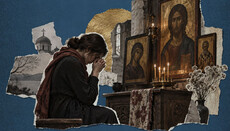

“Rejoice” in Lent: Why the Church celebrates Theotokos feast amid repentance
The day before yesterday, we stood for three hours listening to penitential troparia. Today, the Royal Doors are open and every lamp in the church is blazing. This is no accident.
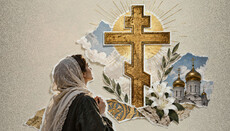
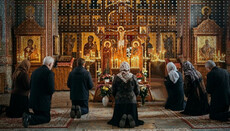
The fifth week of Great Lent is the longest and the hardest for believers. The first surge of resolve has long since faded, while Pascha is still nowhere in sight beyond the horizon of Holy Week. And it is precisely now that the Church does something unexpected: on Friday evening, an icon of the Mother of God is brought out into the middle of the church, all the lights are lit, and the choir again and again sings, “Rejoice, O Bride Unwedded.” This is the Saturday of the Akathist – the one and only festal celebration in all forty days of the Fast.
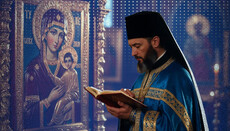
Only forty-eight hours earlier, on Wednesday evening, we had stood through the service of St. Mary of Egypt. We saw the clergy in dark vestments, the dimmed lights, and listened to the two hundred and fifty troparia of St. Andrew of Crete’s penitential canon – one after another, hour after hour. Now the clergy emerge from the altar in bright blue or white vestments. Usually, the full illumination of the church is switched on at the reading of each of the four stases of the Akathist, and then dimmed again between them while the canon is read. This pulsing of light is no decorative flourish: the Typikon builds a gradual ascent, just as joy itself rises and cannot be given all at once.
The city that had nowhere left to retreat
The first performance of this hymn was not liturgical, but military. The summer of 626. Constantinople was encircled: from the west came the forces of the Avar Khaganate with their Slavic allies, while from the east, across the Bosporus, stood the Persian army. Patriarch Sergius walked along the city walls carrying the icon of the Mother of God Hodegetria and Her robe from the Blachernae church. During the night, a storm arose in the Golden Horn and destroyed the Avar ships. The Persians, left without a crossing, withdrew.
That same night, the people of the city gathered in the Blachernae church and sang a hymn of thanksgiving standing – and from this comes the name akathist, meaning “not seated,” or standing chant.
The kontakion “To Thee, the Champion Leader” was most likely composed precisely at that time, by Patriarch Sergius, as a military song of thanksgiving. Yet scholars still debate whether it was the hymn’s original opening or whether it was added to an already existing text. The main body of the Akathist – twenty-four stanzas arranged in strict order according to the Greek alphabet, from alpha to omega – may have existed even before the siege. The manuscript gives no author’s name. Among those proposed as its hymnographer are St. Romanos the Melodist and George of Pisidia. But the true author of the Akathist remains unknown.
What we do know is this: after 626, the hymn was sung two more times – in 677, when the Arab fleet retreated from the city walls, and again in 717, when the Arabs returned under Emperor Leo III and once more departed empty-handed. The capital of Byzantium survived three sieges. And three times the same hymn was heard, on the same night, in the same church. After the successful repulse of the third siege, the Feast of the Praise of the Most Holy Theotokos became firmly established in the Church’s tradition.
Why the Akathist is read in four sections
In the Typikon, this hymn is called simply “the Akathist” – without any further title and without even mentioning the Mother of God. Because at that time, there was only one. All the other akathists written since – and today there are hundreds – are merely a genre born in imitation of this one.
This is the Church’s first and unique hymn to the Most Pure One.
The text of the Akathist is architectural in its design. It consists of twenty-four stanzas – twelve kontakia and twelve ikoi. They alternate with strict precision: a short kontakion, followed by an extended ikos ending with the twelvefold cry of “Rejoice.” Each of the twenty-four stanzas begins with the next letter of the Greek alphabet, from alpha to omega. Today we tend to think of acrostics as an ancient ornament, but in Byzantium this structure made the hymn almost impossible to corrupt. Remove a stanza, alter one, and the acrostic would break – and everyone would see it at once.
The Typikon divides the reading into four parts, called stases. Between them are read the odes of a canon composed in the ninth century by St. Joseph the Studite specifically for this service. Its structure, too, was not designed for convenience: the ascent had to be gradual. Six stanzas of the Akathist – then a pause and the canon, then the choir again, then silence once more. Each stasis begins and ends with the kontakion “To Thee, the Champion Leader” – that very hymn written on the night after the storm. The chant returns to its beginning four times, like a wave that crashes ashore with greater force each time.
The words of the ikoi are read by the priest or the reader. But the twelvefold “Rejoice” and the refrain “Rejoice, O Bride Unwedded” are, by tradition, sung by the whole church.
This is the only point in the Lenten services where the faithful sing together aloud, with full voice. After two months of prostrations and the reading of the Hours, it resounds like the striking of a bell in the heart of silence.
Sadly, such active participation by the faithful in the service is now encountered all too rarely, though in earlier times it was entirely ordinary in the Church.
In the second half of Holy Forty Days, we finally begin to understand that the Fast is not only darkness and the penitential troparia of the Great Canon. In the midst of it there suddenly rings out, in triumph, the military hymn of a city that stood firm three times, defending itself against foreign invaders through the prayers of our Most Holy Lady, the Theotokos.