
Water is the world’s memory of paradise: Why we are always thirsty
We have grown used to thinking of water as a mere resource, but in Christianity it is a “cosmic hearing” and a witness to the creation of the world. Why a glass of water on the table is a symbol of hope – and how to learn to drink prayer.
In the modern world, accustomed to seeing water only as a resource, a commodity, or an object for chemical analysis, the Orthodox tradition preserves another way of looking at this element. Water is not merely a liquid. It is the “memory of the world” of Paradise – a mirror in which the breath of the Holy Spirit is reflected, and the place where the Creator meets His creation.
In the opening lines of Genesis we encounter an image that sets the tone for all biblical metaphysics: “And the earth was shapeless and void… and the Spirit of God moved upon the face of the waters.” Water is the biblical name for primordial matter, receiving within itself divine warmth. It possesses a kind of “cosmic hearing.” The waters of first matter are clay in God’s hands, still holding an echo of original animation. The world was not created “unclean.” Matter is holy at its source. And water is the chief witness of that holiness.
Intelligent matter
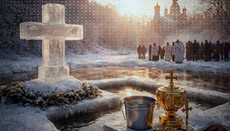
At the Feast of Theophany we are confronted with an event of cosmic scale. Christ enters the currents of the Jordan in order to crush, as the prayer says, “the heads of the serpents nesting there.” This is not merely a beautiful poetic image, but a profound metaphor for the cleansing of the very foundations of the world.
Entering the water, the Savior fills it with His divinity, restoring to water the capacity to be a conduit of life. From that moment water acquires the status of “intelligent matter.” It becomes Aghiasma – a holy thing.
Each time a priest immerses the Cross in water, a cosmic liturgy takes place. It proclaims that God has come not only to save man, but also to sanctify – with His uncreated energy – the entire world. This is Christianity’s great hope for a “new heaven and a new earth,” where all nature will be suffused with light.
In Orthodoxy water is a “condenser” of divine energies. The world is not empty; it is logocentric, threaded through with meaning. A glass of holy water on the table is a symbol of our trust that Darkness will not swallow Light, and that Life is stronger than decay. The mysticism of Baptism teaches us that one becomes truly alive only by “drowning” in God.
A God-shaped hollow
Human life is an unending thirst. When you reach for a mug to drink – pause for a moment and listen. This is not only a biological cry of cells; it is that same longing for the “Living Water,” for those streams of light out of which we were once woven.
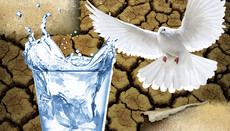
We live in an age of great drought. Our life has become an attempt to cultivate a garden on scorching sand, where instead of living springs there are mirages. We try to flood our inner desert with the wine of entertainment, with the garish flashes of news, with the endless noise of busyness and other people’s opinions. We drink the world’s salt water by the ton, hoping it will bring us peace. Yet the more we drink the “water of this world,” the fiercer the thirst becomes.
Man is a being designed for infinity. Within each of us is a cavity shaped like God. And nothing less than God can fill it.
We are like cracked vessels in the desert: however much earthly gladness is poured into us, it leaks into the sand, leaving only bitterness and dryness. We are wanderers who remember the taste of Eden’s springs.
Our thirst for eternity once again proves that our true homeland is there – where the river of Life flows, clear as crystal. Only He who is Himself the Living Water can quench our thirst. But to drink from this source, we must drill a well into the deepest places of our inner man. And here metaphysics becomes concrete practice – contemplation and the labor of prayer.
How to drink words
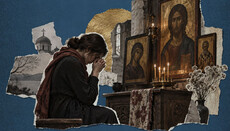
When you rise to pray, do not rush into words. Stand in silence for a couple of minutes. Picture your soul as parched, cracked ground waiting for rain. Consciously bring to God your “spiritual thirst.”
Read the words of prayer slowly, “absorbing” them like a sponge. Drink the words of prayer in small sips, without haste. Do not strive to read a lot. Taste every word you say – until it catches on you and begins to soak you through.
In the hesychast tradition the Jesus Prayer is compared to a spring that never ceases to flow.
It clears the “riverbed” of the mind from stones of thoughts and the sand of distraction. Join this prayer to your breathing. On the inhale: “Lord Jesus Christ,” on the exhale: “have mercy on me.” The inhale is the acquisition of the Spirit (receiving the Living Water); the exhale is cleansing from inner poison.
If you do this attentively through the day (on transport, in a queue, while walking), you will notice something “moist” crystallizing within – a coolness of peace that will not allow external irritants to scorch your soul.
God’s thoughts
St. Maximus the Confessor taught that God is present in the world through His logoi (intentions, inner meanings). Water in a river, rain, dew – these are materialized thoughts of God. When you find yourself near water (even if it is only rain outside the window), look at it not as weather or an element, but as a message. Think of how this water has obeyed God for countless years.
One Athonite elder advised: “When you wash your hands, think: Lord, as this water washes dirt from my hands, so let Your grace wash away the defilement of my soul.” In this way any ordinary action can be turned into an act of contemplation.
Treat Holy Scripture not as a textbook, but as a “river of the Holy Spirit.” Read it thoughtfully, slowly, rereading – when necessary – the same phrase or passage again and again.
First, to understand it; then, to hear in it the Voice of God speaking to you personally; and then, so that the same text becomes your answer to Him. Then you will feel that the Word of God ceases to be letters and becomes “living moisture” that extinguishes the fire of our anxiety.
A quiet haven
The highest point of this “drinking” is the Liturgy. At the Liturgy, try not merely to stand, but as it were to float within the current of worship. The prayers of the anaphora (the Eucharistic canon) are the invocation of the Spirit’s fiery water upon all who are present. Never forget that in the Liturgy we receive God within – and that His Life now courses as living water through your veins. Never let slip the opportunity to partake of Holy Communion each time you come to the Liturgy.
The living water of grace is the very breath of Eternity – transfiguring the parched desert of the human heart into a blooming garden, where the dust of time is washed away and the true fullness of being is found.
Becoming a transparent channel for this inexhaustible spring, we bind the fragile threads of our destiny to the Creator’s eternal design. In this sacred stream the soul discovers a peace beyond understanding, making its chief passage – from the shifting shores of bustle to the quiet haven of unending Joy and the Divine Light.